49 works in this view — arrow keys or swipe to move between them.
Dance in Art
Chipéric Waltz
Cramer Beale & Chappell
- Collection:
- Sheet music
- Source:
- Victoria and Albert Museum
- Rights:
- Rights vary by item — check the source record before reusing this image. Source record ↗
- Recorded as:
- V&A — check rights per item
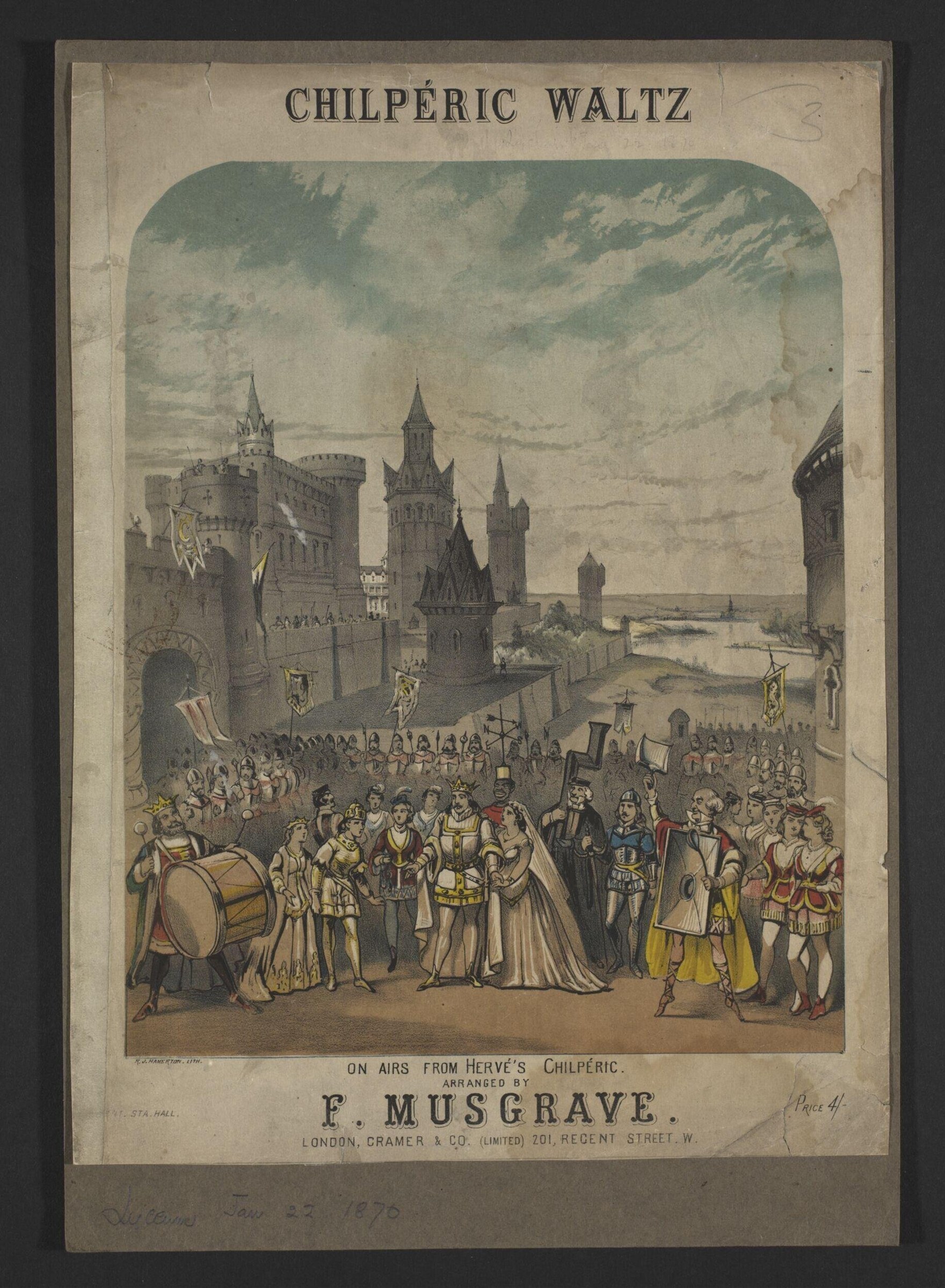
For dance historians, this reveals how the waltz—ostensibly a social ballroom dance—was absorbed into theatrical narrative and dramatic imagery, suggesting the deep cultural permeability between ballroom and stage in the Victorian era. The disconnect between title and image is instructive: it shows that 'Chipéric Waltz' may have been a finale or interpolation in a larger theatrical work, and that sheet music covers marketed these pieces through dramatic scene-setting rather than dance depiction.
What you are looking at
A medieval or fantasy castle courtyard serves as the setting for an elaborate theatrical scene. The background depicts fortified walls with multiple towers and spires under a cloudy sky, with a river or moat visible in the distance. The foreground is crowded with figures in period costume—nobility in rich robes, soldiers in armor and military dress, clergy, and courtiers—arranged in a ceremonial formation. At center, a woman in a flowing white gown stands prominently, attended by figures in gold and crimson. A large drum sits to the left. Banners and flags hang from the castle walls. The composition suggests a moment of state ceremony, coronation, or military gathering rather than social dance, though the formal arrangement and movement of bodies creates a processional, choreographed quality.
The dancing
The figures are arranged in hierarchical groupings rather than dance couples. The central woman in white is stationary and frontal, flanked by attendants. Surrounding figures display varied poses—some standing at attention, others in conversation or gesture. No closed dance holds, frame, or partnered movement is evident. The grouping is processional and ceremonial rather than choreographic; bodies are upright and formal, suggesting pageantry or court ritual rather than the fluid, weight-transferred movement of social dance. The overall impression is of a staged tableau vivant or theatrical spectacle rather than an actual dance event.
The dance depicted
This appears to be title page or promotional material for a theatrical work titled 'Chipéric Waltz,' yet the depicted scene shows no waltz movement whatsoever. The image represents a scene from the opera or theatrical production rather than a depiction of the dance that gives the work its name. The actual waltz would have occurred elsewhere in the score; this image captures a dramatic court scene, likely intended to illustrate the opera's narrative or setting. The waltz itself was a Viennese social ballroom dance by the 1870s, but this theatrical adaptation set it within a historical or pseudo-historical dramatic frame.
How it was made
This is a hand-colored engraving or chromolithograph, visible from the precision line-work, the subtle tonal gradations, and the application of color (particularly in the costumes and sky). The technique is typical of sheet music cover design in the Victorian era—a medium that reached wide audiences through musical publication. The level of detail and production quality suggests this was a substantial theatrical work with significant commercial reach. The combination of fine engraving and hand coloring allowed for both artistic sophistication and reproducibility.
About this work
This is the cover page of a musical score for 'Chipéric Waltz,' arranged by F. Musgrave and published by Cramer, Beale & Chappell in London. Despite its title, the image does not depict the dance itself but rather a dramatic scene from the theatrical work that the waltz accompanied or concluded. It represents the intersection of popular music publishing, theater, and ballroom dance culture in Victorian England. The waltz was among the most fashionable social dances of the 19th century, and theatrical adaptations that wove the dance into narrative contexts were common. This object tells us both about how waltzes circulated (through published scores with theatrical framing) and about the relationship between stage spectacle and ballroom fashion.
How to look at it
Attend to the formal, hierarchical arrangement of the crowd: this is not a snapshot of movement but a carefully composed tableau. The central white-gowned figure is the focal point, surrounded by layers of attendants and spectators. Notice the mixture of military, clerical, and noble dress, which suggests the scene is a moment of state significance. The artist has chosen a moment of stillness and ceremony rather than action—appropriate for a cover page that had to convey the dramatic context of the music rather than the kinetic pleasure of the dance itself. The formal composition and symmetrical arrangement reflect theater design principles of the era.
The artist
F. Musgrave is credited as the arranger, and the score was published by the London firm Cramer, Beale & Chappell (later Cramer & Co.), a major music publisher of the era. No further biographical information is provided in the record. The publisher's involvement suggests this was a commercially significant release.
The period
The 1870s were the height of the waltz's dominance in European ballroom culture. Theatrical waltzes—pieces with dramatic titles and programmatic settings—were immensely popular, often extracted from operas or composed as standalone concert pieces that mimicked operatic splendor. The Viennese waltz had moved from disreputable popular dance to the centerpiece of aristocratic and middle-class social life. At the same time, operatic and theatrical production was reaching unprecedented levels of visual spectacle, and the marriage of waltz music to elaborate stagecraft was a natural commercial and artistic development. The medievalist or pseudo-historical setting here reflects 19th-century romanticism and historicism in theater.
Where it lives
This is sheet music, held as part of a music or theater collection. The publication information appears at the foot: 'London, Cramer & Co. Limited, 201, Regent Street, W.', with a price marked as 4d (fourpence). It represents the commercial apparatus of Victorian popular music publishing.
Questions about this work
Is this depicting people actually dancing?
No. Despite the title 'Chipéric Waltz,' the image shows a ceremonial court or theatrical scene rather than ballroom dancing. This is a cover illustration for the published score, meant to convey the dramatic narrative or setting of the work. The waltz would have been performed to this music, but not depicted in this particular image.
What is a 'theatrical waltz' and why does this exist?
In the 19th century, waltzes were not only social dances but also concert pieces and operatic interpolations. Composers wrote 'waltzes' with elaborate titles and dramatic frames—sometimes for ballroom performance, sometimes for theatrical presentation. Publishing houses issued these as sheet music for domestic and concert use. This score represents that hybrid market: music that could be performed in a ballroom, on stage, or at the piano by amateurs.
Who was Chipéric and what is this scene?
The record does not identify the source of the narrative. 'Chipéric' may refer to a historical or legendary figure (possibly King Charibert I of the Franks), or may be a fictional character invented for the theatrical work. The medieval castle setting and formal court arrangement suggest a scene of state importance, coronation, or dynastic moment, but the image alone does not confirm the plot.
More dance artwork





