49 works in this view — arrow keys or swipe to move between them.
Dance in Art
Waltzing Matilda
Cowan, Marie
- Collection:
- Sheet Music
- Source:
- Victoria and Albert Museum
- Rights:
- Rights vary by item — check the source record before reusing this image. Source record ↗
- Recorded as:
- V&A — check rights per item
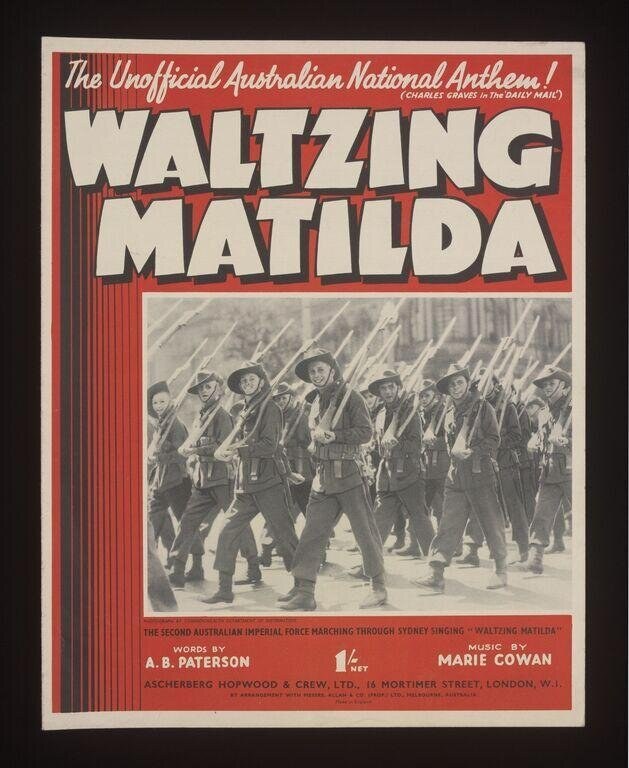
This image connects folk tradition to military mobilization, showing how 'Waltzing Matilda' was repurposed as patriotic marching music during wartime. For dance historians, it documents how marching—a disciplined, synchronized form of bodily coordination—was aestheticized and celebrated through commercial design, revealing the links between military movement, collective identity, and cultural nationalism. The work illustrates how a folk song could be transformed into spectacle through the addition of uniformed bodies in formation.
What you are looking at
This is the cover of sheet music for 'Waltzing Matilda', identified as 'The Unofficial Australian National Anthem'. The central image shows a marching column of soldiers in military dress—slouch hats, tunics, and puttees—advancing through a street or parade ground. They carry rifles with fixed bayonets held at a consistent angle across their bodies. The soldiers are arranged in tight formation, shoulder to shoulder, moving in unified direction. The photograph is black and white, formal in composition, and conveys military precision and collective movement. The red and cream printed frame around the image, with bold white typography, marks this as commercial sheet music from the interwar period. At the base, credits identify this as 'The Second Australian Imperial Force Marching Through Sydney Singing "Waltzing Matilda"', with words by A.B. Paterson and music by Marie Cowan, published by Ascherberg Hopwood & Crew Ltd. in London.
The dancing
The soldiers move as a unified body, not as individual dancers. They maintain a strict military march formation—upright posture, synchronized leg movement, arms holding rifles at a uniform angle across the torso. The bodies are dressed identically in military uniform, which emphasizes uniformity over individual expression. The formation itself is the aesthetic: dozens of figures moving as one organism, their collective discipline visible in the alignment of hats, the parallel lines of rifles, and the synchronized stride. This is marching, not dance in the ballroom sense, yet it operates by the same principle of coordinated group movement.
The dance depicted
This is not ballroom or theatrical dance but military marching—specifically, the regimented movement of soldiers. However, the image documents soldiers 'singing Waltzing Matilda' as they march, which makes this a document of how the iconic Australian folk song was performed and experienced. 'Waltzing Matilda' is a folk song of Australian origin (words by A.B. Paterson, 1895), and this image captures a moment when the song and military marching were fused, likely during the Second World War era when this sheet music was published. The 'dance' here is the march itself—a structured, collective, rhythmic movement performed to music. The image shows Australian soldiers in Sydney, suggesting this was a public, patriotic performance or parade.
How it was made
This is sheet music cover art, a commercial printing format. The image is a black-and-white photograph pasted or lithographed onto the cover, framed by a bold red and cream Art Deco–style design with sans-serif typography in the modernist mode. The photograph itself appears to be a professional press or military photograph, suggesting this cover drew on existing documentary or propaganda imagery. The commercial printing method—inexpensive, mass-reproducible—means this object was designed for wide circulation in households and music shops during the interwar and early wartime period. The choice to use a military photograph rather than illustration emphasizes authenticity and patriotic appeal.
About this work
This sheet music cover documents a moment when Australian military identity, folk tradition, and collective movement intersected during the Second World War era. The photograph shows soldiers marching in unison while singing 'Waltzing Matilda', Australia's most iconic folk song. Although the soldiers are not dancing in the theatrical sense, their synchronized movement is choreographed—a form of military dance that transforms individual bodies into a single collective organism. The cover itself is an artifact of how dance, music, and nationalism were packaged and circulated in the 1940s, making visible the political dimensions of seemingly simple folk traditions.
How to look at it
The viewer should attend to the photograph's composition: the soldiers are presented not as individuals but as a unified mass, their sameness enforced by identical dress and formation. Notice the rigid angles of the rifles and the precision of the marching line—this is choreography, though not dance in the traditional sense. The red frame and bold typography signal commercial design and mass distribution, framing the photograph as a public image meant to evoke national pride and military strength. The moment chosen is one of forward motion and collective action, freezing the march in a way that emphasizes momentum and unity.
The artist
Marie Cowan composed the music for this sheet music edition. The cover credits A.B. Paterson (the original lyricist of 'Waltzing Matilda') and identifies this as published by Ascherberg Hopwood & Crew Ltd., a London-based music publisher with international distribution. The image suggests professional design and printing resources, indicating this was a commercially significant publication, though further biographical details about Cowan and the designer are not established by the record.
The period
In the 1940s, during the Second World War, Australian national identity was being actively constructed and performed. 'Waltzing Matilda', originally a folk song about a travelling worker (a 'swagman'), was being reframed as national anthem and patriotic symbol. Military marching became a visible form of collective cultural performance—used in parades, newsreels, and propaganda. Sheet music covers were a primary medium through which music reached domestic audiences, and commercial designers used photography and bold typography to make music tangible and emotionally resonant. The Art Deco styling of the frame reflects interwar and wartime modernist design conventions.
Where it lives
This is a printed sheet music cover held as part of a sheet music collection. The source is identified as 'va', suggesting a Virginia-based holding institution or collection. Sheet music covers are primary sources for understanding how music was marketed, designed, and circulated in the early-to-mid twentieth century.
Questions about this work
Is this a dance?
Military marching is a form of choreographed group movement, though not ballroom or theatrical dance. The soldiers move in synchronized formation to music, creating a collective spectacle. In this sense, marching can be understood as a dance-like practice—a structured, rhythmic coordination of bodies in space. However, it operates under different aesthetic and functional principles than theatrical or social dance.
What is 'Waltzing Matilda'?
'Waltzing Matilda' is an iconic Australian folk song written by A.B. Paterson in 1895, with various musical settings. The lyrics describe a travelling worker (swagman) and have come to be associated with Australian national identity. By the 1940s, it was being used as patriotic marching music, as shown in this image.
Who are these soldiers?
The caption identifies them as 'The Second Australian Imperial Force Marching Through Sydney'. This refers to the Second Australian Imperial Force, the military organization raised by Australia during the Second World War. The photograph documents a public march or parade through Sydney, likely as a patriotic or recruitment event.
Why would soldiers march while singing?
Military marching with singing served multiple functions: it synchronized movement, boosted morale, expressed collective identity, and created a visible, audible form of national strength. During wartime, such public displays were used for recruitment, morale, and propaganda purposes.
More dance artwork





