49 works in this view — arrow keys or swipe to move between them.
Dance in Art
The Bird Waltz
Coote, Charles Junior
- Collection:
- Sheet Music
- Source:
- Victoria and Albert Museum
- Rights:
- Rights vary by item — check the source record before reusing this image. Source record ↗
- Recorded as:
- V&A — check rights per item
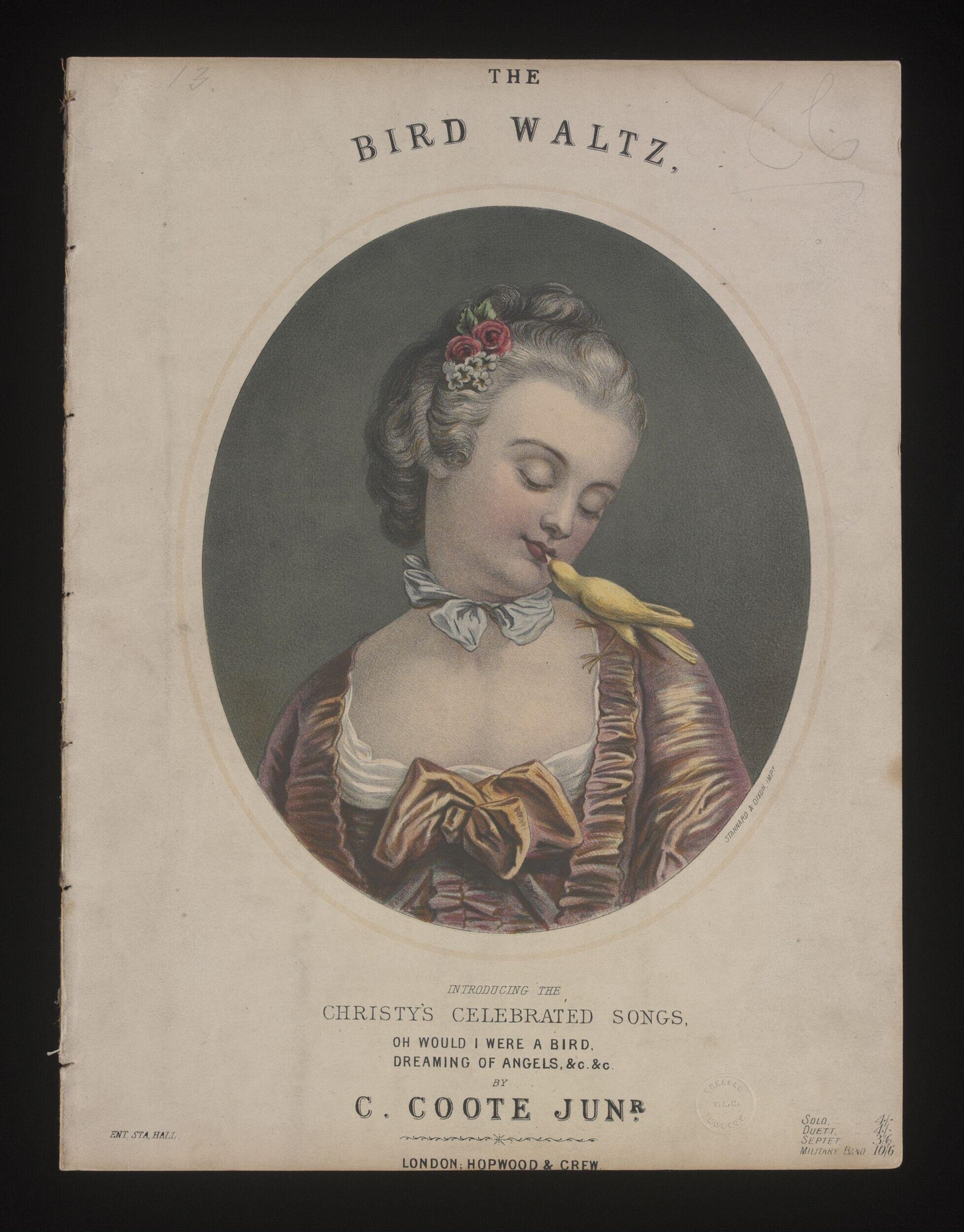
The image reveals the economics and aesthetics of sheet music publication in the late Georgian era, when dance music was a commercial and domestic commodity. It shows how waltzes were sold to the public not through representations of the dance itself, but through fashionable imagery that promised elegance, sentiment, and social refinement—revealing what values were attached to the waltz as a social practice.
What you are looking at
A young woman in rococo dress is shown in a three-quarter length portrait against a dark oval background. She wears an elegant gown of deep rose or purple silk with elaborate ruched details at the bodice and sleeves, and a white linen fichu at the neck tied with a bow. Her hair is styled up and dressed with roses and white flowers. Her head is turned slightly downward in a graceful, contemplative pose, and she holds a small yellow bird (likely a canary) near her mouth—either offering it food or in the act of kissing or cooing at it. The image is a hand-colored engraving or mezzotint, finely detailed and soft in tone. The composition is intimate and charming, centering entirely on the woman's interaction with the bird.
The dancing
A single female figure occupies the frame. Her posture is relaxed and elegant, the torso facing forward while the head inclines gently toward the bird in her hand. There is no balletic line or lifted extension; instead, the body language suggests tender affection and play. The arrangement of the arm holding the bird, the soft turn of the head, and the delicate positioning of the fingers convey grace of manner rather than technical dance training.
The dance depicted
This is not a depiction of dance or a dancer in motion. The image is a fashionable portrait of a young woman from the mid-to-late 18th century, styled to appeal to rococo sensibilities of elegance, sentiment, and refined feminine charm. The title *The Bird Waltz* appears to be marketing or poetic framing for a sheet music cover, not a description of the image's content. The waltz itself—the actual dance—is not represented here.
How it was made
This is a hand-colored engraving or mezzotint, a reproductive printmaking process common in the 18th century for distributing fashionable imagery and sheet music covers. The soft tonal modeling, particularly in the face and the treatment of fabric, suggests mezzotint technique. Hand coloring—visible in the rose tones of the gown, the blush on the cheeks, and the delicate flower ornaments—was applied after printing. This medium was economical and allowed wide distribution to middle-class households through music publishers.
About this work
This is the cover image for a published waltz composition by C. Coote Junr., likely dating to the late 18th century based on dress and printing technique. The engraving presents not a dancer or a dance scene but a fashionable portrait of a young woman in the rococo taste—designed to appeal to the genteel audience who would purchase and perform the music. The *Bird Waltz* itself, presumably a salon dance piece, is not visualized in the image; instead, the cover trades on the sentimental, refined femininity associated with both the rococo style and the social contexts in which waltzes were performed. The work belongs in a gallery of dance art not because it depicts dancing, but because it illustrates how dance—particularly the waltz—was marketed and situated within the cultural and visual world of its time.
How to look at it
Look at what the engraver chose *not* to show. There is no dancing, no couple, no movement—only a woman at leisure, engaged in a moment of tender play. The composition asks the viewer to associate the waltz with refined femininity, sentiment, and genteel domestic life rather than with the physical act of dancing. The soft, flattering style of the engraving and the care lavished on the rendering of silk and lace emphasize luxury and taste. This is how dance music was sold: not through vision of the dance itself, but through the promise of social elevation and emotional refinement.
The artist
C. Coote Junr. was a composer working in London in the late 18th century, publishing both original compositions and arrangements of popular dances for amateur performers. The waltz, still relatively new to English audiences, was marketed to the drawing-room market through printed music and fashionable cover imagery. Nothing else about Coote's practice or output is documented here, but his work reflects the commercial music publishing industry centered on Hopwood & Crew, the London printers credited on the title page.
The period
The waltz emerged from Central European folk and court dance in the late 18th century and spread rapidly into fashionable European society, including England. It was controversial among conservatives but embraced by the younger generation as a symbol of modernity and sensuality. In the 1790s and early 1800s, the waltz was being published and performed in English drawing rooms, and sheet music became a major vehicle for its dissemination. Rococo aesthetics were still influential in commercial art and fashion, though by this date neoclassicism was emerging. The waltz was itself a kind of aesthetic bridge: it retained rococo associations with sentiment and refinement while introducing new physical intimacy between dance partners that shocked conservative society.
Where it lives
The work is catalogued as sheet music in the Virginia collection (source: va). It is the cover page or title page of a published waltz composition, printed by Hopwood & Crew of London. The engraving is unsigned but credited implicitly to the printer's house style. The credit line and publication information appear at the foot of the page.
Questions about this work
Is this a picture of someone dancing?
No. This is a portrait of a young woman in fashionable dress, playing with a bird. It is the cover of a piece of sheet music, not a depiction of the waltz or any dance. The *Bird Waltz* is the name of the musical composition; the visual content is a rococo-style portrait chosen to appeal to the genteel audience who would buy and play the music.
Why does the cover not show the dance?
Sheet music covers in the 18th and 19th centuries often used fashionable portrait imagery rather than dance scenes. This marketing approach associated the music with elegance, refinement, and social aspiration. A graceful, sentimental image of a genteel woman was considered more appealing and commercially effective than a representation of actual dancing bodies.
What is the date of this print?
The catalogue record does not provide a date. Based on the style of dress (rococo with late 18th-century features), the printing technique (hand-colored engraving), and the fashion in which waltzes were being published in London, this likely dates to the 1790s–1810s, but without additional information this cannot be confirmed.
Who is the woman in the portrait?
The catalogue record does not identify her. In rococo and early 19th-century sheet music covers, portrait subjects were often generic fashionable young women rather than specific identities—they were types or ideals rather than historical individuals.
More dance artwork





