49 works in this view — arrow keys or swipe to move between them.
Dance in Art
Ellen Terry Waltz
Hopwood & Crew
- Collection:
- Sheet music
- Source:
- Victoria and Albert Museum
- Rights:
- Rights vary by item — check the source record before reusing this image. Source record ↗
- Recorded as:
- V&A — check rights per item
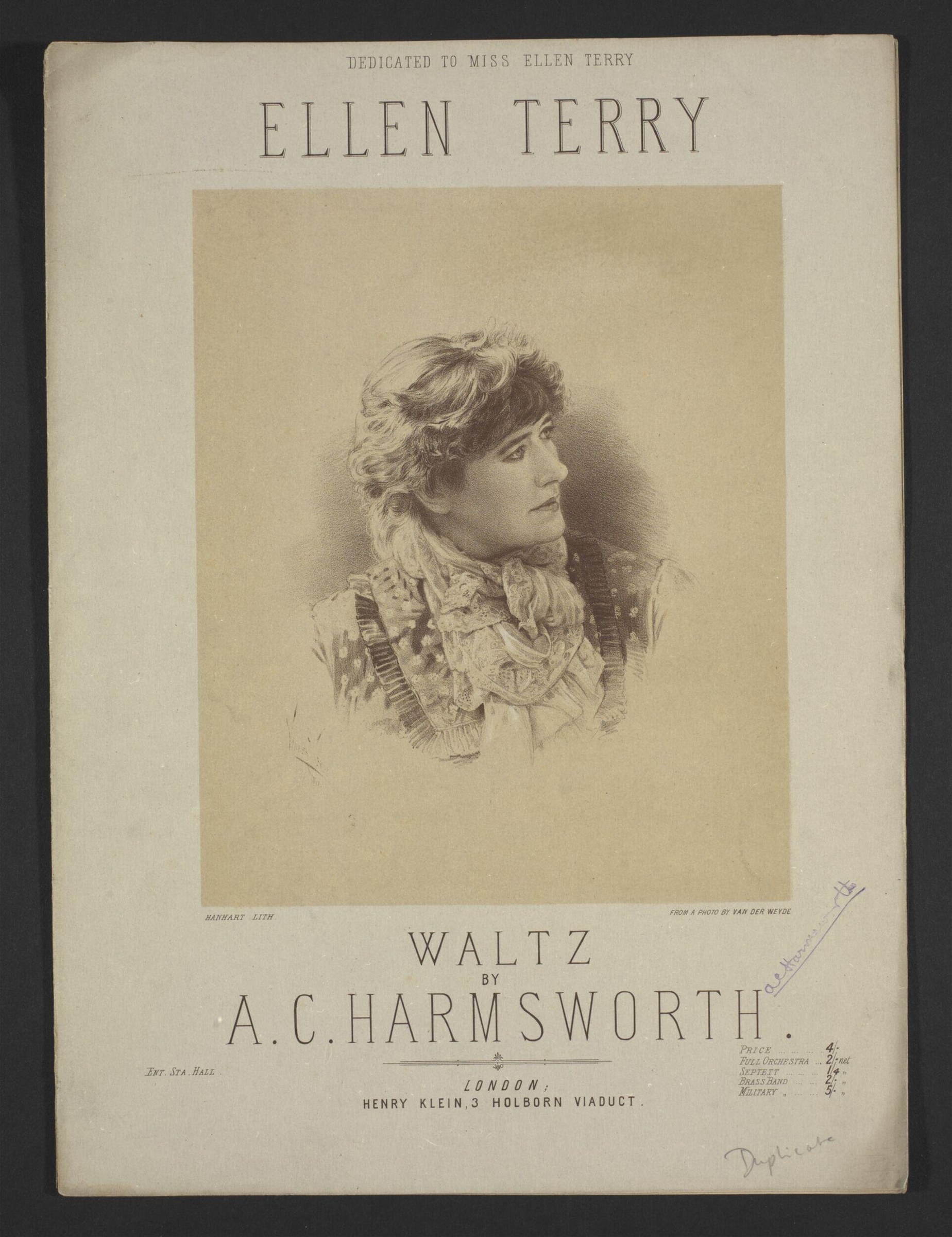
This lithograph is significant as evidence of the crossover between theatrical acting and ballroom dance in the Victorian era, when celebrated stage performers like Ellen Terry were marketed as dancers as well as actors, and when waltz composition was a form of theatrical and commercial commemoration. The sheet music format and public distribution reveal how theatrical celebrity was monetized and consumed in the late 19th century, with performers' likenesses sold to middle-class audiences who could not attend the theater.
What you are looking at
This is a portrait study of a woman shown in three-quarter profile, facing left, rendered in soft graphite or chalk on cream paper. She wears her hair in an elaborate upswept style with ringlets and curls characteristic of the 1890s, adorned with what appears to be a decorative comb or ornament. Her dress is rendered in delicate detail: a high-necked bodice with a generous lace or ruffled collar that extends across her shoulders, and what appears to be a striped or textured jacket or bodice garment beneath. The lighting is subtle, with gentle shading that creates volume in her face and emphasizes the texture of her elaborate coiffure and collar. The background is neutral, allowing the focus to remain entirely on the figure's face and upper body. The drawing captures an intimate moment of repose, almost a rehearsal or study pose rather than action—a moment of stillness that befits a theatrical performer being studied or commemorated.
The dancing
The single female figure is shown from the shoulders up, her head turned slightly to present a three-quarter view. Her posture is upright and dignified, with her shoulders squared back. Her neck is elongated and graceful, a quality often emphasized in artistic studies of performers. The arms are not visible, the composition cropping at approximately mid-torso. Her gaze is directed away from the viewer, contemplative or absorbed—a pose that suggests either preparation, reflection, or the formal conventions of theatrical portraiture.
The dance depicted
The title identifies this as a waltz, and the subject is Ellen Terry, the celebrated Victorian-era actress and dancer. However, the image itself does not depict dance movement. Rather, it is a preparatory or commemorative portrait study of a performer, likely created as sheet music cover art or theatrical documentation. The inscription credits it to a performance, but the portrait shows no active dancing—no turn, frame, or weight shift. The elaborate dress and studied pose are consistent with late Victorian theatrical costume and presentation, but the image documents the performer's appearance and presence rather than her movement vocabulary.
How it was made
This is a lithographic portrait, as indicated by the soft tonal rendering and the printing conventions visible in the margins. The image appears to be a sepia-toned or monochromatic lithographic stone printed on cream wove paper. Lithography allowed for fine gradations of tone and the delicate rendering of texture—particularly evident in the intricate detail of hair, lace, and fabric. This medium was standard for theatrical portraiture and sheet music covers in the 1890s, permitting wide distribution and affordable circulation among theater-goers and music purchasers. The credit to 'Margaret Lith' at bottom left confirms the lithographic process.
About this work
This is a commemorative portrait lithograph of Ellen Terry, likely the cover or frontispiece of sheet music for a waltz composition by A.C. Harmsworth. Terry (1847–1928) was one of the most celebrated actresses of the Victorian and Edwardian stage, renowned for both dramatic acting and dance performance. The work dates to the late Victorian period, when illustrated sheet music covers served as both commercial products and theatrical souvenirs, circulating the likenesses of famous performers into middle-class homes. The portrait emphasizes Terry's fashionable appearance and theatrical presence rather than capturing her in performance—a common practice in theatrical portraiture of the era, where the performer's beauty and elegance were as much the subject as any specific role or movement.
How to look at it
Observe the meticulous rendering of texture and detail—the artist has prioritized the tactile qualities of fabric, hair, and jewelry over the suggestion of movement or dancing. The pose is static and contemplative, a study in theatrical elegance rather than a frozen moment of choreography. The three-quarter view and the direction of the gaze follow the conventions of theatrical portraiture, presenting the performer as an object of admiration and study. Note how the lace collar and striped bodice dominate the composition—costume detail was as important to the market value of theatrical portraiture as facial likeness.
The artist
The work credits 'A.C. Harmsworth' as the composer of the waltz. Hopwood & Crew are credited as the engravers or lithographic printers. Margaret Lith ("Margaret Lithography") is credited at bottom left, indicating the lithographic workshop responsible for printing. These were commercial theatrical publishers and lithographers operating in London during the 1890s–early 1900s, producing affordable theatrical souvenirs and piano music for the domestic market.
The period
The 1890s were the peak era of the Victorian waltz in both ballroom and theatrical contexts. The waltz had been fashionable for nearly a century but remained a primary vehicle for theatrical dance and musical entertainment. Ellen Terry was performing during the height of the Victorian stage, when leading actors were expected to possess ballroom accomplishment and grace. The elaborate dress and hairstyle visible here are consistent with 1890s fashion and theatrical presentation. Sheet music covers featuring celebrity performers were a thriving commercial genre, combining the appeal of famous names, fashionable imagery, and affordable home entertainment. The waltz itself, as a form, was coded as both respectable ballroom entertainment and a staple of theatrical music.
Where it lives
This is sheet music cover art, published by Henry Klein of 3 Holborn Viaduct, London. The dedication at top identifies it as 'Dedicated to Miss Ellen Terry,' indicating it was created as a theatrical souvenir or commemorative object tied to a specific performance or benefit. The publishing details place it firmly within the Victorian commercial theatrical marketplace.
Questions about this work
Is Ellen Terry actually dancing in this image?
No. This is a portrait study created as sheet music cover art, not a depiction of choreography or movement. It shows Terry's face and costume, but not her dancing. The waltz title refers to the musical composition, not to a dance scene shown in the artwork.
Who was Ellen Terry?
Ellen Terry (1847–1928) was one of the most celebrated actresses of the Victorian and Edwardian stages, known for both dramatic acting and ballroom dance accomplishment. She performed extensively in London and was a major theatrical celebrity of her era.
What is sheet music cover art doing in a dance gallery?
Victorian sheet music covers featuring dancers and performers document how dance was marketed, consumed, and celebrated as entertainment. They reveal the crossover between theatrical and ballroom dance culture, and how performers' likenesses circulated in the domestic market.
What is a lithograph?
A lithograph is a print made from a stone treated with grease and water so that ink adheres to drawn areas and repels others. It allowed fine tonal gradation and was the standard method for reproducing theatrical portraits and sheet music covers in the late 19th century, enabling affordable mass production.
More dance artwork





