49 works in this view — arrow keys or swipe to move between them.
Dance in Art
La Périchole Waltz
Coote, Charles
- Collection:
- Sheet Music
- Source:
- Victoria and Albert Museum
- Rights:
- Rights vary by item — check the source record before reusing this image. Source record ↗
- Recorded as:
- V&A — check rights per item
This work documents the commercial apparatus by which operatic music became ballroom dance material in the 19th century. The waltz arrangement of *La Périchole* demonstrates how European theatrical culture reached domestic parlors through printed sheet music, shaping both musical taste and dance practice among the middle classes.
What you are looking at
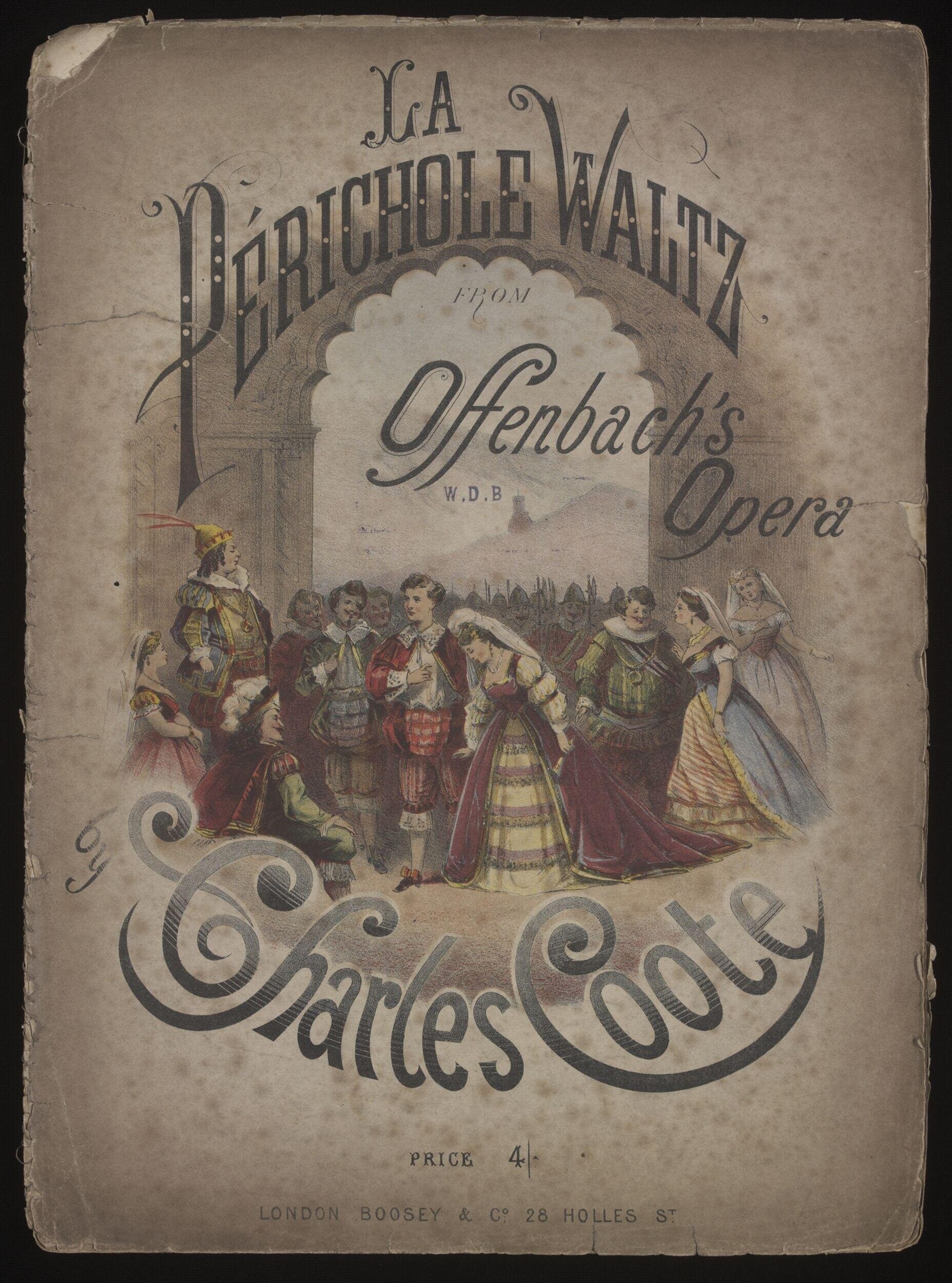
This is the cover of a vocal score for Offenbach's opera *La Périchole*, arranged as a waltz by Charles Coote. A grand architectural archway frames a theatrical scene beneath. Within it stands a assembled group of figures in elaborate 19th-century costume—men in military dress and velvet coats, women in full-skirted gowns with off-shoulder necklines and decorative bodices. The figures are arranged in a loose gathering rather than a choreographed line, suggesting a moment of social interaction or dramatic assembly. The setting evokes a Peruvian colonial town, with buildings visible in the background across a hazy landscape. The color printing is restrained—ochres, reds, and greens accent the predominantly sepia-toned figures. This is a commercial publication cover, not a depiction of actual dancers performing.
The dancing
The figures do not form a dance configuration. Some stand upright in formal poses; one man kneels or bows slightly toward the center. The women's posture is upright and statuesque, with arms at rest or loosely positioned. There is no visible hold between figures, no frame suggesting partner work, and no indication of active movement or footwork. The arrangement is processional and ceremonial rather than kinetic. This is a dramatic tableau vivant rather than a representation of choreographed dance.
The dance depicted
This cover represents *La Périchole*, Offenbach's 1868 opéra bouffe set in colonial Peru. The work became enormously popular across Europe and spawned numerous arrangements, including this waltz version. *La Périchole* is not a dance work but a comedic opera; however, ballroom waltzes extracted from operas were standard commercial publications in the 19th century, and the dance content here is incidental—the waltz is a fashionable salon piece derived from the opera's musical material, not a depiction of choreography from the work itself. The cover image shows the opera's dramatic personae in costume, advertising both the work's theatrical prestige and its musical adaptability.
How it was made
This is a colored lithograph, a commercial printing process that allowed mass production at low cost. The delicate hand-coloring applied to printed impressions is characteristic of mid-to-late 19th-century music covers for middle-class parlor distribution. The quality of the printing is competent but not luxurious—the architecture of the arch is rendered in clean lines, and the figures are carefully composed, but fine detail is sacrificed for broad commercial appeal. This production method indicates a work intended for sheet music retailers and domestic music-making rather than concert hall promotion.
About this work
This is the cover of a commercial vocal score—specifically a piano-vocal reduction arranged as a waltz—adapted from Offenbach's comic opera *La Périchole*. The image does not depict dance but rather theatrical costume and dramatic tableau. The waltz form itself is historically significant as a salon dance adapted from operatic material, a standard practice in 19th-century music publishing. The work sits at the intersection of opera, theatrical fashion, and domestic music-making, and belongs in a dance gallery only as evidence of how operatic music fed into ballroom culture and how dance forms were commercialized through printed arrangements.
How to look at it
Attend to the theatrical costumes and the formality of the arrangement—this is a fashionable opera brought into the domestic sphere through music printing, not a depiction of actual choreography. The archway frames the scene as a stage, emphasizing the theatrical origin of the music. Note that the figures are assembled but not dancing; they represent the opera's dramatic situation, not its musical adaptation for the ballroom.
The artist
Charles Coote is identified as the arranger (likely the orchestrator of the vocal score) but nothing is known of his broader practice. Music arrangers of this period were often anonymous or semi-anonymous commercial workers whose names appear only on popular works; little biographical information survives. Coote's name suggests an English connection, though the publication is London-based.
The period
Offenbach's *La Périchole* premiered in 1868 during the height of the opéra bouffe craze that had captivated Paris and Europe since the 1850s. The work was an immediate success and spawned countless arrangements for piano, for salon orchestras, and as waltzes—forms designed for amateur performance and domestic pleasure. The 1870s and 1880s saw intense commercialization of operatic music through sheet music publication, as improved lithographic printing made colored covers affordable. The waltz itself was the dominant partner dance of the era, and operatic melodies provided endless material for arrangement into fashionable dance forms.
Where it lives
This is a sheet music cover held as part of a music or performing arts collection. It was published by Boosey & Co., 28 Holles Street, London, at a price of 4 shillings—a standard retail price for vocal scores of this period. The work is an arrangement (vocal score with piano reduction) rather than a full orchestral score or orchestral parts.
Questions about this work
Is this depicting an actual dance from the opera?
No. *La Périchole* is a comic opera, not a ballet or dance work. The cover shows the opera's dramatic personae in costume as theatrical illustration. The waltz arrangement itself is a separate commercial product—a piano piece for amateur salon performance derived from the opera's musical material.
Who was Charles Coote?
Coote is identified only as the arranger of this vocal score. 19th-century arrangers were often working musicians employed by publishers, and biographical records rarely survive for those who arranged commercial arrangements rather than composing original works.
What is a 'vocal score'?
A vocal score is a reduction of an opera or other larger work for voice and piano, used for rehearsal, study, and amateur performance. It preserves the vocal line and dramatic structure but simplifies the orchestration to what can be played on a single instrument.
Why would an opera be arranged as a waltz?
Operatic melodies were immensely popular in the 19th century and were constantly adapted into fashionable dance forms for parlor use. A successful opera could generate dozens of arrangements—waltzes, quadrilles, polkas—all marketed as sheet music to middle-class households.
More dance artwork





