49 works in this view — arrow keys or swipe to move between them.
Dance in Art
The Surge Waltz
Andrew Longmuir
- Collection:
- Source:
- Victoria and Albert Museum
- Rights:
- Rights vary by item — check the source record before reusing this image. Source record ↗
- Recorded as:
- V&A — check rights per item
This object matters not as a dance image but as evidence of how waltz culture was marketed and consumed in the late 19th century. It shows the intersection of commercial print design, musical composition, and popular dance culture—revealing what kind of imagery was thought to appeal to people who danced waltzes socially. The naming convention ('The Surge Waltz') and the dramatic natural imagery suggest that waltzes were understood as having expressive or narrative content that extended beyond the mechanical steps of the dance form.
What you are looking at
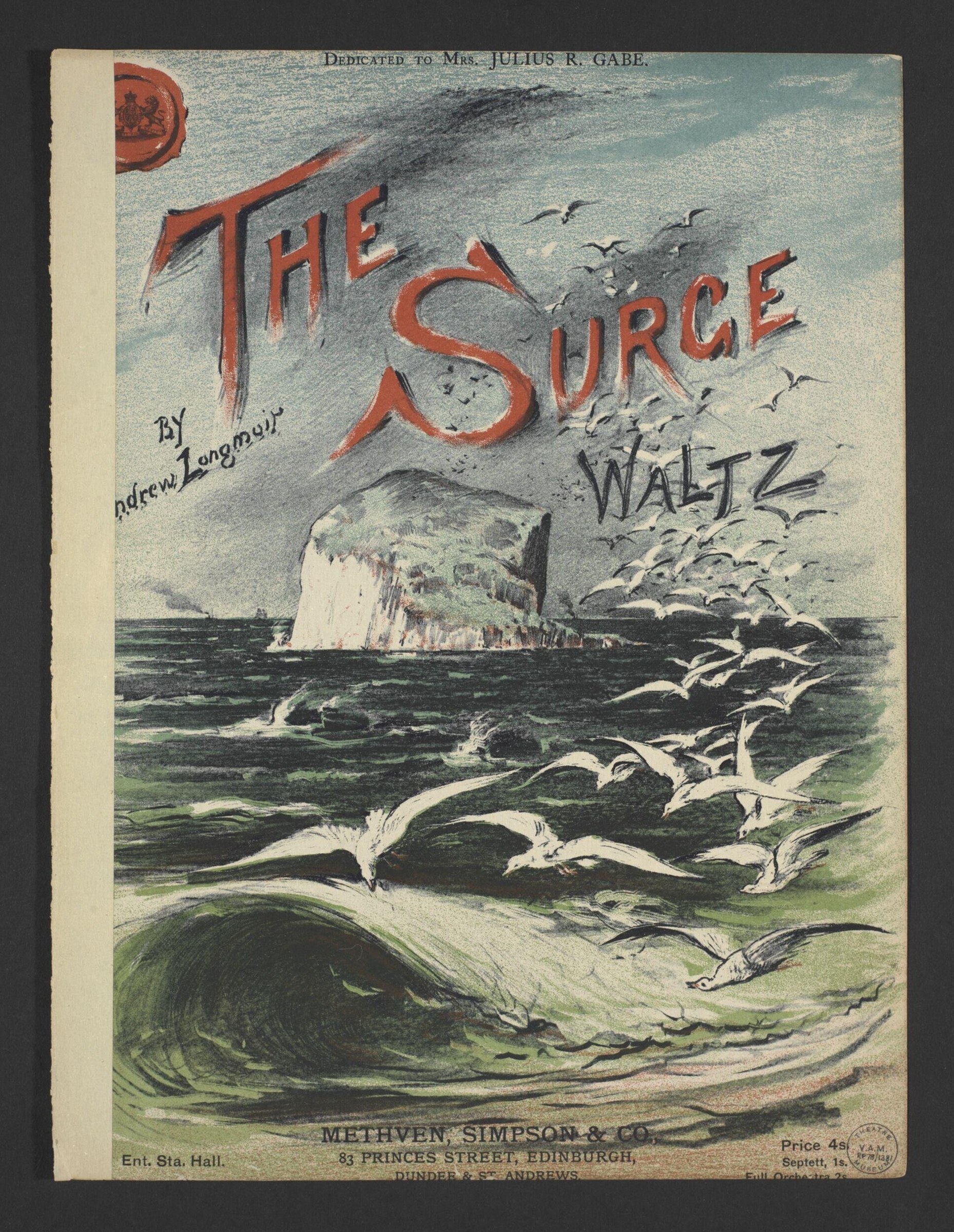
This is a cover or title page for a musical composition in the waltz genre, printed in color and dedicated to Mrs Julius R. Gabe. The composition title 'The Surge Waltz' is displayed prominently in large red letters across the upper portion. The scene depicts a dramatic coastal landscape dominated by a towering white cliff or rock formation rising from dark, turbulent water. In the foreground, a powerful wave with white foam surges toward the viewer. The sky is grey-blue and stormy, with birds in flight scattered across it. The publisher information—Methven, Simpson & Co., 83 Princes Street, Edinburgh, with additional printing credits—appears at the bottom. The overall aesthetic is that of late 19th-century sheet music cover design, combining romantic imagery of nature's power with commercial printing techniques. The inscription 'by Andrew Longmuir' credits the composer.
The dancing
No human figures are depicted. The work is a landscape composition rather than a dance scene. There are no dancers, no bodies in movement, no choreographic positioning.
The dance depicted
Despite the title 'Waltz,' this image contains no depiction of dancing or dancers. The work is a musical composition—a waltz—rather than a visual representation of the dance itself. The waltz was a partner ballroom dance in triple time that became increasingly popular throughout the 19th century, and waltzes were often named after poetic or dramatic themes (such as natural phenomena). This title suggests the musical accompaniment evoked the image of a powerful ocean surge, but the cover art visualizes only the natural phenomenon, not its choreographic interpretation.
How it was made
This is a color lithograph or chromolithograph, a printing technique that allowed multiple colors to be applied in separate passes, producing the soft blending of blues, greens, and warm tones visible here. The process was economical enough for commercial sheet music covers, which needed to be produced in quantity and reach a broad consumer market. The quality of color registration and the subtlety of tonal gradation suggest skilled lithographic printing, likely from Edinburgh. This was a standard format for marketing musical compositions in the late 19th century.
About this work
This is the cover of a published waltz composition by Andrew Longmuir, printed in Edinburgh circa late 19th century. It is not a depiction of dance itself, but rather the commercial packaging of a musical work. The waltz was one of the most commercially successful ballroom dances of the era, and publishers routinely commissioned artists to create romantic or dramatic cover images that would appeal to amateur musicians and dancers purchasing sheet music for home performance. The image of a dramatic seascape—powerful, wild, and evocative—was meant to convey the emotional or physical character of the music within, inviting the buyer to imagine how such a theme might be expressed through movement and sound.
How to look at it
Attend to the symbolic relationship between title and image: the word 'surge' is visualized literally as a wave, suggesting that musical composition and visual design worked together to market the piece. The storm and dramatic light were meant to evoke the character or 'mood' of the music—energy, power, perhaps a sense of danger or excitement. Consider that the buyer of this sheet music would have taken this image home and imagined, while learning the piece, how their own body moving through a waltz might embody the power or drama suggested by the seascape. The composition is romantic in sensibility but entirely commercial in function.
The artist
Andrew Longmuir was a Scottish composer working in Edinburgh in the late 19th century. The waltz was a popular form for amateur and professional composers in this period, and publishing sheet music was a viable commercial enterprise. Little else is known of Longmuir from this single source.
The period
The waltz dominated European and North American ballroom culture from the early 19th century through the Edwardian era. By the late 1800s, waltzes were central to social dancing at all class levels, from aristocratic balls to middle-class drawing rooms. Publishing houses produced enormous quantities of waltz sheet music, often with illustrated covers aimed at amateur pianists and dancers. The naming of waltzes after picturesque or emotional themes—'The Blue Danube,' 'Gold and Silver Waltz,' 'The Skaters' Waltz'—was a commercial and artistic convention that invited performers to interpret the music through a narrative or atmospheric lens. Scottish printing and publishing was a significant industry in Edinburgh during this period.
Where it lives
This is a printed sheet music cover held as a print in a collection. It was published by Methven, Simpson & Co. in Edinburgh and printed in Scotland, indicating both the production and the market were local or regional rather than international.
Questions about this work
Is this a picture of people dancing a waltz?
No. This is the cover of a piece of sheet music—a musical composition titled 'The Surge Waltz.' It shows a seascape, not dancers. The title tells us it is a waltz (a type of ballroom dance), but the image does not depict the dance itself. Instead, it visualizes the dramatic natural phenomenon ('surge') that the composer named the piece after, meant to evoke the emotional character of the music.
When and where was this made?
The catalogue record does not provide a date, but the style of chromolithographic printing and the design aesthetic suggest late 19th century (likely 1880s–1900s). It was published and printed in Edinburgh, Scotland, by Methven, Simpson & Co., a publishing firm based on Princes Street.
Who would have bought this?
Amateur musicians and dancers—likely middle-class households where piano playing and social dancing were part of domestic leisure. Sheet music was affordable and widely distributed. A household member (often a woman) would purchase it, learn the waltz melody or accompaniment on the piano, and the family or their guests would dance to it.
What was a waltz?
A waltz was a partner ballroom dance in triple time (3/4), performed in a closed hold with a characteristic rotating motion. It originated in Austria and Germany in the late 18th century and became the dominant social dance of the 19th century, performed at balls, social gatherings, and in homes. Unlike earlier courtly dances, the waltz allowed couples to dance in an intimate hold and move freely through the room.
More dance artwork





