49 works in this view — arrow keys or swipe to move between them.
Dance in Art
The Talisman Waltz
Godfrey, Charles
- Collection:
- Sheet Music
- Source:
- Victoria and Albert Museum
- Rights:
- Rights vary by item — check the source record before reusing this image. Source record ↗
- Recorded as:
- V&A — check rights per item
This work reveals the gap between the title of a piece and what it actually depicts—a reminder that 'waltz' in 19th-century parlor music was often more about the musical form than the dance. For historians of dance imagery and theatrical pantomime, the kneeling posture, the supernatural visitor, and the religious emblem offer a window into how Romantic ballet and theatrical spectacle inflected domestic music consumption. The artist's choice to illustrate narrative and emotion rather than choreographic movement shows how little the ballroom dance itself mattered to the audience for this sheet music.
What you are looking at
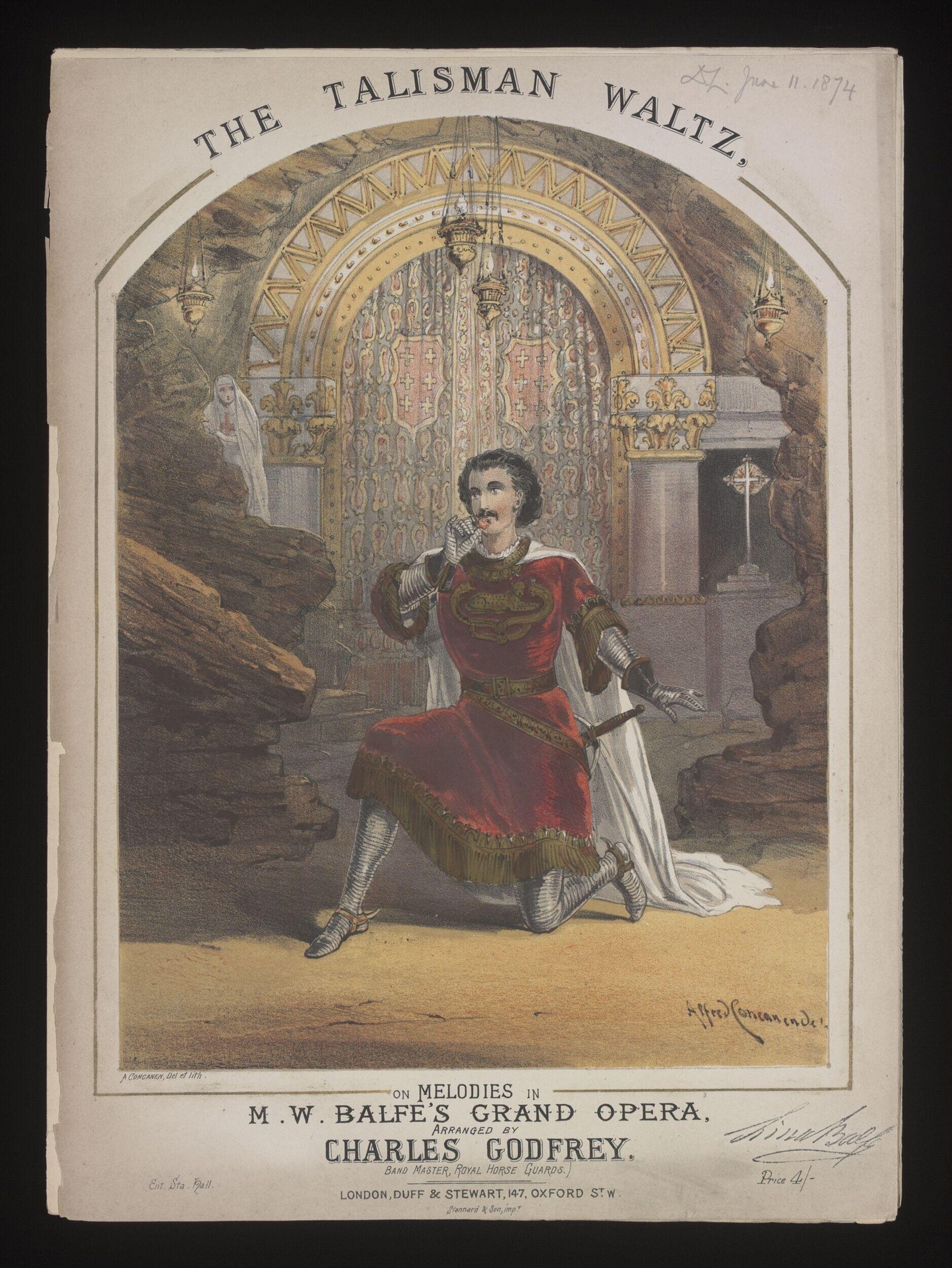
A kneeling male dancer in early 19th-century military dress occupies the center of an ornate Eastern or fantasy setting. He wears a crimson tunic with gold epaulettes and a broad gold-trimmed sash, his right hand raised to his chest in a gesture of reverence or supplication. His left knee is planted firmly on the ground in a deep lunge. The architectural setting is theatrical: a vaulted archway frames the figure, its interior decorated with elaborate gold and jeweled ornament suggesting a palace or temple. Hanging lamps dangle from the arch. To the left, a ghostly or spectral female figure in white appears to float or hover near the wall, while to the right a simple cross mounted on a pedestal introduces an explicitly Christian element into the otherwise Orientalist scene. The color is hand-tinted, with rich golds, reds, and flesh tones against darker stone walls. The composition suggests a moment of spiritual or emotional intensity—prayer, vision, or dramatic supplication—rather than social dance.
The dancing
The male dancer's posture is emphatic and asymmetrical: left knee bent and planted, right leg extended behind, torso upright and rotated, right arm raised to the chest with palm inward. This is not a ballroom hold or a paired formation but a solo, devotional attitude. The knee-down position is unusual for ballroom dance of any era and suggests either theatrical, religious, or narrative pantomime rather than social dancing. The spectral female figure in the background is static and ethereal, not a dance partner in the conventional sense.
The dance depicted
Despite the title, this image does not depict a waltz in the ballroom sense. The composition and gesture suggest theatrical pantomime or ballet—the kneeling supplication, the exotic setting, the apparition, and the religious imagery are consistent with Romantic-era ballet narrative. The military costume and the Orientalist setting recall ballets such as *Le Dieu et la Bayadère* (1830) or similar exotic-military tableaux. The image may illustrate a dramatic moment from a ballet libretto rather than depict ballroom waltz technique. The music was arranged from Balfe's opera, suggesting it was theatrical music adapted for piano or salon performance, not a genuine ballroom waltz.
How it was made
This is a hand-colored lithograph or engraving, identified by the fine linework, the tonal modeling in the architecture, and the selective application of color wash. The technique allowed for wide circulation as sheet-music cover art—this is the front wrapper of a published arrangement. Hand-coloring was typical for mid-19th-century popular music covers, making the image both affordable and visually appealing to middle-class piano pupils and their families. The theatrical illustration style suggests a professional theater-trained artist (the signature 'Alfred Concannon' appears in the lower right).
About this work
This is the illustrated cover page of a piano arrangement titled *The Talisman Waltz*, based on melodies from M.W. Balfe's opera *The Talisman*. Although marketed as a waltz, the image does not depict ballroom waltz dance but rather a moment of Romantic theatrical drama—a kneeling male figure in military dress before an ornate, Orientalist interior, visited by a ghostly female apparition. The work is part of the 19th-century practice of arranging opera and theatrical music for domestic piano performance, and the cover art serves both to identify the piece and to evoke the emotional and exotic register of the source material. The image is valuable not as a record of actual waltz practice but as evidence of how theatrical spectacle and pseudo-Oriental fantasy were marketed to Victorian parlor musicians.
How to look at it
Notice first that the figure is alone and kneeling, not dancing with a partner—a major departure from ballroom-dance imagery. The raised hand to the chest and the downward gaze suggest prayer, petition, or vision rather than social pleasure. The apparition in white and the cross are literal narrative elements, signaling that you are looking at a scene from a story, not a dance manual. The artist has frozen a moment of religious or emotional crisis, using the exotic setting and supernatural figure to heighten the drama. This is theater costumed as dance.
The artist
Alfred Concannon was a professional illustrator and lithographer active in mid-19th-century London, where he produced theatrical designs and cover art for published music. The signature and the professional quality of the hand-coloring indicate he was a trained commercial artist working for a music publisher. Little else is known of his practice from the catalogue record.
The period
The 1870s saw enormous growth in the domestic music market in Britain. Operatic arrangements for piano were best-sellers, and sheet-music covers were sites of artistic ambition and theatrical marketing. At the same time, the waltz was at the peak of its social dominance in ballrooms, yet composers and arrangers freely adapted operatic and exotic material under the waltz label for sale as parlor pieces. Romanticism in theater and literature—with its taste for the Oriental, the supernatural, and the redemptive—pervaded visual culture including music covers. The mixture of military dress, ghost, and Christian symbol reflects both Victorian fascination with exotic lands (often mediated through opera) and residual spiritual concern.
Where it lives
The object is sheet-music cover art, part of the commercial music publishing trade in mid-Victorian London. It was produced by Duff & Stewart, music publishers on Oxford Street. The handwritten date '22 June 1874' suggests either the date of publication or a library annotation. Such covers were mass-produced and widely distributed, making them accessible historical records of how the dance and music industries marketed themselves to domestic consumers.
Questions about this work
Is this a waltz? The title says waltz but the picture doesn't look like dancing.
The title refers to the musical form and the source (operatic melodies arranged in waltz meter), not the image. The picture illustrates a dramatic scene from the opera or ballet, not ballroom dance technique. By the 1870s, 'waltz' could mean almost any keyboard piece in triple time intended for parlor or concert use, regardless of whether the music or image had anything to do with the ballroom dance.
Who was M.W. Balfe?
Michael William Balfe (1808–1870) was an Irish composer, conductor, and singer celebrated for his operas, especially *The Bohemian Girl* (1843) and *The Talisman* (1874). His operas were widely performed and arranged throughout the 19th century. Balfe died in 1870, so this arrangement from *The Talisman* was likely published shortly after the opera's premiere or during a revival.
What is the ghostly figure on the left?
The white-clad apparition is consistent with Romantic ballet and opera tradition, where supernatural or angelic visitors appear to the protagonist. Without seeing the libretto of *The Talisman*, we cannot identify her with certainty, but she may represent a muse, a lost love, a spirit, or a divine messenger—all common figures in theatrical narratives of the period.
Why is there a cross in the picture?
The cross likely signals that this scene has religious or spiritual significance. *The Talisman* is based on a Walter Scott novel set during the Crusades, so Christian imagery would be appropriate to the story. The cross may also reflect Victorian viewers' comfort with mixing exoticism and Christian virtue in their theatrical entertainment.
More dance artwork





