49 works in this view — arrow keys or swipe to move between them.
Dance in Art
Sweet Alice Waltz
Adair, Allan
- Collection:
- Sheet Music
- Source:
- Victoria and Albert Museum
- Rights:
- Rights vary by item — check the source record before reusing this image. Source record ↗
- Recorded as:
- V&A — check rights per item
This work exemplifies how dance and music were inseparable in Edwardian popular culture, and how photography was deployed in sheet music marketing to create celebrity and consumer desire. For historians of social dance, it illustrates the gap between named dances and how they were actually performed—a waltz existed as a musical genre and a social practice, but the image that sold it to the public was of a single performer in formal dress, frozen in an elegant but unchoreographed pose.
What you are looking at
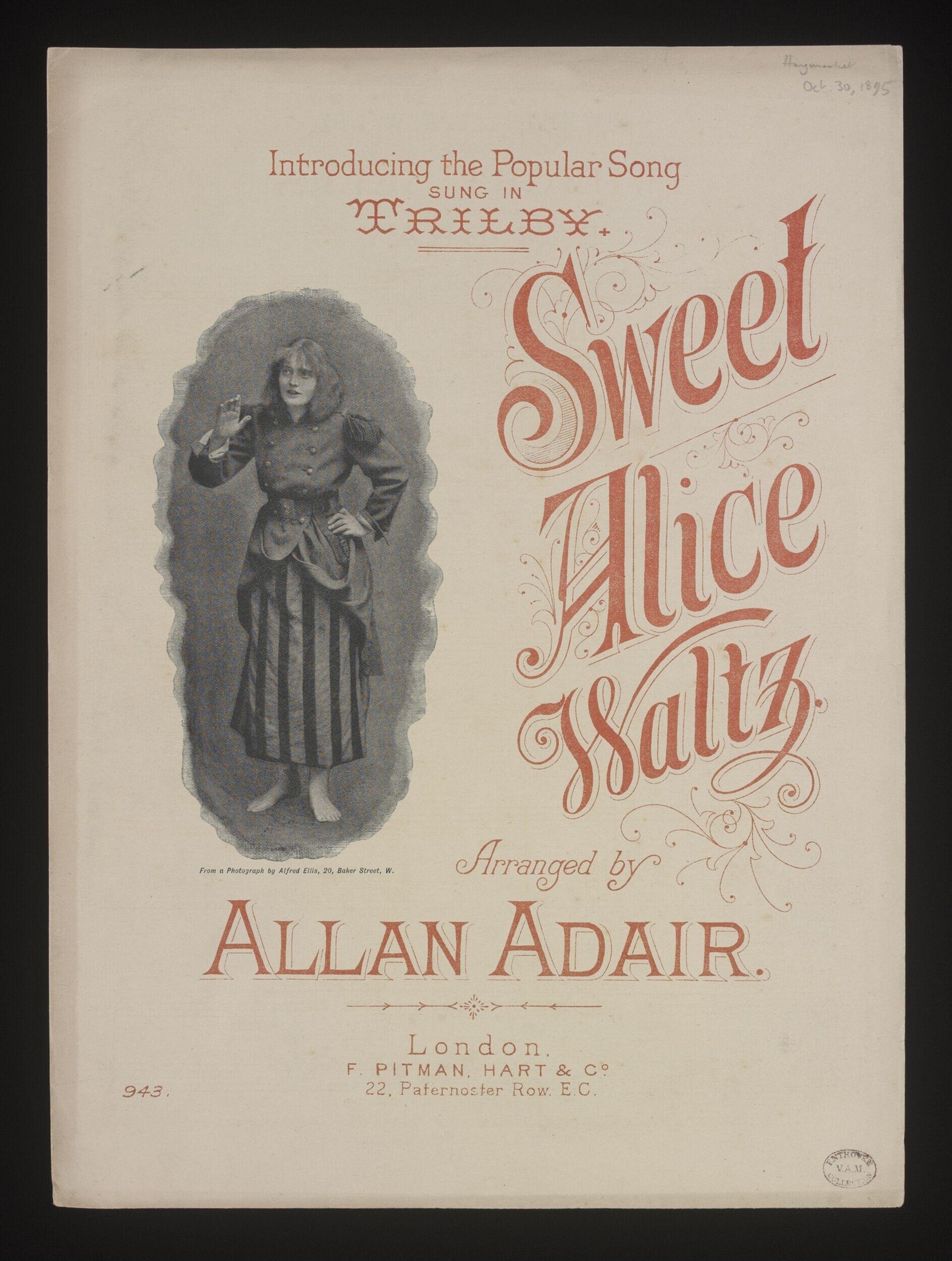
A single female dancer stands center, isolated against a pale background in a softly vignettéd oval frame. She wears a high-collared Edwardian dress with puffed sleeves and a fitted waist, her posture upright and formal. Her right arm is raised with palm outward in a gesture that reads as both presentational and restrained; her left arm hangs at her side. The lighting is even and frontal, cast by early photographic technique. The composition is a theatrical portrait rather than an action scene—this is a posed introduction of a performer, not a capture of movement. The work introduces sheet music rather than documenting choreography.
The dancing
A single standing figure in a formal dance position with weight evenly distributed and the body held erect. The raised right arm and open palm suggest presentation or greeting rather than the dynamic extension of actual waltz movement. There is no partner, no spatial development, and no evidence of the momentum or frame that ballroom dance requires. The pose is deliberate and static—a portrait convention rather than a moment of dancing.
The dance depicted
The title *Sweet Alice Waltz* identifies the musical genre as a ballroom waltz, but the image shows no waltz choreography. No couple is present, no closed or open frame, no turning movement. The figure is presented as the solo performer or subject of the composition—possibly Alice herself, or the performer who introduced the song. The photograph documents the performer rather than the dance; it is promotional imagery for sheet music, where the waltz exists as notation and melody rather than visible movement.
How it was made
This is a gelatin silver or platinum print, pasted directly onto the cover sheet—a photographic emulsion that renders fine detail and tonal gradation. The vignetting (soft oval border) is a darkroom technique that focuses attention and adds a decorative, gallery-worthy quality. The photograph was made by Alfred Ellis (as credited), a London photographer active in theatrical portraiture. The printing onto commercial sheet music indicates mass production and wide distribution; this was a popular song with promotional reach into homes of piano-playing audiences.
About this work
A promotional cover for *Sweet Alice Waltz*, arranged by Allan Adair and published in London by F. Pitman, Hart & Co. around the mid-1890s. The work is a sheet music cover featuring a theatrical photograph of a performer, likely named or representing "Alice," presented as the vocalist or featured artist. The image combines photographic portraiture with decorative typography in the commercial aesthetic of Gilded Age popular song. This is not a document of waltz choreography, but rather a marketing image that leverages the performer's identity and theatrical presence to sell printed music to drawing-room audiences.
How to look at it
Look at what is *not* shown: no partner, no ballroom, no floor, no frame or hold. This is a studio portrait, not a dance document. The raised arm and open palm are a gesture of presentation—a performer acknowledging an audience—rather than the upper-body extension of an actual waltz turn. The vignetting directs all attention inward to the figure's face and bearing. The image is designed to be glanced at quickly in a sheet music display or shop window; it sells the performer as much as the tune.
The artist
Alfred Ellis (1843–1899) was one of London's most prolific theatrical photographers, known for high-quality platinum prints of performers and celebrities. He worked extensively in portraiture for the stage and for commercial promotion, establishing a house style of soft focus, vignetting, and refined tonal control. His photographs appear on numerous sheet music covers and theatrical playbills of the 1880s–90s, making him a key visual chronicler of London's music hall and drawing-room entertainment industries.
The period
The 1890s saw explosive growth in commercial sheet music publishing and the rise of celebrity culture attached to popular songs. The waltz had evolved from a ballroom staple into a fashionable genre for sentimental drawing-room music, often performed by trained vocalists rather than simply danced by couples. Photography's arrival as a reliable, reproducible medium made it possible to attach a performer's face to a musical commodity, turning the song into a vehicle for a named artist. This coincided with the emergence of the photograph as a mass-market consumer image, blurring the line between theatrical promotion, visual art, and commercial product.
Where it lives
Sheet music cover from F. Pitman, Hart & Co., London publishers. The accession number 943 and date marking (October 30, 1895) suggest this copy belongs to a music or performing arts collection. The physical object is a printed cover with a pasted photograph—a composite commercial artefact of the 1890s.
Questions about this work
Is this actually showing a waltz?
No. The image is a promotional portrait, not a choreographic document. The performer stands alone, unpartnered, in a posed gesture of presentation. A waltz involves two dancers in a closed or open frame moving through space in a turning pattern; none of that is visible here. The waltz exists in the sheet music itself—as notation and melody—not in the photograph.
Who was Alice?
The sheet music does not identify the specific performer. "Alice" may refer to a character in a sung narrative, a named vocalist who premiered the piece, or simply a familiar first name chosen for its appeal. Without additional publishing records, the identity cannot be confirmed from the image alone.
Why is a portrait used to sell a waltz?
In the 1890s, sheet music was sold to amateur musicians—mostly women—for home performance. A photograph of a performer added novelty and celebrity appeal, turning the printed music into a multimedia object. It suggested that the buyer was purchasing not just notation, but access to a performer's interpretation and presence.
More dance artwork





