49 works in this view — arrow keys or swipe to move between them.
Dance in Art
International Exhibition, Waltz and Galop
E. Reyloff
- Collection:
- Music score
- Source:
- Victoria and Albert Museum
- Rights:
- Rights vary by item — check the source record before reusing this image. Source record ↗
- Recorded as:
- V&A — check rights per item
For dance historians, this work documents the intersection of ballroom music, Victorian public culture, and the Great Exhibitions—a period when ballroom dance was at the height of its cultural visibility. The sheet music cover reveals how the waltz and galop were commercially promoted and associated with major civic events, and the image preserves the social context in which such dances were performed and circulated.
What you are looking at
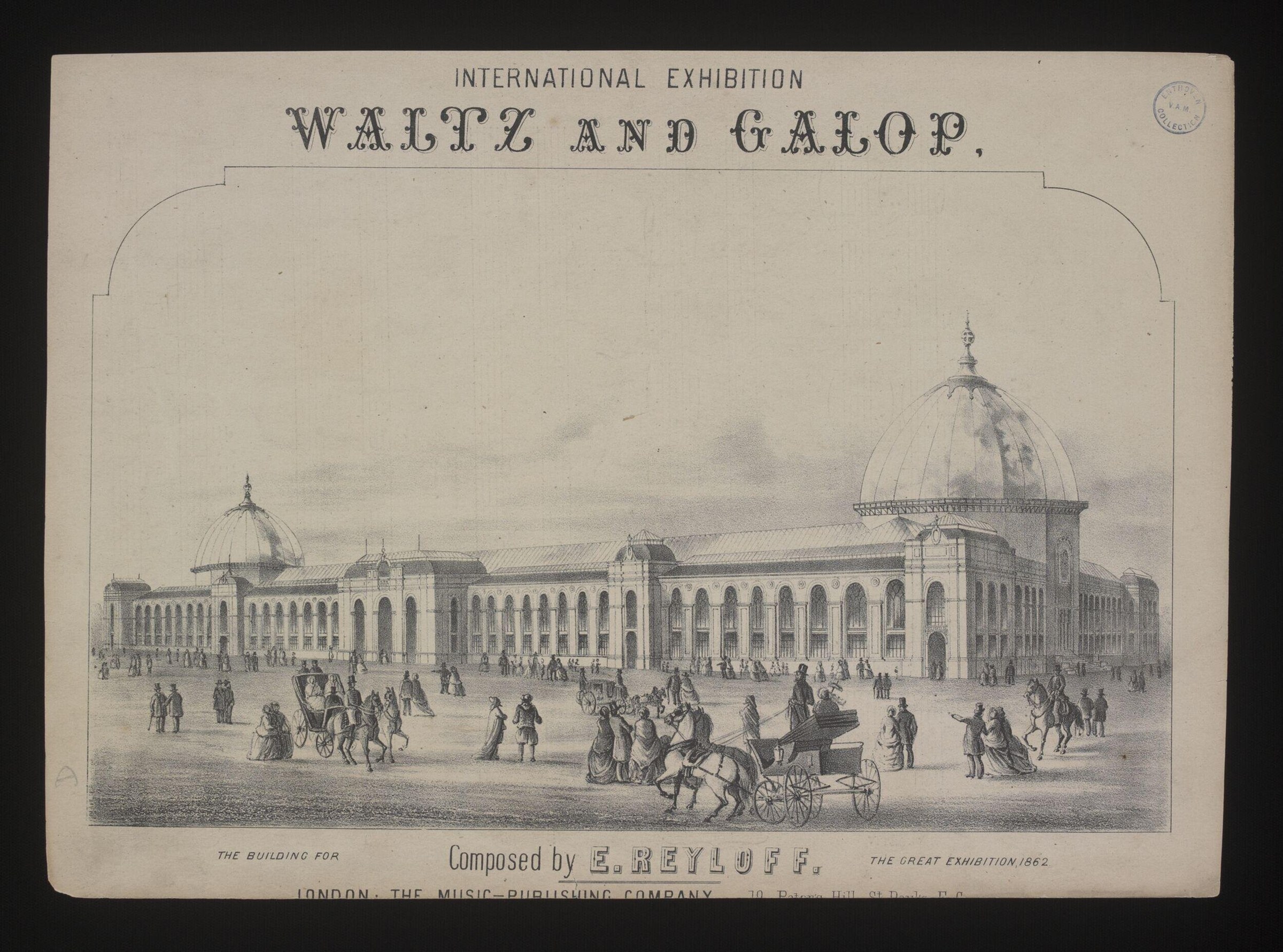
This is a printed score cover or title page for a musical composition titled *Waltz and Galop*, commissioned for the 1862 Great Exhibition. The image shows the grand neoclassical exhibition building as the focal point, rendered in fine engraving. The structure features a massive central dome flanked by smaller domed pavilions, with rows of tall arched windows and ornamental details. The building is set within an expansive plaza filled with well-dressed crowds—men in top hats and dark suits, women in full skirts and bonnets typical of the 1860s, horse-drawn carriages, and clusters of pedestrians strolling or standing in conversation. The foreground shows the bustle of public social activity, with figures dispersed across the plaza in relaxed, leisurely poses rather than in the midst of formal dance. The engraving is finely detailed with careful attention to architectural ornament and the social texture of mid-Victorian public gathering.
The dancing
The figures throughout the plaza are rendered in period dress and posed in the attitudes of social walking and standing rather than dancing. The postures are upright and formal, consistent with Victorian propriety and public decorum. No dancers are shown in recognizable dance positions, holds, or frames. The crowds appear as social bodies moving through an important public space rather than as performers. The variety in pose—some figures isolated, others in small groups or pairs—suggests documentary observation of how crowds actually occupy such grand civic spaces.
The dance depicted
This is a title page or cover for a musical score rather than a depiction of dance in progress. The waltz and galop were both prominent ballroom dances of the 1860s, and the music was composed in honor of the Great Exhibition of 1862. The image documents the building and the public event rather than showing how the dances would have been performed. No choreography, partnering, or movement technique is visible. The work is valuable as evidence of what music was commissioned for this historic occasion and how the exhibition was visually promoted, but it does not show the dances themselves being performed.
How it was made
This is a fine engraving, likely steel or copper, rendered in the detailed naturalistic style typical of mid-Victorian commercial and commemorative prints. The technique allows for fine architectural detail and the careful rendering of crowds at a distance, creating a sense of scale and public spectacle. Engravings of this quality and subject matter were produced for mass distribution—they would have been sold as prints, used as covers for published sheet music, or included in exhibition catalogues and commemorative publications. The medium indicates this was a commercial, public-facing work intended to celebrate the exhibition and promote the musical composition.
About this work
This is the cover or title page of a musical score for *Waltz and Galop* composed by E. Reyloff for the 1862 Great Exhibition in London. Rather than depicting the dances themselves, it serves as documentary evidence of how the exhibition building and the social occasion of the fair were visualized and commemorated. The engraving records the grandeur of the Crystal Palace-era exhibition structure and the crowds that would have gathered there—the same audiences for whom the waltz and galop were primary social dances. The work is a historical artifact of 1860s ballroom culture, useful for understanding what music accompanied public celebration and what the social world of mid-Victorian dance looked like.
How to look at it
Approach this as a historical document rather than a dance image. The architectural rendering gives precise information about the exhibition building and its scale. The crowd distribution and dress reveal how 1860s public social spaces were organized and how people moved through them. The title and composer's name link the visual record to the specific music—waltz and galop—that would have been performed by orchestras and danced by ballroom dancers at the exhibition and in London society more broadly. The engraving technique itself is worth observing: the fine lines that build form and atmosphere, the way distant figures are suggested rather than detailed, and the carefully composed perspective that emphasizes the building's grandeur.
The artist
E. Reyloff is identified only as the composer of this work; nothing in the image confirms the engraver's identity. The engraving itself is the work of an accomplished commercial print maker working in the mid-19th-century tradition of fine architectural and commemorative engravings, a practice well-established for recording important buildings and public events.
The period
The 1862 Great Exhibition in London was a major public celebration of industrial and cultural achievement, following the hugely successful 1851 Crystal Palace Exhibition. By the 1860s, the waltz and galop were well-established in Victorian ballroom culture, having become the dominant fashionable dances among the middle and upper classes. Music commissioned for such exhibitions would have been intended for performance at balls, receptions, and public entertainments associated with the fair, reaching audiences who attended in their thousands. The medium of the engraved print allowed this image and the music to circulate widely, making the exhibition and its cultural associations available to those who could not attend in person.
Where it lives
This is a music score or sheet music cover held in the va (Virginia) collection. It is a printed commercial object from the mid-19th century, produced for circulation as a published score or as promotional material for the exhibition.
Questions about this work
Does this image show people actually dancing?
No. This is a title page or cover for published sheet music, not a scene of dance in progress. The figures shown are crowds gathered at the exhibition building in the plaza, posed in the attitudes of social walking and standing. The waltz and galop would have been danced to this music at balls and public entertainments, but they are not depicted here.
What does the composition tell us about the waltz and galop in 1862?
The fact that music in these forms was commissioned for a major public exhibition and distributed as a printed score indicates that waltz and galop were fashionable, commercially successful ballroom dances. They were integrated into public celebration and civic culture, not marginal or private entertainments. The scale of the printed music suggests a large market for such works.
Why is this building shown?
The 1862 Great Exhibition was held in London to showcase industrial and cultural achievements. The building shown here is the exhibition hall—the site of the fair. Including the building in the score cover linked the music to the prestige of the exhibition and to attendance at major public events.
Who was E. Reyloff?
E. Reyloff is identified only as the composer of this waltz and galop. Beyond this attribution, nothing further is recorded about his identity, training, or other works. He appears to have been working as a composer for the London music publishing market in the 1860s.
More dance artwork





