49 works in this view — arrow keys or swipe to move between them.
Dance in Art
The Henry Irving Waltz
King, Horatio
- Collection:
- Sheet Music
- Source:
- Victoria and Albert Museum
- Rights:
- Rights vary by item — check the source record before reusing this image. Source record ↗
- Recorded as:
- V&A — check rights per item
This work documents the commercial ecosystem of ballroom dance in the 1890s: the practice of publishing named compositions, the circulation of dance music through domestic channels, and the role of celebrity endorsement in marketing music to amateur performers. It shows how waltz composition was a viable commercial venture and how social dance was valued as a cultural practice worth commemorating in print. The Irving dedication—brief, cordial, and businesslike—reveals the transactional nature of musical patronage among Victorian public figures.
What you are looking at
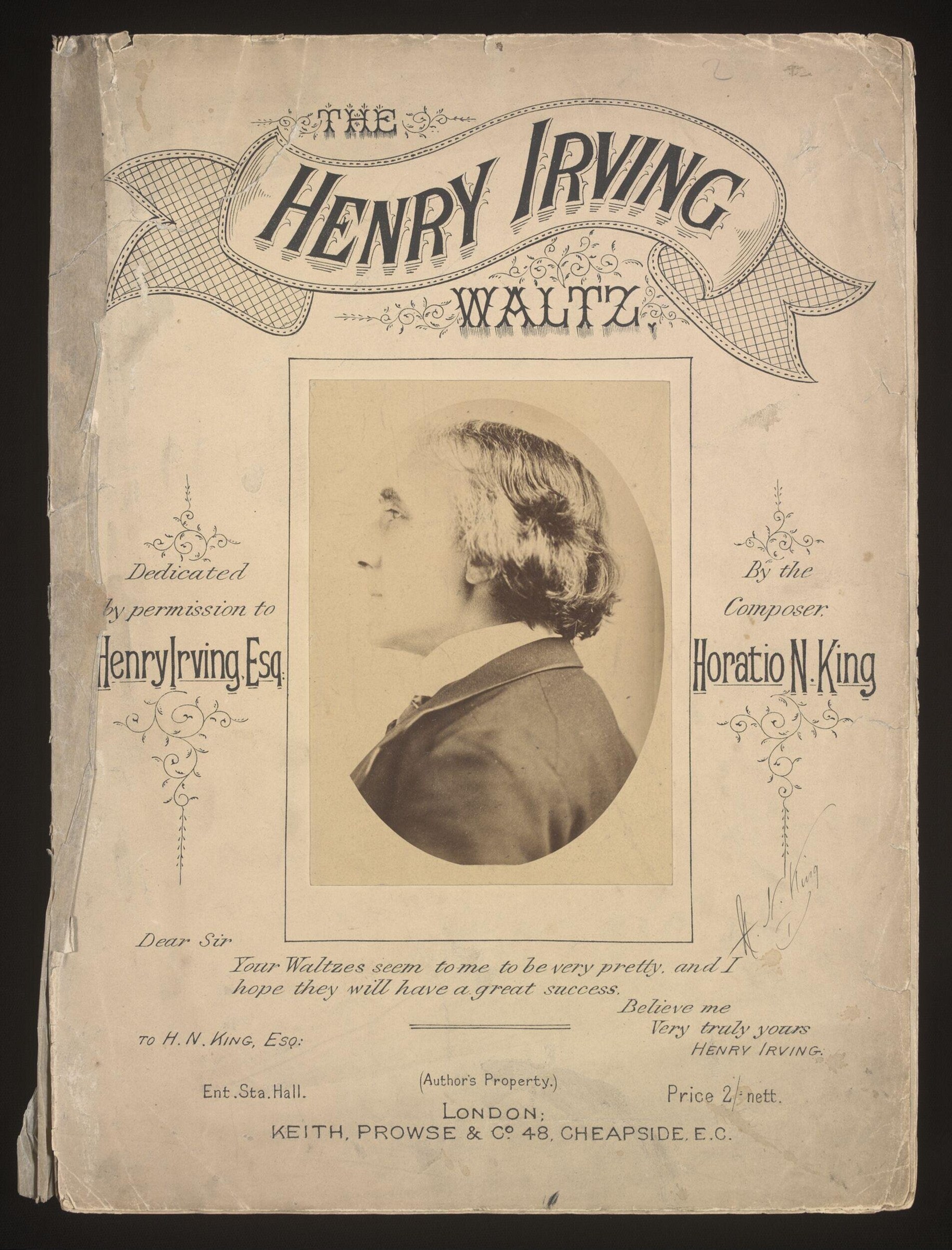
This is the cover of a published waltz composition titled *The Henry Irving Waltz*, dedicated to the actor Henry Irving Esq. and composed by Horatio N. King. The page is dominated by a portrait medallion of a man in profile facing left, rendered in soft sepia tones. He wears a dark jacket with what appears to be a draped collar or shawl. The portrait is oval and framed within a bordered rectangle. Above the portrait, an ornamental banner in a decorative serif font announces the title. Below the image appears a handwritten dedication: "Dear Sir, Your Waltzes seem to me to be very pretty, and I hope they will have a great success. Believe me, Very truly yours, Henry Irving." The composition is clearly the cover sheet of published sheet music intended for a drawing-room or concert audience. Publication details at the bottom identify it as London: Keith, Prowse & Co., 48 Cheapside, E.C., priced at 2/6 (two shillings and sixpence). The document is marked "Author's Property" and carries an earlier entry mark: "Ent. Sta. Hall."
The dancing
The only human figure is the portrait subject, shown in profile with his head tilted slightly downward in a contemplative pose. There is no depiction of actual dancing or dancers. The image does not show bodies in motion or the physical execution of dance.
The dance depicted
This is sheet music for a waltz—a ballroom dance in triple time, typically performed by couples in a closed position. The work is titled after Henry Irving, the celebrated Victorian actor (1838–1905), though there is no evidence from the image itself that Irving danced. The dedication from Irving to the composer suggests this was a tribute composition or possibly a social gesture. The waltz was the dominant ballroom dance of the late nineteenth century, and publication of named waltzes was a common commercial practice. However, this particular object is an artifact of music publication rather than a direct representation of choreography or dance practice.
How it was made
This is a printed sheet music cover, likely produced by lithography or letterpress engraving and printed on card stock, characteristic of Victorian-era music publishing. The portrait appears to be a photogravure or similar photo-reproduction process, allowing for the soft tonal rendering typical of period commercial printing. The ornamental title banner and decorative flourishes are typical of music publisher branding. This format—a single cover sheet with title, dedication, and publisher information—was the standard vehicle for circulating dance music to the amateur pianist and domestic dancer, implying an audience of middle-class households rather than professional performers.
About this work
This is the cover sheet of a published waltz composition from 1890, named in honor of the Victorian actor Henry Irving. It belongs to a vast archive of nineteenth-century social dance music, most of which commemorated public figures, locations, or social events as a form of cultural tribute. The work itself is not a choreographic document but a commercial music publication designed for drawing-room performance. Its inclusion in a dance archive reflects the historical intertwining of ballroom dance and music publishing: waltzes existed principally as musical scores performed by and for dancers, and the cover art and dedicatory language are part of how dance entered popular culture and domestic life. The Irving connection makes this a minor artifact of Victorian celebrity culture as much as of dance history.
How to look at it
Examine the inscription at the center of the page. The handwriting is formal and courteous, expressing appreciation for King's compositions—a professional compliment rather than a personal endorsement of dancing ability. Note that Irving is depicted as a serious, contemplative man in his profile, not as a dancer. This is a music publisher's object, not a dance artist's record. The oval framing and soft toning of the portrait are conventional tropes of Victorian celebrity reproduction, designed to lend dignity and respectability to a commercial product.
The artist
Horatio N. King was a composer active in late nineteenth-century London. This is his only identified surviving composition in standard references, though the existence of at least one named waltz suggests he may have written other salon music. The practice of naming compositions after celebrities and dedicating them to patrons was a standard commercial strategy, and King's willingness to undertake such a composition indicates he was operating within the ordinary music trade rather than as an avant-garde or concert-hall composer.
The period
The waltz reached its peak of popularity in Victorian ballrooms during the 1880s and 1890s. Though the dance had scandalized earlier generations (its close hold was considered improper), by the late nineteenth century it was the unquestioned foundation of respectable social dancing. Hundreds of waltz compositions were published annually, many bearing names of celebrated people, places, or events. The 1890 date places this at the height of Victorian ballroom culture, shortly before the American ragtime and newer dance forms began to compete for social dancers' attention. Henry Irving's eminence as an actor (he was the first actor to receive a knighthood, in 1895) made him a suitable honoree for a musical tribute.
Where it lives
This is a published sheet music cover held as part of a collection focused on dance history. It represents the ordinary, mass-produced material culture of nineteenth-century ballroom dance—the documents that entered millions of middle-class homes and were used, performed, and frequently discarded. This particular copy survives as an archival specimen.
Questions about this work
Did Henry Irving dance?
There is no evidence from this object or from Irving's known biography that he was a dancer. He was an actor and theatre manager. The waltz was named in his honor, likely as a commercial tribute, but the dedication is merely a courtesy inscription rather than a claim that Irving danced.
What was a Victorian waltz like?
The waltz was danced by couples in a closed position (one partner's right hand on the other's back, left hands joined), moving in a characteristic rotating pattern to three-quarter time music. It was performed in ballrooms and at social gatherings, and was the dominant social dance of the late nineteenth century. Sheet music like this was published in enormous quantities for amateur pianists to accompany dancers in home and hall settings.
Why were waltzes named after famous people?
Naming a composition after a celebrated public figure was a marketing strategy that gave the music prestige and made it more commercially appealing. It cost the composer little and provided the honoree with a form of flattery that might encourage purchase. Hundreds of such tribute compositions were published in the Victorian era.
What does 'Ent. Sta. Hall' mean?
This is an entry mark indicating the work was registered at Stationers' Hall, the historical centre of copyright and publishing registration in London. It was a standard procedure for published works in Britain.
More dance artwork





