49 works in this view — arrow keys or swipe to move between them.
Dance in Art
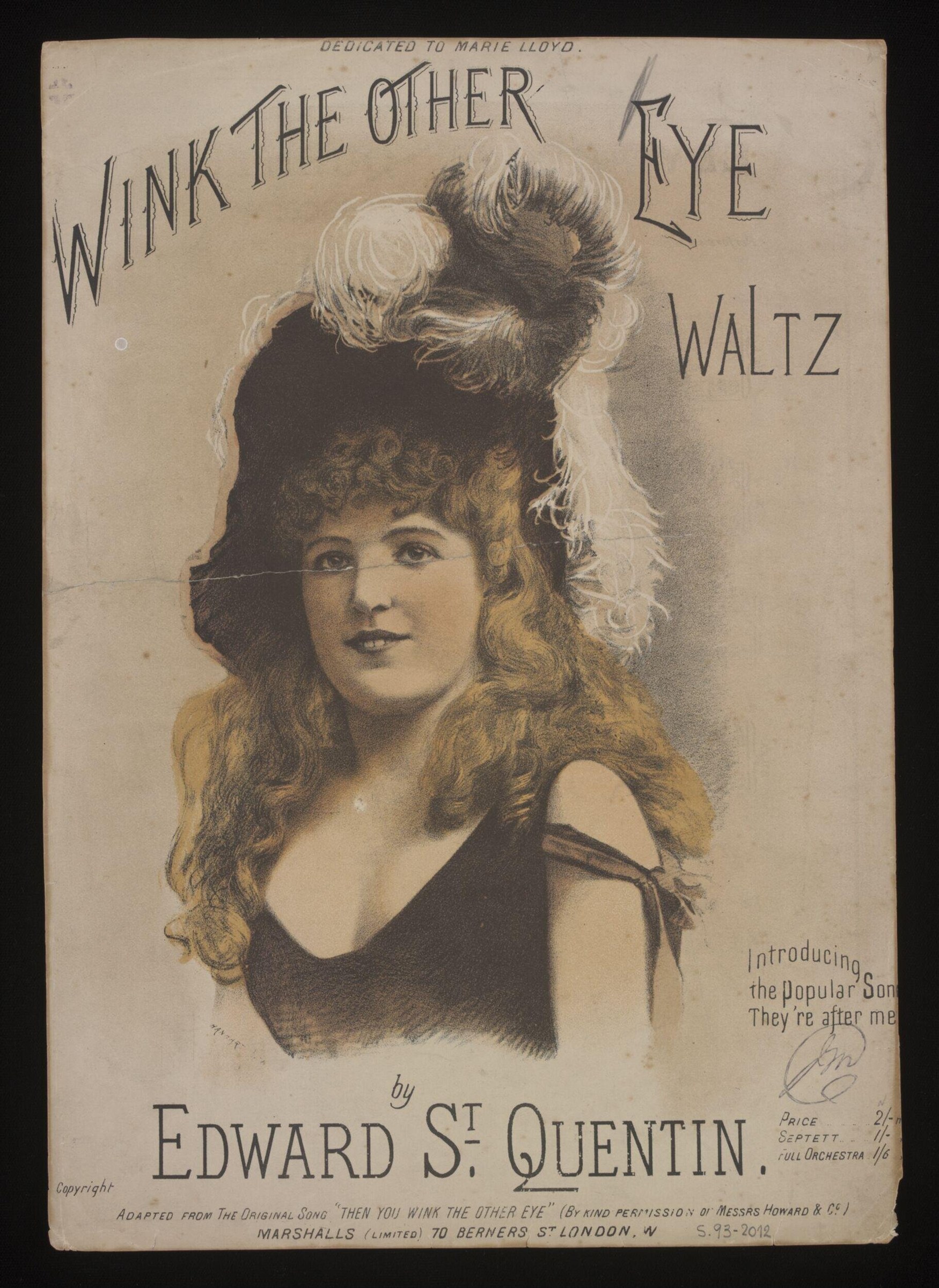
Wink The Other Eye Waltz
St. Quentin, Edward
- Collection:
- Source:
- Victoria and Albert Museum
- Rights:
- Rights vary by item — check the source record before reusing this image. Source record ↗
- Recorded as:
- V&A — check rights per item
This object reveals how dance music was sold and imagined in the early 20th century: not through images of dancing bodies, but through the glamour of the performer and the emotional tone of the piece. The waltz at this period was transitioning from ballroom standard to nostalgic theatrical device, and this cover—with its music-hall dedication and coquettish styling—documents that shift. For historians of dance imagery, it is a reminder that not all dance-related art shows dancing: some of the most influential shaping of dance culture happened through sheet-music design, theater posters, and the marketing of celebrity.
What you are looking at
A three-quarter portrait of a young woman with elaborate Gibson Girl styling dominates the composition. She has long, wavy blonde hair piled high and swept to one side in the fashionable S-bend silhouette of the Edwardian era. Above her head floats a decorative element—a woman's face in profile, rendered in lighter tones, suggesting a playful visual pun on the title "Wink the Other Eye." The subject wears a black off-shoulder dress with a ribbon tie at the shoulder, posed with her head tilted slightly, her gaze directed toward the viewer. The background is plain and neutral, rendered in soft gradations of tone that make the figure advance. The overall effect is one of coquettish charm, with theatrical lighting that emphasizes the modeling of her face and the texture of her hair. The dedication at top reads "Dedicated to Marie Lloyd," anchoring the work in theatrical and music-hall culture.
The dancing
The single figure is posed in a relaxed, three-quarter stance with her weight settled and her shoulders square to the picture plane. Her head tilts in a gentle contrapposto, chin slightly lifted, with a direct, knowing gaze. The arm position is not clearly defined—her right shoulder is bared and pulled back slightly, creating an S-curve through the torso typical of Edwardian dress silhouette rather than active dancing posture. There is no suggestion of weight transfer, footwork, or the dynamic tension of ballroom hold. The pose is closer to a theatrical portrait than a captured moment of movement.
The dance depicted
The work is promotional material for a waltz composition, as stated in the title and publication information. The dedication to Marie Lloyd, a celebrated British music-hall singer and actress, suggests the piece was written for theatrical performance rather than ballroom social dancing, though the waltz was equally at home in both contexts in the Edwardian period. The image itself does not depict the waltz in motion; it is a portrait of a performer, likely Lloyd or a stage dancer in her style, that would have accompanied the published sheet music. The playful title and the floating face above the subject allude to flirtation and the theatrical charm that characterized music-hall entertainment, but no dancing body or partnered hold is visible.
How it was made
This is a color lithographic print, characteristic of Edwardian sheet-music cover design. The process allowed for the combination of photographic portraiture (the main face) with drawn and hand-colored elements (the floating profile, lettering, and decorative text). The print shows the soft tonal gradations and subtle color blending typical of chromolithography, with flesh tones carefully modeled and the black dress rendered in deep shadow against pale backgrounds. The dedication and publisher information (Marshalls Limited, 70 Berners Street, London) are printed at the base. Such covers were mass-produced and inexpensive, designed to be eye-catching at the music shop and to sell the song through the appeal of the performer and the elegance of the design. The survival of this copy, with its creasing and aging, speaks to its circulation as a popular commercial object.
About this work
This is the sheet-music cover for Edward St. Quentin's waltz composition "Wink the Other Eye," dedicated to the music-hall star Marie Lloyd. It dates to the Edwardian era, when the waltz was still the dominant ballroom dance and was frequently adapted for theatrical performance and popular song. The cover is a chromolithographic portrait rather than a dance scene: it presents a fashionably dressed young woman in the Gibson Girl style, with a witty visual pun (the floating face) that plays on the song title and the flirtatiousness expected of music-hall entertainment. The work belongs in a gallery of dance in art because it documents both the aesthetic of Edwardian dance culture and the commercial machinery by which dance music reached the public—the sheet-music cover as a form of visual marketing that made the waltz not just a dance but a style, a mood, and a fantasy of feminine charm and theatrical allure.
How to look at it
Attend to the play between the portrait and the witty visual pun: the main face is direct and modern, gazing at the viewer in a way that invites recognition (this is a famous performer), while the floating profile above is dreamy and decorative, an almost Pre-Raphaelite ghost that literalizes the "other eye" of the title. The S-curve of the Edwardian silhouette is on display—the corsetry, the high pile of hair, the bare shoulder—all markers of fashionable femininity of the moment. The composition is designed not to freeze a moment of dance but to present an ideal: the waltz as a mood, as glamour, as theatrical charm. The modest price printed at the lower right (2/- for the vocal score, 1/6 for full orchestra) grounds the image in commercial reality—this is not a fine art print but a mass-market commodity.
The artist
Edward St. Quentin was an Edwardian composer and musician active in London in the early 1900s. Little is recorded of his biography beyond his published works, which include waltzes, songs, and light theatrical pieces. He worked within the tradition of salon and music-hall composition, writing pieces designed for both amateur performance at the piano and professional stage use. His collaboration with the publisher Marshalls Limited places him within the London commercial music trade, where composers produced a steady stream of fashionable dances and songs for the middle-class market.
The period
In the Edwardian era (1901–1910) and the years immediately following, the waltz remained culturally dominant but was undergoing a transformation. In the ballroom, it competed with the new ragtime dances arriving from America—the foxtrot, the one-step, and the tango. In the theater and music hall, the waltz had become a vehicle for sentiment and nostalgia, often performed by female vocalists in elaborate costume. Marie Lloyd, to whom this piece is dedicated, was the supreme music-hall performer of her age, famous for her wit, charm, and ability to invest popular songs with personality and innuendo. The sheet-music cover design of the period merged photography, lithography, and commercial art in a way that made the performer's image and persona inseparable from the music itself. The floating-face motif and the coquettish pose were stock elements of Edwardian entertainment marketing.
Where it lives
This sheet-music cover is housed in the Victoria and Albert Museum, London. It is part of the holding of printed dance and theater ephemera that documents popular entertainment and music-hall culture. The copyright and publication information printed on the cover indicates it was published by Marshalls Limited of Berners Street, London, and adapted from an original song "Then You Wink the Other Eye" by Howard & Co., used by kind permission.
Questions about this work
Why is this sheet-music cover in a gallery of dance in art?
Sheet-music covers were one of the primary ways the public encountered dance imagery in the early 20th century. This cover documents not a ballroom or stage waltz in motion, but the theatrical and commercial culture surrounding the waltz: how it was marketed, who performed it, and what emotions and aesthetics it was meant to evoke. For historians of dance, these covers are as important as photographs of dancers because they show how dance shaped popular culture and consumer taste.
Who was Marie Lloyd?
Marie Lloyd (1870–1922) was the most celebrated music-hall entertainer of her age, famous for her comic timing, risqué wit, and ability to make every song her own through personality and charm. She was known as the "Queen of Comedy" and her performances defined the style and tone of British popular entertainment in the Edwardian era. Many composers and songwriters dedicated works to her, as this waltz was.
What does the floating face above the main portrait mean?
It is a visual pun on the song title: "Wink the Other Eye." The profile is another pair of eyes, another face, as if the woman is simultaneously looking outward and inward, or as if a partner is gazing at her from behind. It is a playful, slightly flirtatious device typical of music-hall and entertainment graphics of the era, where double meanings and witty visual tricks were expected.
When was this cover made?
The catalogue record does not provide an exact date, but the style of the dress, the hair, the lithographic technique, and the publisher's location in London all point to the early 1900s, most likely the 1900s–1910s. The Edwardian S-bend silhouette and Gibson Girl styling were at their peak in this period.
More dance artwork





