49 works in this view — arrow keys or swipe to move between them.
Dance in Art
H Beard Print Collection
Brandard, John
- Collection:
- Source:
- Victoria and Albert Museum
- Rights:
- Rights vary by item — check the source record before reusing this image. Source record ↗
- Recorded as:
- V&A — check rights per item
The image reveals the gendered aesthetics and narrative framing that surrounded ballroom dance in the Romantic period—the expectation that women should be passive and modest while men performed courtly ardor. For historians of social dance and gender performance, it documents the cultural fantasy that shaped real ballroom behavior. For researchers of 19th-century opera and theatrical dance, it shows how popular operas were disseminated to the public through affordable prints, making opera characters and costumes part of everyday visual culture.
What you are looking at
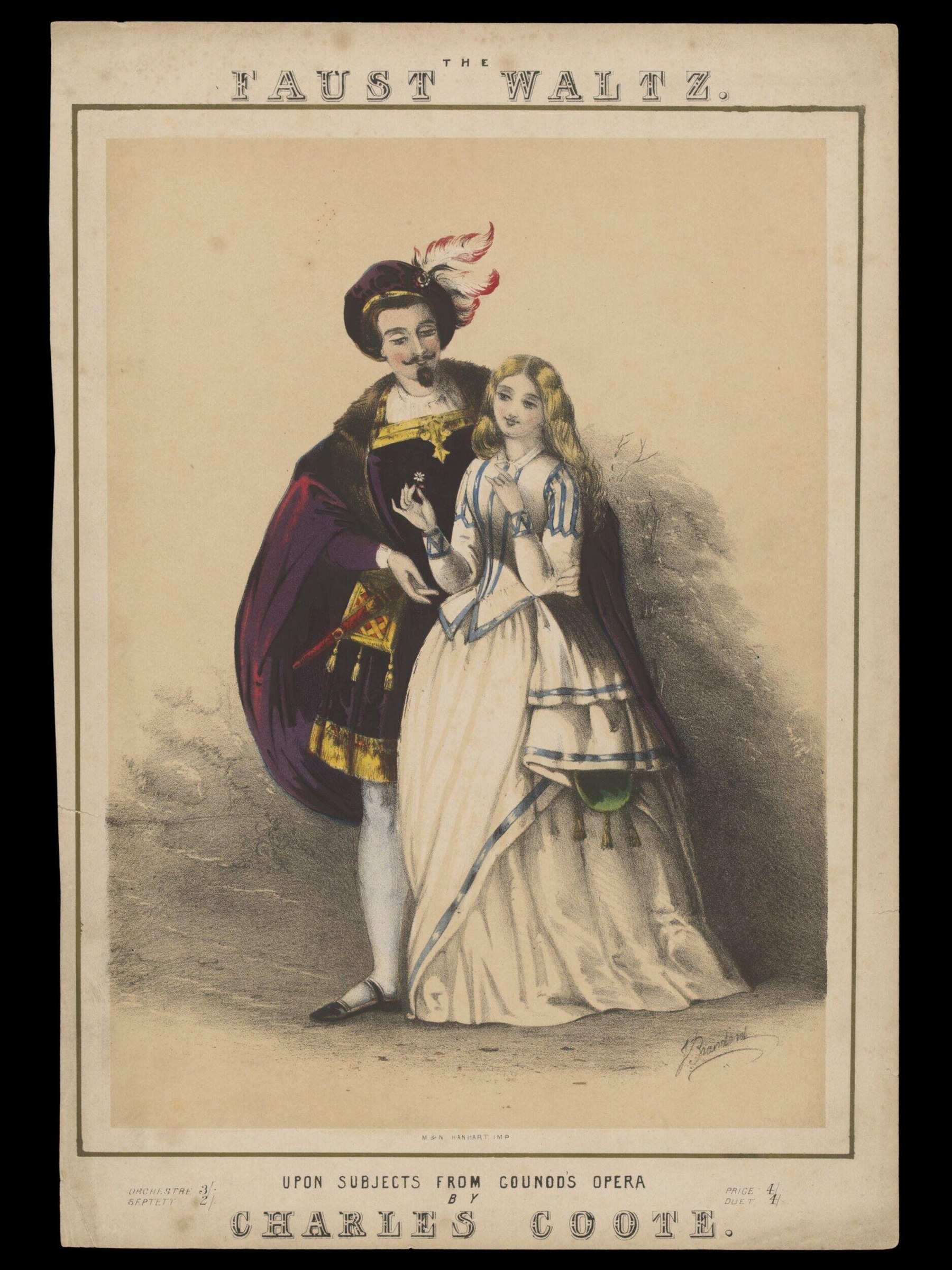
A hand-colored engraving presents a Romantic-era couple in formal dress against a neutral background. The man wears a dark military-style coat with gold embroidery, a plumed hat in the Hussar style, and a dramatic crimson-lined cape that sweeps behind him. The woman stands in an elegant white gown with blue ribbon trim and a fitted bodice, her blonde hair long and unadorned. They stand close together in a pose suggestive of courtship or flirtation rather than active dancing—the man inclines toward the woman with a gallant gesture, while she gazes downward in a demure attitude. The composition is intimate and theatrical, lit from a consistent source that creates soft shadow work on the woman's skirt and the background.
The dancing
The couple does not assume a closed dance hold. Instead, the man's posture is an exaggerated courtly bow or lean, his body angled toward the woman while his arms remain largely at his sides or gesturing loosely. The woman stands upright with her weight evenly distributed, her arms relaxed, her expression one of modest restraint. Neither figure shows active footwork or the bodily suspension typical of dance in motion; the pose is one of courtship display and social interaction rather than choreographed movement.
The dance depicted
This image does not depict active dancing, but rather the courtship ritual and flirtation that framed social dance in the early-to-mid 19th century. The title references Gounod's opera *Faust* (1859), and this print illustrates a moment between the title character and Marguerite—a dramatic encounter rather than a ballroom waltz or cotillion. The Hussar costume and military styling suggest the Romantic opera's historical fantasy setting. The work captures the narrative and emotional tenor of theatrical romance more than the technical practice of social dance.
How it was made
This is a hand-colored engraving or possibly a lithograph, identifiable by the fine line work, the tonal gradation achieved through hatching and stipple, and the evidence of selective hand-coloring in watercolor or gouache—particularly visible in the vivid crimson cape, the blue ribbon trim, the flesh tones, and the gilded decoration. The technique allowed for mass production and wide circulation; this print type would have been affordable to the middle classes and sold in theatrical shops and print houses to commemorate popular operas. The signature at lower right (partially legible) and the publisher's marks indicate commercial publication.
About this work
This is a theatrical keepsake engraving commemorating a scene from Gounod's *Faust*, one of the most performed operas of the 19th century. It documents not a dance itself but the Romantic aesthetic surrounding dance and courtship in the era—the ideal of gallant masculine display and modest feminine reception that underwrote both social ballroom culture and theatrical narrative. The work sits at the intersection of opera, fashion history, and the visual culture of dance, capturing a moment when dance was inseparable from dramatic storytelling and the codification of gender performance. It belongs in a dance archive because it reveals how dance and dancers were understood and imagined in an era when social dance was central to courtship, class performance, and theatrical spectacle.
How to look at it
Attend to the asymmetry of the pose: the man's exaggerated lean and gesture against the woman's composed stillness. This is not a moment of choreographed movement but of theatrical narration—the artist has frozen a dramatic beat, a moment of proposition or confession. Notice the costume detail, particularly the military Hussar styling and the dramatic cape, which signal historical fantasy and operatic grandeur rather than everyday ballroom dress. The soft modeling of fabric and flesh, achieved through careful engraving and hand-coloring, was a hallmark of theatrical prints meant to capture the glamour and emotional intensity of stage performance.
The artist
John Brandard was a prolific English engraver and lithographer of the mid-19th century, specializing in theatrical and operatic subjects. His prints were widely circulated and remain valuable documents of Victorian theatrical culture. He worked in the commercial print trade, producing affordable keepsakes and souvenir images for theaters and print shops, making high culture accessible to the growing middle-class audience for opera and drama.
The period
This print dates to the era of Romantic ballet and opera (approximately 1830–1870), when narrative spectacle and emotional intensity dominated both forms. Gounod's *Faust* premiered in 1859 and became one of the most frequently performed operas in the world. In the same decades, Romantic ballet was celebrating female dancers as ethereal, passive, and melancholic ideals (the *ballerina* as central figure), while male dancers were increasingly sidelined in European ballet—though male dancers remained central to opera and to the courtship narratives that framed social dance. The print reflects the period's obsession with theatrical fantasy and the codification of romantic heterosexual encounter as a visual and narrative ideal.
Where it lives
This print is part of the H. Beard Print Collection at the Victoria and Albert Museum, a major repository of 19th-century theatrical and dance-related prints. It was likely sold as an affordable keepsake or souvenir following performances of Gounod's *Faust* in London or another major theatrical center.
Questions about this work
Is this image from a real dance or a made-up theatrical scene?
It depicts a scene from Gounod's opera *Faust*, not a real social dance. However, it reveals how opera and theater shaped the visual and emotional language of ballroom dance in the 19th century. The pose and the coded gender behavior it displays—the man's active display and the woman's modest reserve—reflected real ballroom conventions.
What is the man wearing, and why does it look military?
He wears a Hussar costume, a theatrical rendering of Central European cavalry dress. Hussars were exotic, dangerous, and romantic figures in 19th-century European fantasy, and this costume signals both the opera's literary and historical setting (Gounod's *Faust* is set in a fantasy medieval world) and the Romantic period's fascination with military masculinity and exotic otherness.
Why is the woman so passive?
The pose reflects the Romantic period's gendered ideal of femininity: women in ballroom and theatrical contexts were expected to be modest, receptive, and emotionally restrained on the surface, while men performed active courtship and desire. This dynamic shaped both social dance and theatrical representation of romance.
Is this a valuable or rare print?
Brandard's theatrical prints were widely circulated in the 19th century and are not exceptionally rare today, but they are historically significant documents of Victorian operatic culture and popular visual taste. The V&A holds many such prints as part of its extensive theater collections.
More dance artwork





