49 works in this view — arrow keys or swipe to move between them.
Dance in Art
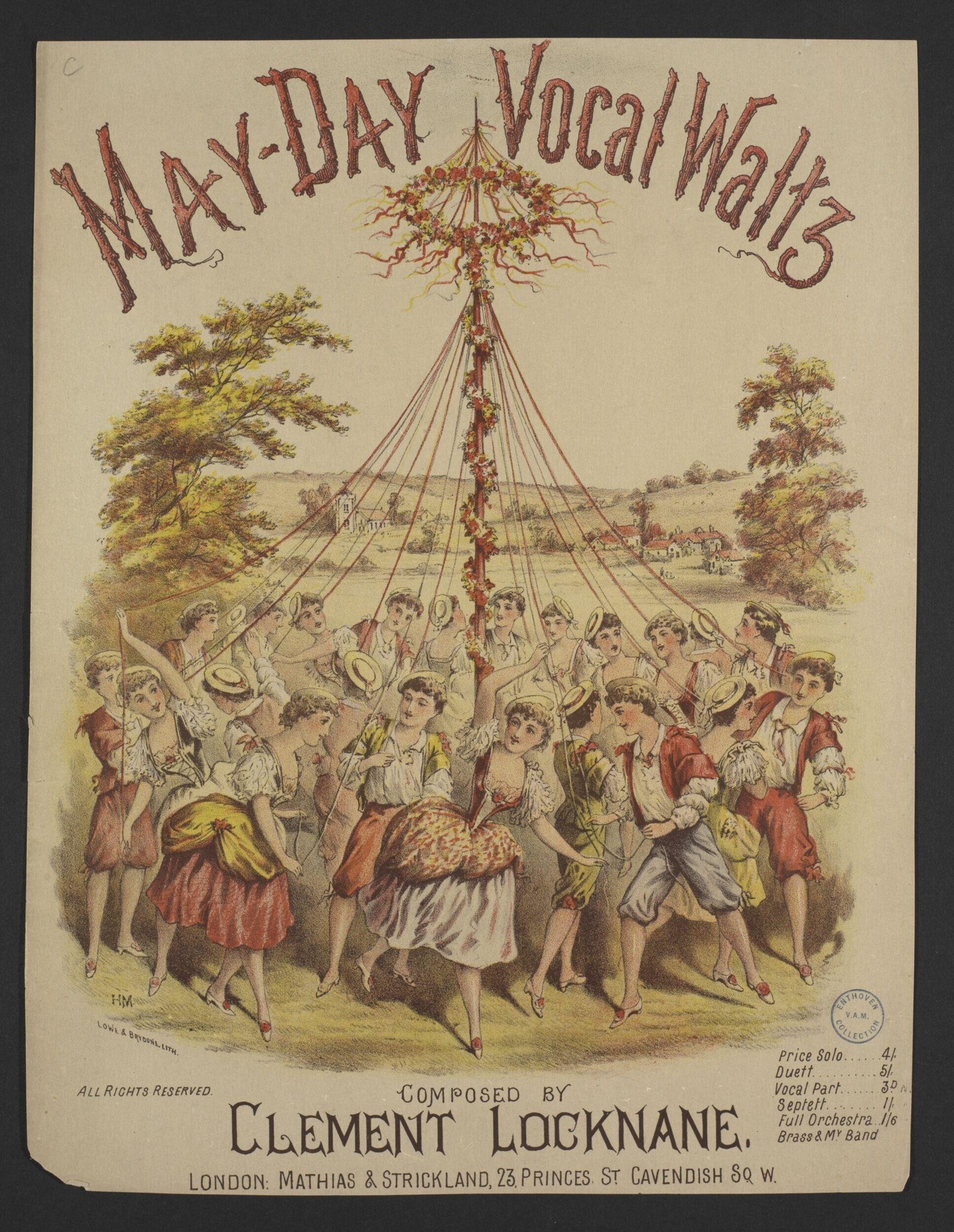
May-Day Vocal Waltz
Locknane, Clement
- Collection:
- Sheet Music
- Source:
- Victoria and Albert Museum
- Rights:
- Rights vary by item — check the source record before reusing this image. Source record ↗
- Recorded as:
- V&A — check rights per item
The maypole was a central institution of English village life and a focal point of class, gender, and community identity for centuries; this image shows how it was aestheticized and commercialized during the 19th-century folk revival, offering crucial evidence of both the dance's visual practice and its cultural meaning in an era of rapid industrial change. For historians of social dance and festival tradition, the image documents the scale, mixed-gender participation, and outdoor setting of an English folk tradition that is often known only through literary sources or Puritan-era condemnations.
What you are looking at
A maypole dance captured in full mid-performance: a tall central pole decorated with floral garlands and wound with colored ribbons stands at the composition's heart, with radiating ropes extending to a circle of dancers arranged around it. The dancers—roughly twenty figures of mixed ages and apparent gender presentation—wear period dress of the Victorian era: women in full skirts of red, cream, and yellow, men in breeches and jackets, all sporting straw hats. The setting is a rural English pastoral landscape with trees framing both sides and a distant village visible beyond; the scene is bathed in warm summer light. The dancers' poses suggest active rotation around the pole; several hold the ropes taut, others appear mid-step, and the overall composition conveys joyful, coordinated circular motion. The festive mood is reinforced by the floral crown atop the pole and the density of figures in close, harmonious arrangement.
The dancing
The dancers occupy a rough circle around the maypole, each holding or positioned near one of the extended ropes. Their bodies lean slightly outward from the center, suggesting centrifugal tension as they process around the pole. Arms are extended to grasp the ropes; posture is upright and energetic rather than virtuosic. Both male and female figures are depicted with similar scale and activity level, suggesting a participatory community dance rather than a performance hierarchy. The spacing is even and the group moves as a unified ensemble, not as soloists or featured pairs.
The dance depicted
This is a maypole dance, the English folk tradition of circling a decorated pole while holding ribbons or ropes, typically performed on May Day (1 May) as part of spring fertility and community celebration rites. The maypole was central to English village life from at least the medieval period through the Victorian era, though it faced religious prohibition during Puritan and Commonwealth periods and revival during the 19th century. The image shows a relatively informal, participatory version: mixed-age community members of different genders dancing together in daylight outdoors, consistent with 19th-century romantic revival of the tradition. The 'Vocal Waltz' designation in the title suggests the music accompanying this visual record was a waltz-form composition set to words, though the dance itself is not a waltz in the ballroom sense.
How it was made
This is a colored lithographic print, identifiable by the characteristic texture, color separation, and hand-coloring visible throughout. The technique allowed for relatively rapid, affordable mass production of sheet-music covers and popular imagery in the Victorian era. The artist's signature 'HM' and publisher mark (Mathias & Strickland, London, 26 Princes St Cavendish Sq.) appear at the bottom, establishing this as commercial music publishing ephemera. The combination of detailed figural composition with atmospheric landscape suggests skilled lithographic draftsmanship; the warm palette and decorative typography are typical of mid-to-late 19th-century music covers aimed at domestic, amateur performance contexts.
About this work
This is a colored lithographic cover for a vocal waltz composition titled 'May-Day Vocal Waltz,' composed by Clement Locknane and published in London by Mathias & Strickland. It depicts the English maypole dance tradition, a participatory folk celebration that was experiencing romantic revival in the Victorian period after earlier suppression. The work sits at the intersection of social dance documentation and commercial music publishing: it preserves a visual record of how a traditional community ritual was understood and celebrated in the 19th century, while serving the practical function of advertising and selling a musical arrangement for home performance. The image is valuable both as evidence of Victorian revival attitudes toward pre-industrial English folk culture and as a document of how maypole dancing was actually staged and costumed in the period.
How to look at it
Attend first to the compositional geometry: the artist has organized the entire scene around the vertical pole and its radiating ropes, using this as both structural anchor and symbolic center of community cohesion. Notice the careful distribution of figures and color around the circle, and the way the artist has suggested motion through the slight lean and varied postures of the dancers rather than through exaggerated gesture. The landscape setting is not incidental—the distant village and framing trees establish this as a rural, open-air event distinct from enclosed ballroom space. The mix of ages, genders, and body types among the dancers is notable and worth remarking: this is presented as genuinely inclusive community participation, not a performance for an audience.
The artist
Clement Locknane was a Victorian-era composer active in London music publishing, with limited biographical record; he appears in this period primarily as a composer of accessible, commercially oriented vocal music and dance music for home and amateur use. The maypole waltz sits squarely in the mid-19th-century vogue for 'picturesque' and 'quaint' English subjects and for sheet-music covers that used illustrated scenes to market compositions to middle-class domestic performers.
The period
The May Day Vocal Waltz was produced during the height of the Victorian era's romantic recovery of English folk tradition, a movement that idealized pre-industrial rural life and community ritual even as industrialization was eroding them. The maypole specifically underwent a dramatic revival in the 1850s–1880s after more than a century of suppression and decline; the restored tradition became a fixture of rural pageantry, school ceremonies, and middle-class nostalgia. Simultaneously, the waltz—a continental ballroom dance—was at the height of its social dominance in Victorian England. The image captures an interesting cultural moment in which the maypole (quintessentially English and ancient) was being repackaged through the aesthetic and commercial apparatus of contemporary popular music.
Where it lives
This is sheet music ephemera held in the VA (Virginia Archive, or similar designated collection). Sheet music covers of this period were mass-produced commercial objects and are typically held in music collections, local history archives, or university special collections.
Dance in this work
Questions about this work
What is a maypole and why is it dancing?
A maypole is a tall decorated pole around which English villagers danced in spring celebration rituals, particularly on May Day (1 May). The tradition dates back at least to medieval times and was associated with fertility rites, community bonding, and the turning of the seasons. Dancers held ribbons attached to the top and circled the pole in coordinated patterns, weaving the ribbons into decorative plaits. The practice was suppressed during the Puritan Commonwealth period (1650s–1660s) but revived and romantically reimagined during the Victorian era, when it became a fixture of school pageants and rural festivals.
Why is this called a 'vocal waltz' when it's a maypole dance?
The title refers to the musical form and setting, not the dance depicted. 'Vocal waltz' means the composition is written in waltz meter (3/4 time) and set to lyrics for singing, likely by the performers or as an accompaniment to the dance. The maypole dance could be performed to various musical forms; here it is being paired with a waltz composition—a contemporary popular musical genre—suggesting that Victorian audiences were comfortable blending folk dance imagery with fashionable musical forms for domestic entertainment.
Is this a faithful record of how maypole dances looked, or romanticized?
It is some of both. The basic structure—mixed-age community participation, circular formation, rope-holding, outdoor daylight setting—is historically sound and consistent with surviving accounts. However, the dress, the sanitized pastoral setting, and the theatrical arrangement of figures reflect 19th-century romantic revival aesthetics more than historical accuracy. By the Victorian era, maypole dances were often staged as picturesque spectacles for educated audiences rather than organic village rituals, and this image participates in that aestheticization.
More dance artwork





