49 works in this view — arrow keys or swipe to move between them.
Dance in Art
Albert Victor Polka
Watson, M
- Collection:
- Sheet music
- Source:
- Victoria and Albert Museum
- Rights:
- Rights vary by item — check the source record before reusing this image. Source record ↗
- Recorded as:
- V&A — check rights per item
This piece documents the intimate intersection of dance, children, and commercial culture in Victorian England. The polka was a dance for couples and groups, yet here it is named for a child—likely a young aristocrat or member of the musical establishment—whose portrait sells the sheet music and lends it social prestige. For historians of dance and childhood, the image asks what role children played in the dissemination and cultural authority of popular dances.
What you are looking at
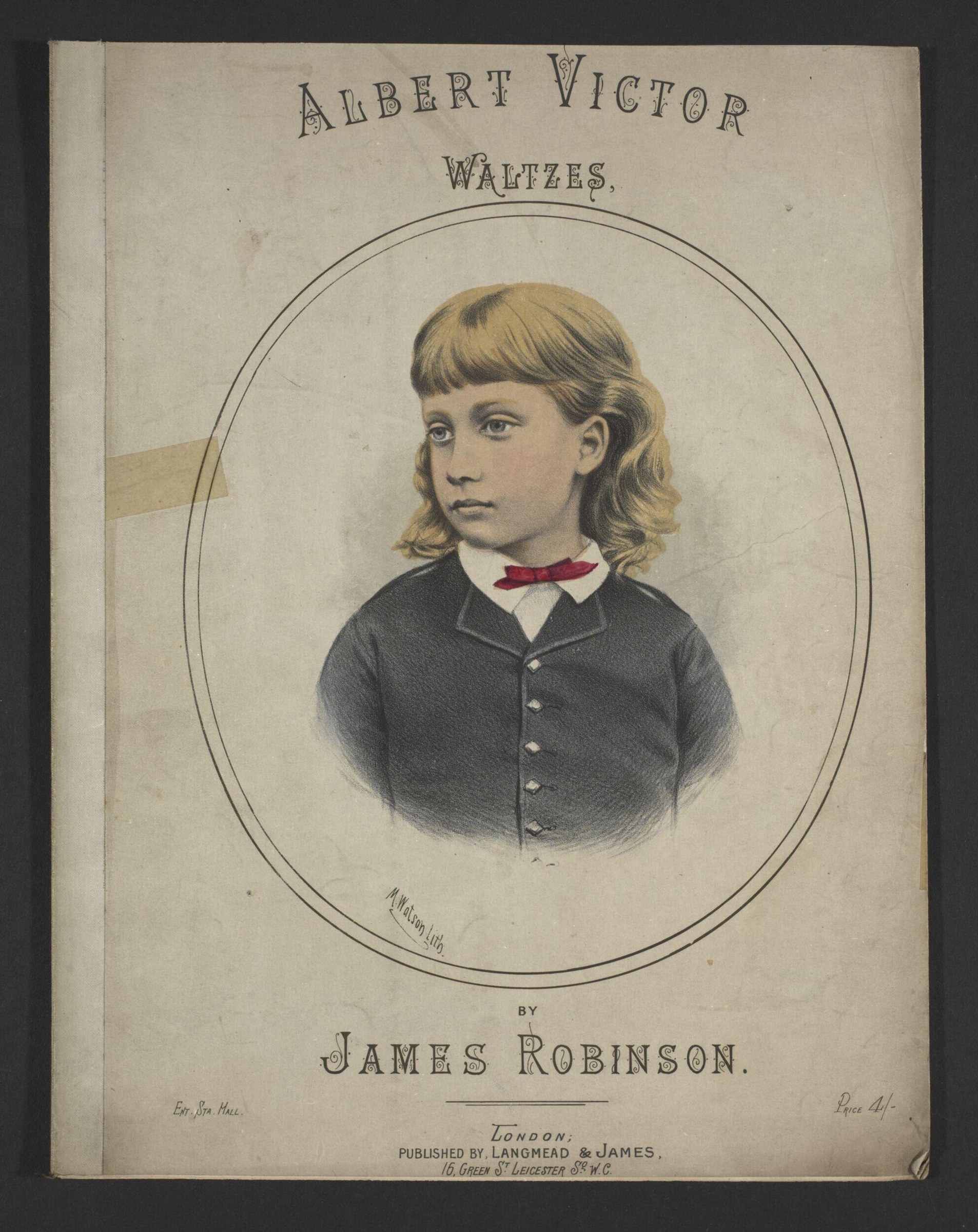
A formal sheet music cover presents a half-length portrait of a young child, probably a boy, rendered in hand-colored engraving. The figure is shown against a plain background within a circular frame defined by a thin ruled line. The child has shoulder-length blonde hair with bangs and wears formal dark clothing—a navy or charcoal jacket or coat with a white collar and white buttons running down the front. A crimson bow tie or ribbon sits at the neck. The engraving displays fine cross-hatching for shading, particularly in the jacket and hair. The oval frame and formal presentation are typical of 19th-century sheet music title pages, which often featured portraits of notable patrons, performers, or subjects to whom a piece was dedicated.
The dancing
The child's pose is static and frontal, head turned slightly to the viewer's right in a three-quarter view. The shoulders are squared and held still within the formal coat. There is no suggestion of movement, gesture, or dance position—this is a formal portrait photograph rendered as an engraving, not a depiction of physical action.
The dance depicted
The title identifies this as the 'Albert Victor Polka,' which confirms the dance form: the polka was a popular ballroom and social dance of the 19th century in duple metre with a characteristic hop-step pattern. However, the image itself contains no depiction of dancing. No couple is shown in hold, no footwork is visible, and the child is posed as a static portrait subject. This appears to be a commemorative or dedicatory sheet music cover—the piece is likely named after or dedicated to the child shown, a common practice of the era, rather than illustrating the polka itself.
How it was made
This is a hand-colored engraving printed from a metal plate, a dominant technology for sheet music covers in the 19th century before lithography became standard. Engraving allowed fine linear detail and could be mass-produced through printing; hand coloring (visible in the hair tones, the red bow tie, and subtle shading) was applied after printing. This technique was economical for editions of several hundred copies and suitable for middle-class circulation. The publisher Langmead & James of London was active mid-to-late 19th century and distributed such sheet music through music retailers.
About this work
This is a sheet music cover for a polka published in London in the 19th century, titled after or dedicated to a young child named Albert Victor. The cover bears a formal engraved and hand-colored portrait of the presumed dedicatee rather than depicting the dance itself. Sheet music covers of the era routinely featured portraits—of composers, patrons, or performers—and served as a form of celebrity endorsement or memorial. The polka was one of the most popular social dances of the Victorian period, originating in Bohemia and reaching English ballrooms and domestic music rooms by mid-century. This work belongs in a dance art gallery not because it depicts dancing, but because it is an artifact of dance's material culture—evidence of how the polka was marketed, circulated, and anchored to social identity.
How to look at it
Examine the engraver's rendering of the child's formal dress and composed expression—the tight cross-hatching of the jacket, the precision of the button work, and the soft modeling of the face all signal serious portraiture, not caricature. The choice to use a tight oval frame, a convention of portrait engraving, elevates the sitter above the merely decorative. Notice that the sheet music title and publisher information are subservient to the portrait; the dance is named for the image, not illustrated by it. This is characteristic of Victorian sheet music marketing, where a recognizable or fashionable face was considered an asset to sales.
The artist
The engraving is signed 'A. Morland' in the lower left. Morland was a commercial engraver active in mid-19th-century London, known for portrait and title-page work for music publishers and book trades. The publisher Langmead & James distributed dance music and theatrical works from their location at 10 Great Pulteney Street, London, and employed a stable of engravers for cover illustration.
The period
The polka reached peak popularity in Britain during the 1840s–1870s. It was imported from Bohemia and was embraced by the English ballroom as a spirited alternative to the waltz and the stately quadrille. Sheet music for polkas proliferated for home performance on piano, and social dancing of polkas was widespread in middle- and upper-class drawing rooms. The 1870s–1880s, when this piece was likely published (based on printing style and publisher dates), represent the polka's consolidation into the repertoire of 'standard' ballroom dances. The dedication or naming of a polka after a child may reflect a family connection to the composer or publisher, or it may be a marketing tactic associating the lively, youthful energy of the polka with actual youth.
Where it lives
The work is held as sheet music in an unspecified collection identified in the record as 'va' (Virginia, likely the University of Virginia or a Virginia institution). Sheet music covers were mass-produced objects and have often survived in libraries and archives in mixed batches, making precise provenance difficult to establish.
Dance in this work
Questions about this work
Why is a portrait of a child on a dance music cover?
Sheet music covers in the 19th century served as advertisement and marketing. Placing a portrait of a notable person—in this case, a young member of an aristocratic or prominent musical family—on the cover lent prestige and celebrity to the piece. The polka was named after or dedicated to Albert Victor, likely to connect the lively dance to his name and status. This practice was common for pieces composed for or commissioned by wealthy families.
What was the polka, and how was it danced?
The polka is a couples' ballroom dance in 2/4 time, originating in Bohemia in the 1830s and reaching its peak popularity in England during the 1840s–1870s. It is characterized by a hop-step pattern and performed in a closed or semi-closed ballroom hold. It was less formal than the waltz and was favored for domestic performance and social events. Dance masters of the period taught it as a standard ballroom figure alongside the quadrille and the galop.
Who was Albert Victor, and why was a polka dedicated to him?
Without additional archival research, the specific identity of Albert Victor cannot be determined from the image alone. He may have been a member of a musical or aristocratic family, or a child of a publisher or composer. The polka was likely composed as a gift or mark of affection, or to commemorate a family connection. The formal presentation and engraved portrait suggest he was of some social significance.
How do we know this is a polka and not another dance?
The title of the sheet music clearly states 'Albert Victor Polka,' and 'polka' is a recognized dance form. The publisher and publication format are consistent with 19th-century polka sheet music issued for home and ballroom use. However, the image itself shows no dancers or choreographic content, so the identification rests entirely on the textual label.
More dance artwork





