49 works in this view — arrow keys or swipe to move between them.
Dance in Art
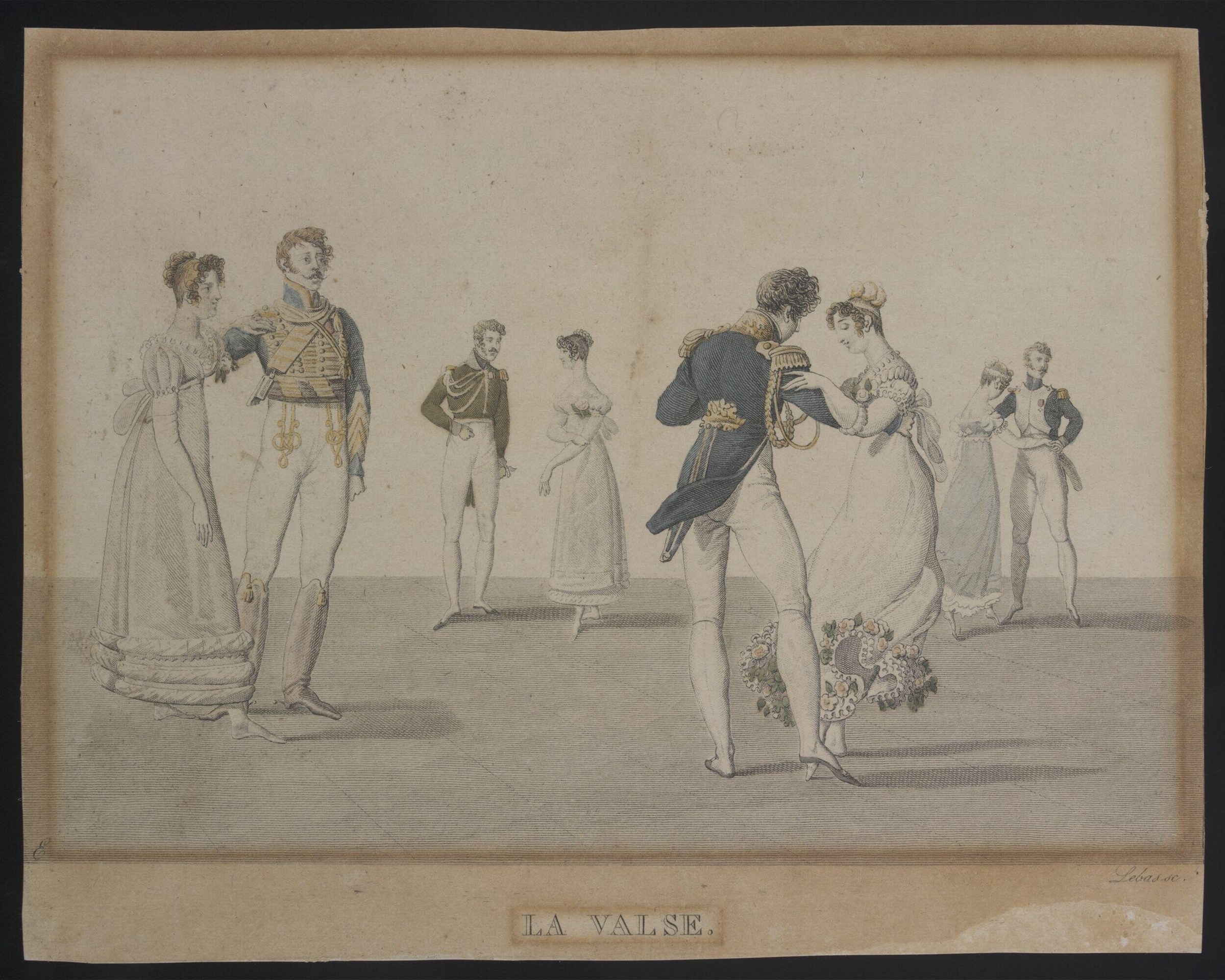
La Valse
Unknown artist
- Collection:
- Source:
- Victoria and Albert Museum
- Rights:
- Rights vary by item — check the source record before reusing this image. Source record ↗
- Recorded as:
- V&A — check rights per item
This print documents the exact moment when the waltz was transforming ballroom dance and facing fierce moral and social resistance. By showing the dance in its proper context—surrounded by onlookers, framed by formal etiquette, and stripped of sensuality—the image argues for the waltz as respectable social practice. For historians, it reveals what the body positions were and how they were meant to be read; for dancers, it shows the formal deportment and spatial relationships that are often lost when only the steps survive in written descriptions.
What you are looking at
A formal ballroom scene rendered in hand-colored engraving, likely early 19th century. A man in dark military dress uniform with gold epaulettes and decorations stands at center-right, bending forward in a respectful gesture toward a woman in a high-waisted white Empire-line gown. Around them, three other couples are arranged across the floor in various attitudes of social interaction: some standing in conversation, others positioned as if mid-dance. The figures are arranged in a shallow, frieze-like composition against a plain background with a baseline indicating the floor. The lighting is even and descriptive rather than dramatic, typical of didactic dance instruction prints of the period. The overall impression is one of formal courtship and refined social dancing, with emphasis on the decorous interaction between the central couple.
The dancing
The central male figure leans forward from the waist in a deep bow or courtly gesture of respect, his posture formal and controlled. The woman receives this gesture with an upright, dignified stance. The other dancers around them adopt various positions: some stand in conversation, others show the characteristic arm positions and vertical carriage of early 19th-century ballroom dance. The figures are slender and elongated in the neoclassical style of the period, with particular attention to the line of the spine and the elevation of the torso. Skirts fall in vertical pleats from the high Empire waistline, and the men's legs are shown in extended, pointed positions characteristic of courtly deportment.
The dance depicted
This print depicts the waltz as it was danced and taught in elite European ballrooms of the early 1800s. The title 'La Valse' makes this explicit. The central moment shows the formal social protocol of the dance: the gentleman's respectful approach and invitation, and the lady's acceptance. The surrounding couples demonstrate the variations of position and interaction that made up the social waltz experience. This is instructional imagery, designed to teach both the steps and the etiquette of waltz dancing to the expanding middle-class dance audience of the period. The waltz was considered a scandalous innovation in some circles because of the closed hold and the man's hand at the woman's waist, and prints like this served to standardize and legitimize the dance's proper execution.
How it was made
This is a hand-colored engraving, a reproductive print technique that allowed for wide circulation of dance instruction and social commentary. The lines are cleanly incised and printed in black, with watercolor or gouache added by hand afterward—note the uneven coverage of the flesh tones and the careful rendering of the military uniform's gold details. This technique was ideal for dance pedagogy: the clean lines make the body positions legible, and the hand-coloring adds the social markers of dress and rank essential to understanding the etiquette of the scene. The print's existence in multiple copies (suggested by the hand-coloring variations typical of the period) indicates it was a commercial product aimed at dance masters, their students, and fashionable society.
About this work
This engraved and hand-colored print depicts the waltz in its early 19th-century form, presenting both the technical and social dimensions of the dance through a carefully composed scene of couples in a ballroom. The waltz was the defining dance of the period, breaking with 18th-century conventions by introducing a closed hold and rapid turning. The image functions simultaneously as instruction manual and social document: it shows how the dance was done and how dancers were expected to behave. The central moment—the gentleman's respectful approach to his partner—captures the ritual of social negotiation that framed the dance itself.
Prints like this circulated widely among the middle classes who were adopting ballroom dancing as a marker of social refinement. They served multiple purposes: teaching newcomers the steps and etiquette, legitimizing the dance in the face of moral objections, and reinforcing class and gender hierarchies through the prescribed formality of the encounter. The work belongs in a dance gallery precisely because it is not primarily an artwork but a cultural artifact that shows how dance was learned, understood, and integrated into social life.
How to look at it
Attend first to the central couple and the formal protocol on display: the man's deep bow and the woman's dignified acceptance establish the social frame within which the dance unfolds. Notice the consistency of posture across all the figures—the vertical alignment of the spine, the controlled arm positions, the elongation of the legs. The arrangement of the couples is not realistic (they are not moving through space in a ballroom line) but diagrammatic: each couple shows a different aspect or moment of the dance or the courtship ritual. The print's value lies not in capturing motion but in freezing and displaying the correct positions and the correct etiquette, making it as much a manual as a picture.
The artist
Unknown. The print was made in the commercial publishing tradition of early 19th-century dance instruction, when such images were produced in workshops by teams of engravers and colorists rather than individual artists. The competent but not exceptional draftsmanship suggests a professional dance master or a specialist in instructional imagery rather than a fine artist. Attribution in such works was often omitted because the image was valued for its informational content rather than as a personal creative vision.
The period
The waltz arrived in Vienna from the countryside in the 1780s and spread rapidly through aristocratic and then middle-class ballrooms across Europe and America in the early 19th century. It was genuinely controversial: critics objected to the speed, the closed embrace, and the way it allowed unrelated men and women to touch. Dance instruction prints proliferated in this period partly to defend the waltz against moral objections and partly to meet the demand from newly wealthy middle-class dancers who wanted access to the same skills as the aristocracy. By the 1820s-1830s, when this print was likely made, the waltz had largely won acceptance, though prints remained a crucial tool for teaching and standardizing technique across different regions and social classes.
Where it lives
Held as a print in a collection designated 'va' in the source record. The work's survival in a print collection, and the careful hand-coloring, suggest it was valued and preserved as both an instructional document and a record of contemporary social practice.
Dance in this work
Questions about this work
Was the waltz actually this formal and stiff?
In public ballrooms, yes—at least in appearance. Instructional prints emphasized correct posture and propriety to counter moral objections to the dance. The actual movement was faster and more energetic than this image suggests, but the formal bearing and the careful etiquette were essential. Private accounts show more informality and even humor, but in public, especially in middle-class contexts, the formality depicted here was the ideal.
Why does the man bow to the woman like that?
This shows the invitation and acceptance ritual that preceded each dance. The gentleman approached, bowed, and offered his hand; the lady accepted by taking it or curtseying. This formal protocol made clear that the dance was a negotiated social interaction, not an automatic entitlement, which was important to the social legitimacy of a dance that involved close physical contact.
What is this print for? Is it art or instruction?
Both. It served as a teaching tool for dance masters and students, but it was also a souvenir of fashionable society and a record of contemporary taste. Prints like this circulated in dance studios, in fashionable drawing rooms, and in homes of people learning to dance. They were art for a specific purpose and audience, not fine art, but that distinction did not exist as sharply then as it does now.
More dance artwork





