49 works in this view — arrow keys or swipe to move between them.
Dance in Art
The Swedish Nightingale Walz
Jullien
- Collection:
- Music sheet
- Source:
- Victoria and Albert Museum
- Rights:
- Rights vary by item — check the source record before reusing this image. Source record ↗
- Recorded as:
- V&A — check rights per item
This work is significant as a primary document of nineteenth-century ballroom culture and music commerce: it shows how waltz music reached amateur dancers, how performers were marketed through visual celebrity, and how dance music was packaged for home consumption during the peak era of the waltz's popularity.
What you are looking at
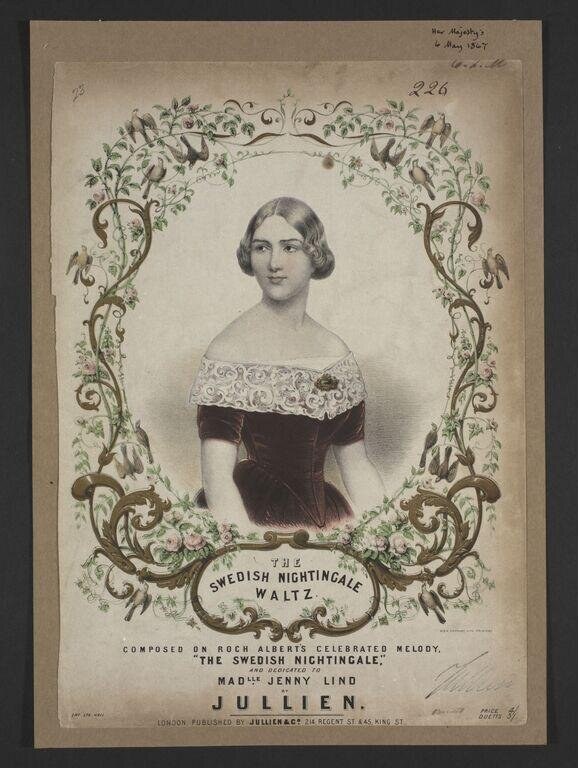
This is the cover sheet of a musical composition titled *The Swedish Nightingale Waltz*, a decorative music publication featuring a portrait of the performer framed by an elaborate ornamental border. The sitter, identified as Mademoiselle Jenny Lind, occupies the center of the composition in a three-quarter view bust portrait. She wears an off-shoulder dress with a fitted bodice in dark velvet or similar fabric and a white lace chemisette or bertha across the shoulders and neckline. Her hair is parted in the center and arranged in the mid-nineteenth-century style of waves and loops over the ears. The ornamental frame surrounding her portrait is rendered in brown and gold tones with naturalistic botanical detail—climbing vines with leaves and small flowers forming a cartouche border—characteristic of mid-Victorian commercial print design. The composition is symmetrical and formal, with the portrait positioned as if on display. Below the portrait, a decorative cartouche contains the title, and further below are publication details naming the composer (Jullien) and the performer (Jenny Lind), establishing this as a commercial music sheet intended for domestic performance.
The dancing
The portrait shows a single figure in a frontal, static pose—a three-quarter bust without visible full body or any indication of movement. There is no depiction of dance posture, hold, frame, weight distribution, or footwork. The figure is seated or positioned at rest, facing the viewer with a serene expression. This is a commemorative portrait of a performer rather than a representation of her performing.
The dance depicted
While the composition celebrates Jenny Lind, one of the most celebrated vocalists of the nineteenth century, and the work is titled as a waltz composition, the image itself does not depict dance. The portrait is static and commemorative. The waltz was a fashionable ballroom dance of the period, and this sheet music would have been intended for ballroom or domestic social dancing, but the visual content here is the performer's likeness rather than a scene of the dance itself.
How it was made
This is a hand-colored lithograph or chromolithograph, a process that allowed for rapid commercial reproduction of color images on sheet music covers. The careful gradation of tones in the portrait—the soft modeling of the face, the precise rendering of fabric textures, and the decorative botanical detail—is characteristic of chromolithographic technique. The multiple stone or plate layers required for color separation made this a relatively expensive production, indicating circulation among middle-class households with the means and inclination to purchase and perform published music.
About this work
This is a sheet music cover commemorating Jenny Lind, the Swedish singer renowned across Europe and America, paired with a waltz composition by Jullien. The work belongs in a dance archive as evidence of how ballroom dance music circulated in the nineteenth-century music market and as a document of a celebrated performer whose name was invoked to market dance compositions to domestic musicians. The image demonstrates the cultural prestige of the waltz in this period and the use of celebrity portraiture in music publication marketing.
How to look at it
Look at the careful framing device—how the ornamental border elevates the portrait and separates the image of the performer from the commercial text below. Notice the absence of any dancing body or ballroom setting; this is a portrait, not a narrative scene. The static pose and dignified demeanor align with nineteenth-century conventions of celebrity portraiture. The work presents the waltz not through visual depiction of movement but through the association of an admired performer's name with a fashionable musical form.
The artist
Jullien (Louis-Antoine Jullien, 1812–1860) was a French conductor, composer, and dance music entrepreneur. He was prolific in composing waltzes, quadrilles, and other fashionable ballroom dances for publication and performance in concert settings. He wrote dance music under his own name and occasionally for commercial purposes, including compositions tied to celebrity names or topical events. This waltz exemplifies his commercial music production for the popular ballroom market.
The period
This sheet music dates from the mid-nineteenth century, the height of the waltz's social and commercial dominance in European ballrooms and domestic music-making. The 1840s–1860s saw unprecedented circulation of waltz compositions in print, both in concert arrangements and in simplified versions for amateur domestic performance. Jenny Lind's international fame following her European tours and her 1850–1852 American tour would have made her name a valuable commodity in music marketing. The decorative lithographic production of sheet music covers reflects expanding middle-class leisure and musical consumption in this period.
Where it lives
This is a sheet music cover held in the British Library, a commercial music publication produced in London by J. Jullien & Co., establishing it as a mass-market publication intended for sale to domestic musicians and dancers across the English-speaking market.
Questions about this work
Did Jenny Lind dance the waltz?
Jenny Lind was primarily celebrated as a vocalist, not a dancer. This composition uses her name and portrait to market a waltz to music consumers—a common commercial practice of the period. The portrait suggests the visual appeal and celebrity status that might motivate a buyer, but it does not document any dancing performance.
Who would have bought and played this music?
Middle-class amateur musicians and dancers in households with access to published music and the skill to perform it. Sheet music was distributed through music sellers and imported to English-speaking markets. The simplified arrangement and decorative presentation suggest an audience of domestic social dancers rather than concert musicians.
Why is Jenny Lind's portrait on a waltz when she was a singer?
Celebrity names and portraits were used commercially to market sheet music in the nineteenth century, regardless of whether the named performer actually danced or was involved in the composition. Lind's international fame and visual recognition made her a valuable marketing asset for music publishers.
More dance artwork





