49 works in this view — arrow keys or swipe to move between them.
Dance in Art
Inez (The Love Token)
Edwin H. Prout
- Collection:
- Music
- Source:
- Victoria and Albert Museum
- Rights:
- Rights vary by item — check the source record before reusing this image. Source record ↗
- Recorded as:
- V&A — check rights per item
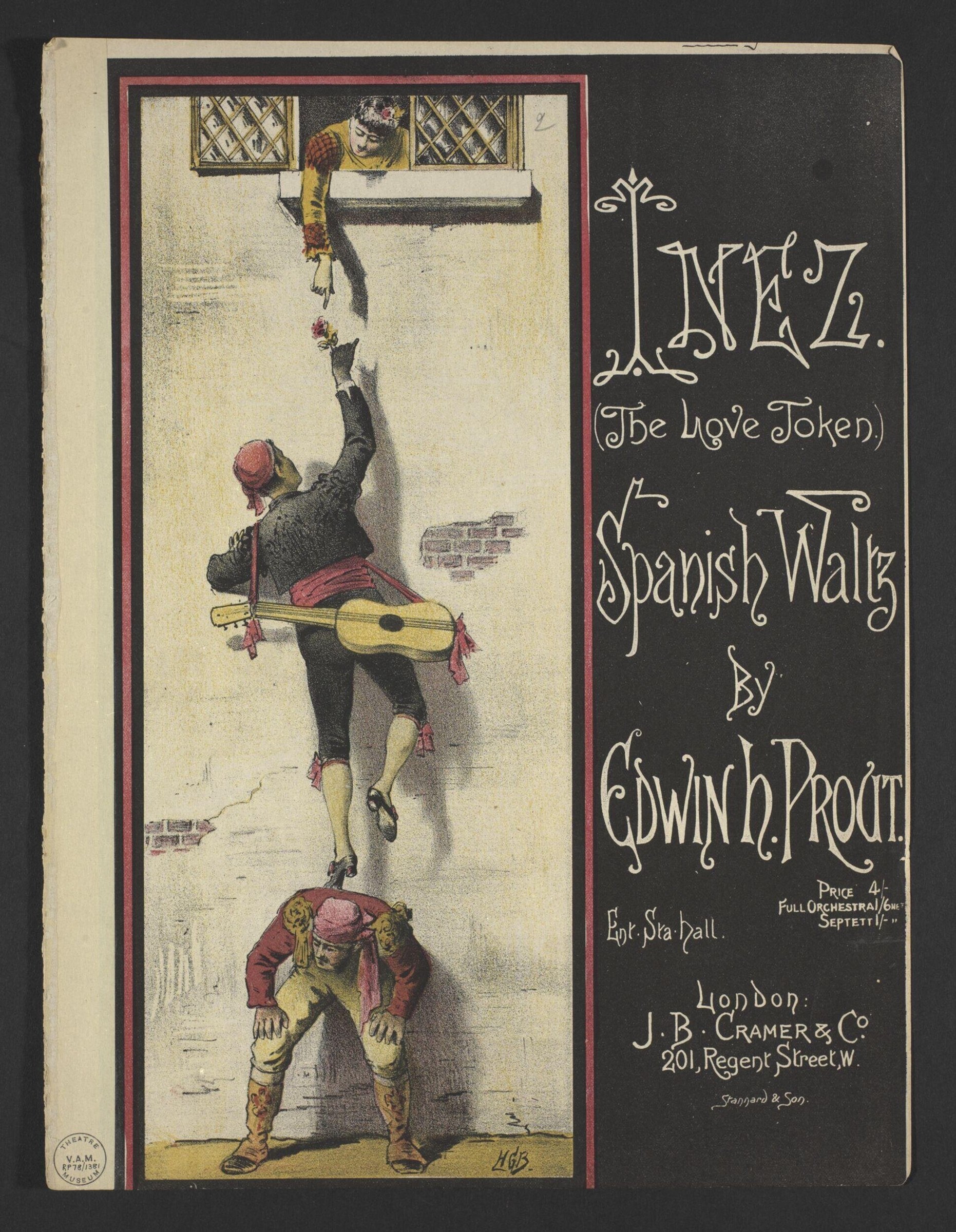
This image is evidence of how the waltz functioned in Victorian culture not merely as a dance but as a vehicle for narrative and sentiment. It shows the theatrical apparatus and courtship scenarios that made instrumental dance music commercially appealing to domestic audiences who may never have danced it formally. For historians of dance as social practice, it reveals the gap between ballroom technique and the fantasies of romance the waltz could be made to serve.
What you are looking at
A Spanish guitarist serenades his beloved at a window high above the street. The woman leans from a latticed window in a cream-coloured wall, her upper body visible as she receives a flower or token from below. The man stands in the street dressed in dark clothing with a red sash, his guitar held across his body, his posture one of ardent address—weight forward, one arm raised toward the window. A third figure crouches low in the foreground, also in red and dark dress, perhaps a servant or companion. The composition is vertical and theatrical: the window frames the woman at the top, the guitarist occupies the middle distance, and the crouching figure anchors the lower register. Warm cream and buff tones dominate, with strong reds in the clothing and deep shadows defining the architecture. The scene is intimate yet public, staged as a moment of romantic declaration caught mid-gesture.
The dancing
The guitarist's stance is one of performing address rather than partnered dance: weight forward, torso angled upward, one arm extended in supplication or presentation. His posture is that of a suitor in a serenade, not a dancer in closed hold or frame. The woman at the window is static, receiving rather than moving. The crouching figure's role is unclear but appears subsidiary. This is gestural theatre of courtship rather than ballroom or folk dance technique—the body positions are expressive and narrative rather than technical.
The dance depicted
This is not a depiction of dance per se, but of the theatrical gesture and courtship ritual associated with Spanish serenading tradition—a close cousin to the dramatic scenarios of operatic and theatrical music. The 'Spanish Waltz' subtitle suggests this is a musical composition accompanying or illustrating such a scene rather than a record of actual dancing. The image shows the romantic tableau that would have framed such music in Victorian entertainment, where the waltz was increasingly used as a vehicle for sentimental narrative. No actual waltz movement is visible; instead, the work documents the scenario—the street below, the window above, the lover's supplication—that gave emotional context to the music.
How it was made
This is a colour lithograph, recognisable from the chalk-drawn quality of line, the flat planes of colour, and the hand-tinted appearance of the reds and flesh tones. The technique allowed for mass production of theatrical music covers and novelty prints in the late 19th century. The signature 'L.465' and publisher mark (J.B. Cramer & Co., London) identify this as a commercial print—a music cover or cover art intended for distribution to amateur musicians and drawing-room audiences. Lithography's capacity for fine detail in line work and colour tinting made it ideal for such covers, which needed to be both visually appealing and economical to produce in quantity.
About this work
This is a coloured lithographic music cover for 'Inez (The Love Token): A Spanish Waltz' by Edwin H. Prout, published by J.B. Cramer & Co. of London. It documents not dance technique but the theatrical romantic scenario that framed sentimental instrumental music in the Victorian drawing room. The 'Spanish Waltz' was a popular genre of novelty dance music, and Prout's cover illustrates the dramatic premise—a nocturnal serenade, a lover's token delivered to a window—rather than the music's actual choreography or movement. The work belongs to the history of theatrical music and domestic performance culture, showing what kind of romance the waltz could be made to express when music and image worked together.
How to look at it
Attend first to the composition's verticality and the window as the focal point: this is the architecture of romantic desire, not a dance floor. Note the guitarist's raised arm and forward lean—these are the gestures of theatrical address, the vocabulary of operatic or stage romance, not the measured frame and hold of a formal waltz. The red clothing and shadows create drama and specificity of place (Spanish setting, nocturnal). The image captures not a moment of dance movement but a frozen tableau vivant—the kind of still, dramatic moment that would be held for effect in a stage performance. This is how the waltz was visualised when it served romance rather than technique.
The artist
Edwin H. Prout was a prolific composer and arranger of light instrumental music in late Victorian England, working primarily in the tradition of salon music and novelty dances. His works were published by Cramer, one of London's leading music publishers, and distributed to amateur pianists and drawing-room musicians. Prout specialised in descriptive or narrative instrumental pieces—waltzes, galops, and character dances with evocative titles and printed covers that told a story. His practice was typical of the commercial music trade in the 1870s–1890s, when the ability to give a piece visual and narrative context (through a printed cover image) was as important to its marketability as its musical content.
The period
In the late 19th century, the waltz had become the dominant social dance of the drawing room and the ballroom, but it had also become a vehicle for theatrical and narrative fantasy. Composers filled the market with descriptive waltzes—'The Dream Waltz,' 'The Parisian Waltz,' 'Tales from the Vienna Woods'—each with a printed cover that invited the listener to imagine a scene. The Spanish Waltz and the serenade scenario were particularly popular, reflecting Victorian fascination with picturesque European settings and romantic melodrama. At the same time, chromolithographic printing was making illustrated music covers cheap and ubiquitous, turning every piece into a small theatrical moment. This convergence of music, image, and domestic performance created a new kind of audience: people who owned the music, studied it at home, and experienced dance and narrative together through print.
Where it lives
This is a printed music cover from the catalogue of J.B. Cramer & Co., a major London music publisher. It is held in a music collection, suggesting its primary role as commercial sheet music rather than fine art. The work belongs to the vast archive of Victorian amateur music culture—the songs, waltzes, and salon pieces that filled drawing rooms and parlours across the English-speaking world.
Questions about this work
Is this actually a waltz, or is the title misleading?
The title refers to the musical composition, which would have been in waltz metre and rhythm. The image, however, illustrates the romantic scenario accompanying the music rather than the dance itself. Printed music covers in this era often prioritised narrative appeal over accuracy to actual dance movement. A performer learning this waltz would have consulted the notation, not the cover image.
Why is the scene set as a serenade rather than a ballroom dance?
The serenade was a popular literary and operatic motif in the 19th century, associated with passionate, transgressive love—a man outside the law or society's bounds expressing desire. By framing the waltz as a serenade, Prout's cover invited Victorian listeners to experience the dance as an expression of romantic feeling rather than social propriety. It glamorised the waltz by giving it narrative weight.
What does 'The Love Token' refer to?
The flower or object being passed between the guitarist and the woman at the window—a tangible token of affection. In romantic theatre of the period, such tokens were plot devices signifying the exchange of feeling, promises, or secrets. It gives the serenade a specific dramatic moment: not just the declaration of love through music, but the exchange of a physical object.
More dance artwork





