49 works in this view — arrow keys or swipe to move between them.
Dance in Art
The Music Box Show
Kingman, Tod
- Collection:
- Set design
- Source:
- Victoria and Albert Museum
- Rights:
- Rights vary by item — check the source record before reusing this image. Source record ↗
- Recorded as:
- V&A — check rights per item
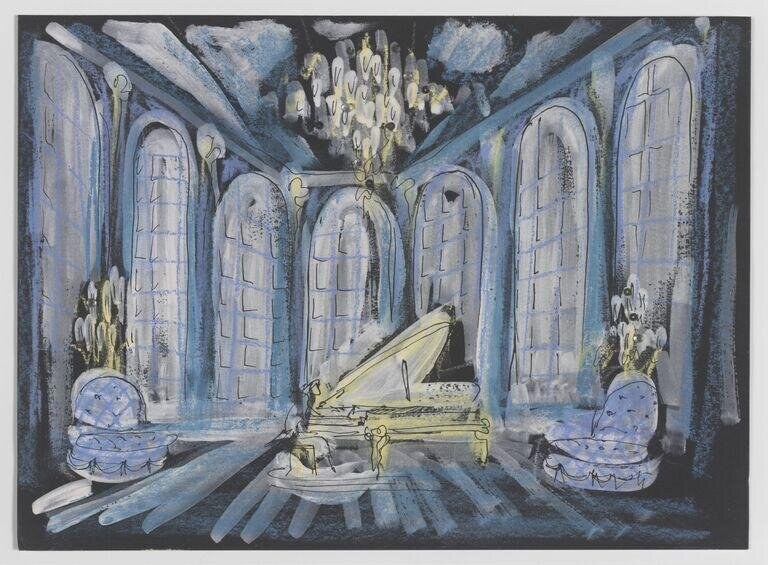
Set designs are primary sources for understanding how dance and theater were staged, lit, and framed for audiences in a given era. This work shows the sophisticated visual vocabulary of American theatrical design in 1960 and demonstrates how the performance space itself was conceived as a work of design—the grand piano, chandelier, and architectural surround create a mise-en-scène that influences how any performer or dancer inhabits it.
What you are looking at
A grand interior space rendered in cool blues and purples, dominated by a pale yellow grand piano positioned center stage. The room is defined by towering arched windows with geometric patterning that recedes into atmospheric perspective, suggesting architectural grandeur. A massive tiered crystal chandelier hangs from a coffered ceiling, casting warm light downward. Two upholstered chairs or seats flank the piano symmetrically, their details soft and luminous. The floor is marked by bold linear perspective lines converging toward the piano, emphasizing the depth and formality of the space. The overall palette and geometric precision suggest a theatrical set design rather than a naturalistic interior—the space is simplified, stylized, and composed for visual impact from a distance.
The dancing
No human figures or dancers are visible in this composition. The work is entirely architectural and decorative, focused on the spatial envelope and the piano as a central object. The absence of performers is notable for a work titled to evoke spectacle and performance.
The dance depicted
This is a set design rather than a depiction of dance in motion. The work documents the visual and spatial context for a theatrical performance—likely a musical revue or variety show—but does not show dancers or choreography. The title *The Music Box Show* suggests a theatrical production, possibly drawing on the novelty and mechanical elegance of music box aesthetics. No specific dance style can be identified from the image.
How it was made
The work appears to be a mixed-media theatrical design, possibly gouache, watercolor, or tempera on paper with charcoal or graphite underdrawing. The technique emphasizes bold linear perspective and atmospheric color gradation—cooler tones receding, warm highlights on the piano and chandelier creating focal points. This method of rendition is characteristic of mid-twentieth-century American theatrical design documentation, produced for production planning and archival purposes rather than as a finished artwork for exhibition.
About this work
This is a set design by Tod Kingman for *The Music Box Show* (1960), a Broadway or touring theatrical production. The work documents an elegant interior space conceived for a musical or variety performance. Set design is an essential but often overlooked dimension of dance presentation: the spatial frame, lighting architecture, and decorative vocabulary shape how choreography is perceived and experienced. This design demonstrates the designer's grasp of geometric harmony, atmospheric depth, and the symbolic weight of luxury and spectacle—elements that frame a performance whether or not dance is the primary medium.
How to look at it
Trace the linear perspective lines converging toward the piano to understand how the space is organized to draw the eye and the body toward the stage's visual center. Note how the cool palette of the walls and floor is interrupted by warm highlights on the piano and chandelier, creating zones of visual attention. The symmetry of the flanking chairs and the regularity of the arched windows emphasize formal balance—a spatial order that any performer must work within or against. The design is conceived for visibility and formal elegance rather than intimacy.
The artist
Tod Kingman was an American theatrical designer working in the mid-twentieth century, known for set and lighting design for Broadway and touring productions. His work exemplified the geometric abstraction and atmospheric refinement characteristic of 1950s–60s American theater design, balancing geometric clarity with decorative richness. Designers of his generation bridged earlier ornamental traditions and modernist reduction.
The period
In 1960, American theatrical design was marked by a tension between geometric modernism and glamorous spectacle. The postwar era saw increased technical sophistication in lighting and materials, allowing designers to create more ambitious atmospheric effects. Simultaneously, Broadway was dominated by musical theater and revue formats in which dance was integral to the spectacle. The cool, refined palette of this design reflects period taste for elegant minimalism within a framework of luxury.
Where it lives
This work is held as a set design within a theatrical archive or design collection. It documents a specific production and serves as a record of how theatrical space was conceived and rendered for mid-twentieth-century American musical theater.
Questions about this work
Is this a painting or a design document?
This is a theatrical set design—a design document produced for production planning and archival purposes. It is rendered with the techniques of painting (color, composition, perspective) but serves the practical function of communicating spatial, decorative, and lighting ideas to a production team. Such designs were working tools as well as records.
Why is there no dancer in this image?
The work documents the performance space itself rather than the performance. The designer's task was to create an architectural and decorative frame for the theatrical action. Dancers or actors would occupy this space during the actual production; the design shows the stage itself.
What does 'The Music Box Show' refer to?
The title likely refers to a theatrical revue or musical production, possibly drawing on the novelty appeal of music box imagery—mechanical, jeweled, miniature-like. The elegant and symmetrical design reflects that aesthetic of compact, refined, mechanically perfect beauty.
More dance artwork





