49 works in this view — arrow keys or swipe to move between them.
Dance in Art
The Guards Waltz
Coote, Charles
- Collection:
- Sheet Music
- Source:
- Victoria and Albert Museum
- Rights:
- Rights vary by item — check the source record before reusing this image. Source record ↗
- Recorded as:
- V&A — check rights per item
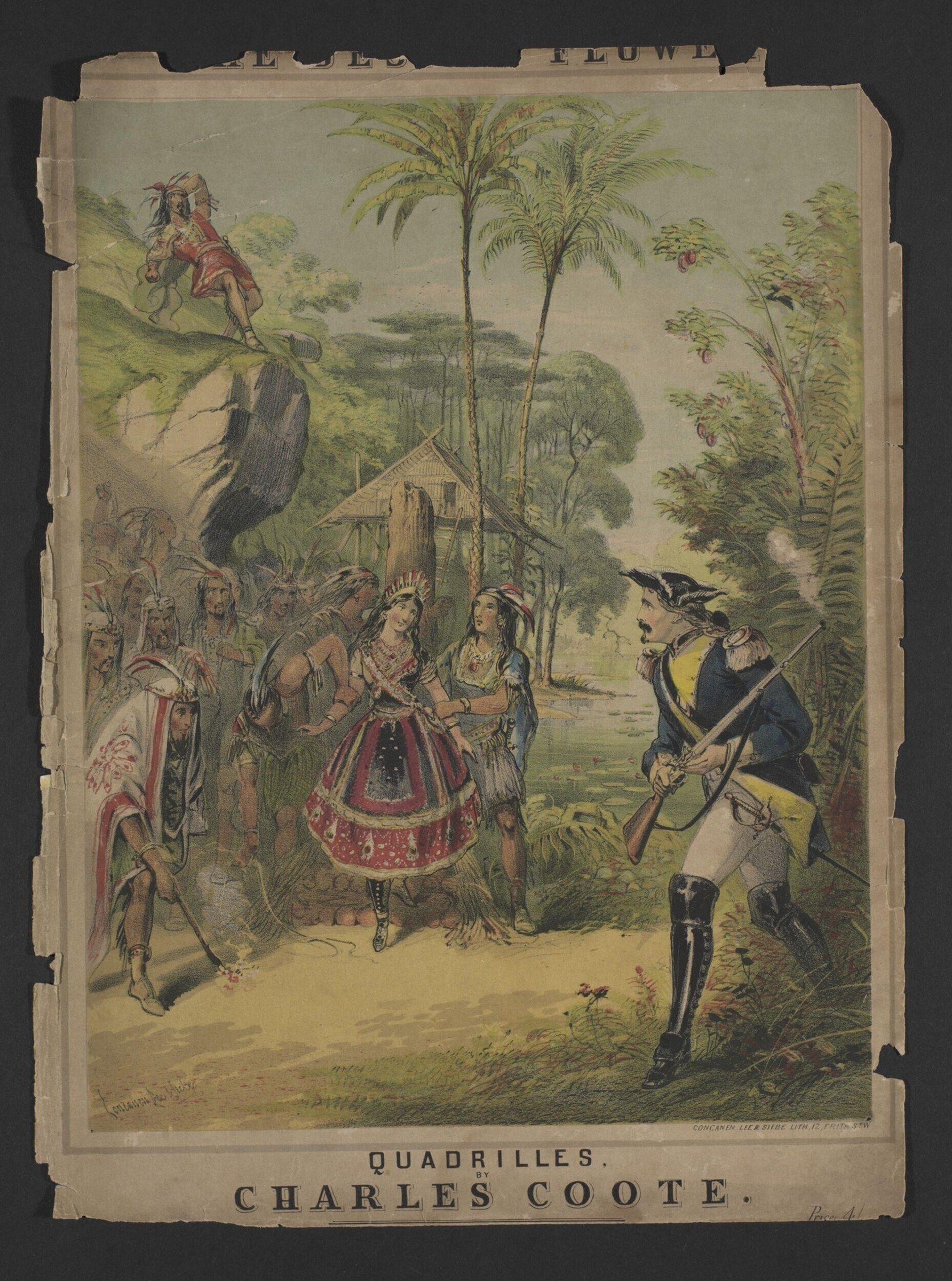
The work is valuable precisely because it reveals the gap between what dance titles promised (a fashionable European ballroom form) and what colonial imagery actually contained. It documents how dance music and ballroom culture were entangled with narratives of empire and encounter in 19th-century popular culture, even when no actual dancing appears on the page.
What you are looking at
A European military officer in the right foreground gestures toward a group of Indigenous people in the left and center of the composition. The officer wears a dark uniform with yellow collar and cuffs, bicorne hat, and sword; his pose is animated, suggesting command or invitation. Opposite him stand several Indigenous figures in elaborately decorated dress—the central woman wears a red skirt with ornate patterning and feathered headdress, flanked by other women and men in vibrant traditional clothing. A palm-thatched settlement with tall palms rises behind them. The landscape is lush and tropical, rendered in soft greens and yellows. A figure on a high rock or outcrop watches from the upper left. The moment captured appears to be one of encounter or negotiation, with the officer's gesture dominating the composition.
The dancing
The officer stands in contrapposto weight distribution, one arm extended toward the Indigenous group in an open, authoritative gesture. The central Indigenous woman faces the officer, her body upright and frontal, with her arms held loosely at her sides—a posture of presence rather than active movement. The surrounding figures cluster in informal groupings, some facing the officer, others oriented to their companions. Their bodies are at rest or in gentle standing positions; there is no suggestion of the rapid footwork or held partnering frames of European ballroom dance.
The dance depicted
Despite the title *The Guards Waltz*, the image does not depict waltz or ballroom dancing in any recognizable form. The Indigenous figures wear clothing and adornment consistent with early colonial depictions of Caribbean or Amazonian peoples, and they stand or move naturally rather than in ballroom hold or closed partnering. The work appears instead to document—or romanticize—a moment of encounter between European military and Indigenous communities. If any social dancing is intended, it is not the quadrille or waltz suggested by the title, and no choreographic movement is visible.
How it was made
The work is a hand-colored lithograph or engraving, executed with fine line work and selective coloring in watercolor or hand tint. The detail suggests a mid-19th-century European production, likely aimed at popular audiences as sheet music cover art or an illustrated publication. The technique allowed wide circulation of images of colonial encounter and military life. The precision of the uniforms and the softer, romanticized rendering of the landscape and Indigenous figures are typical of commercial illustration of the period.
About this work
This work is titled as a waltz—a fashionable ballroom dance of 19th-century Europe—but its actual subject is a scene of colonial encounter between a European military officer and Indigenous peoples in a tropical setting. The contradiction between title and content is striking and unresolved. The image may be a cover or illustration for a musical composition titled *The Guards Waltz* that was inspired by or associated with colonial narratives, or the title may have been misapplied. As a dance image, it fails to depict recognizable ballroom or Indigenous dance practices; it records instead a moment of social and military power relations frozen in a moment of gesture and presence.
How to look at it
Attend to the stark contrast between the title and the image: the work is named for one of Europe's most formal partner dances, yet depicts standing figures in no ballroom hold and no visible movement. Notice how the officer's gesture and uniform dominate the composition, positioning European military authority as the focal point, while the Indigenous figures—despite their vivid dress—occupy a subordinate, receptive visual role. The palm trees and tropical setting mark this as colonial imagery; the waltz in the title is a marker of European cultural prestige. The work illustrates how dance titles functioned in 19th-century print culture: less to describe actual movement than to signal fashion, refinement, and connection to metropolitan European culture.
The artist
Charles Coote was a 19th-century illustrator and engraver active in European print culture. The style and execution suggest professional commercial production, likely for London or continental publishers. Little is recorded of Coote's practice or biography in readily available sources.
The period
The waltz rose to fashionable prominence in European ballrooms in the early 19th century, particularly in Vienna and London, becoming associated with military officers and court circles. Simultaneously, European colonial expansion produced a flood of illustrated narratives of encounter with Indigenous peoples in the Caribbean, South America, and Pacific. The romanticized "tropical" imagery and military dress in this print are typical of popular illustrated publications of the 1830s–1860s, which often paired exotic colonial subjects with European cultural forms (including dance) in their titles.
Where it lives
The work is held as sheet music by the Library of Congress or similar institutional collection (indicated by the source marking 'va'). It appears to be a printed cover, illustration, or title page associated with a musical composition, rather than a fine art print. The printing mark visible at the bottom suggests professional commercial production and wide distribution.
Questions about this work
Is this actually a dance scene?
Not in the sense of showing ballroom or choreographed movement. It is a scene of encounter between a European military officer and Indigenous peoples, frozen in a moment of gesture and address. The title *The Guards Waltz* refers to the musical composition the print illustrates, not to movement visible in the image. It is a useful example of how dance titles in 19th-century print culture often reflected aspirations to metropolitan fashion rather than actual choreographic practice.
What dance style is this?
The work does not depict recognizable waltz technique, ballroom partnering, or Indigenous social dance. It records a colonial encounter. If it accompanied a musical waltz (a likely scenario for sheet music), the music would be understood as European ballroom form, but the print illustrates narrative and encounter rather than dance itself.
Who was Charles Coote?
A 19th-century illustrator and engraver whose practice is not well documented in readily available sources. The style and technique suggest professional commercial production for popular audiences, likely in London or continental Europe during the mid-1800s.
More dance artwork





