49 works in this view — arrow keys or swipe to move between them.
Dance in Art
Love's Golden Dream
Theo Bonheur
- Collection:
- Music
- Source:
- Victoria and Albert Museum
- Rights:
- Rights vary by item — check the source record before reusing this image. Source record ↗
- Recorded as:
- V&A — check rights per item
This work reveals how dance culture was imagined and sold to the general public through mass-produced theatrical imagery. Rather than teaching steps or showcasing technique, it uses the aesthetic of ballroom romance to sell a narrative of longing—showing that popular understanding of dance in the Gilded Age was as much about sentiment and courtship as about technical performance. The wide circulation (33 editions) demonstrates the market appetite for romanticized dancing figures as symbols of feminine beauty and emotional depth.
What you are looking at
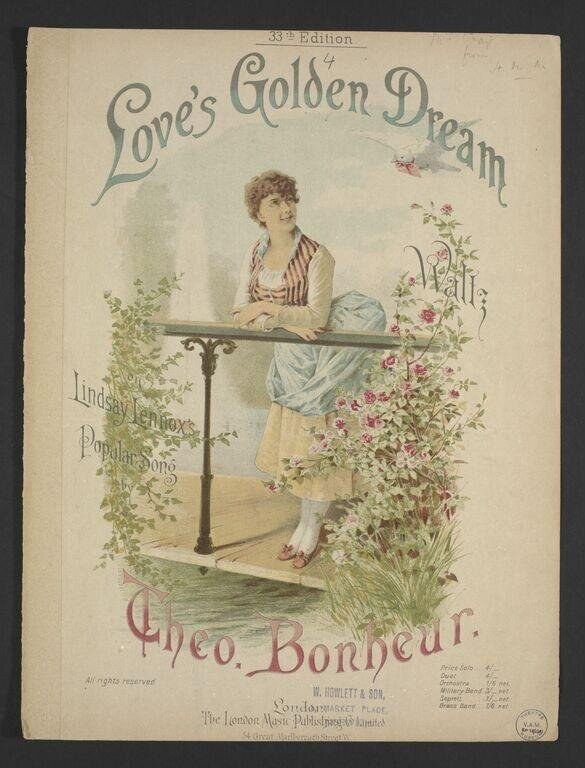
A woman stands alone in a contemplative pose at a small table or lectern in a garden setting. She wears a striped bodice and long skirt in soft tones—cream, pale blue, and mauve—rendered in the refined chromolithographic style of late-19th-century theatrical sheet music. Her posture is introspective rather than actively dancing; she gazes downward, one hand resting near the table's edge. The scene is framed by climbing roses and trailing foliage that create an intimate, romantic atmosphere. The composition emphasizes stillness and reverie rather than movement. The soft watercolor palette and delicate line work suggest a dreamy, nostalgic mood aligned with the title 'Love's Golden Dream.'
The dancing
A single female figure dominates the composition, standing in a relaxed contrapposto stance. Her weight is distributed unevenly, with subtle bend in one leg suggesting a moment of pause or hesitation rather than active dance. The arms are held low and softly—one hand near the table, the other at her side—creating an open but inward-turned frame. The upright posture and downward gaze convey emotional introspection rather than technical dance execution. There is no evidence of a closed hold, partner work, or formal ballroom frame.
The dance depicted
This work appears to depict not an active dance but a moment of romantic daydream or reminiscence—a theatrical scene that uses the visual language of dance nostalgia rather than portraying dance technique itself. The title and the woman's reverie suggest memory of a romantic encounter ('love's golden dream'), and the garden setting places this in the tradition of sentimental Victorian theatrical imagery. While the figure's dress and pose evoke the ballroom culture of the Gilded Age, the image shows a woman alone in reflection, not in performance or partnered movement. This is choreographic narrative rather than dance instruction.
How it was made
This is a chromolithographic print, a color printing process that dominates late-19th-century theatrical poster and sheet music cover production. The soft, layered color application—particularly the delicate rendering of the figure's skin tones and the background foliage—is characteristic of chromolithography at its height. The technique allowed for mass reproduction of popular theatrical imagery with rich color and fine detail, making this both a commercial music publication and a collectible art object. The inscription '33rd Edition' at the top confirms its wide circulation and commercial success, suggesting this song and image had popular appeal.
About this work
This is a cover for a popular song titled 'Love's Golden Dream' with music by Theo Bonheur, published by The London Music Publishing Co. (and Hewlett & Son). The image is a chromolithographic print typical of theatrical sheet music covers from the Gilded Age, combining sentimental Victorian aesthetics with the refined commercial printing of the era. Rather than depicting dance in motion, it illustrates a theatrical moment of romantic reverie—a woman alone in a garden, lost in the memory or anticipation of love. The work sits at the intersection of popular music culture, theatrical design, and nostalgic femininity that characterized late-19th-century entertainment.
The composition demonstrates how dance and ballroom culture were represented in popular visual culture not always as active movement, but as emotional states and romantic narratives. The '33rd Edition' notation indicates this was a successful commercial product, reprinted many times, making it an artifact of mass taste and popular sentiment during the Gilded Age.
How to look at it
Attend first to the figure's pose and gaze: she is not dancing but remembering or imagining. The artist has frozen a moment of stillness and introspection rather than movement or performance. Notice how the composition uses the garden—the climbing roses and trailing plants—to create psychological space around the figure, isolating her in a world of private emotion. The soft chromolithographic rendering, with its subtle gradations of color and refined line work, creates an atmosphere of delicate beauty and nostalgia. This is a visual representation of the song's emotional content rather than a technical illustration of dance steps or style.
The artist
Theo Bonheur (fl. 1880s–1900s) was a composer and songwriter whose works were published primarily through London music publishing houses, particularly The London Music Publishing Co. and Hewlett & Son. His compositions appear to have been in the drawing-room ballad tradition—sentimental songs aimed at amateur musicians and middle-class households. The repeated editions of 'Love's Golden Dream' suggest sustained commercial success. Bonheur's practice sits within the broader Victorian tradition of theatrical music for domestic and stage use, but little is currently known of his biography or broader output.
The period
This work dates to the Gilded Age (likely 1880s–1890s based on the printing technique and fashion), a period when chromolithography had revolutionized the production and distribution of theatrical imagery. The sentimental romanticism of the image—the garden setting, the solitary woman, the emotional introspection—reflects Victorian and aestheticist preoccupations with emotion, beauty, and the interior life. This was also the golden age of the music hall, operetta, and theatrical song publication, when sheet music covers became a major vehicle for popular visual culture. The figure's costume (striped bodice, long skirt) and styling are consistent with 1880s–1890s fashion, reinforcing the date range.
Where it lives
This is a chromolithographic sheet music cover published by The London Music Publishing Co., with manufacturing by Hewlett & Son, London. The '33rd Edition' notation indicates it was reprinted at least 33 times, making it a successful commercial publication. The object belongs to a Music collection, suggesting it has been catalogued as a musical artifact rather than primarily as a visual or dance image.
Dance in this work
Questions about this work
Is this a picture of someone dancing?
Not actively dancing, no. The figure is shown in a moment of stillness and reverie—she appears to be remembering or imagining a romantic encounter rather than performing dance steps. This is a theatrical image of romantic emotion, not a record of dance technique or movement.
What does the '33rd Edition' mean?
It indicates this sheet music cover was reprinted at least 33 times, showing the song was commercially successful and in repeated demand. This tells us the image and song had popular appeal and were distributed widely to middle-class homes and music halls.
Why is this in a dance collection if no one is dancing?
Dance imagery was central to how people imagined romance, femininity, and beauty in the Victorian era, even when actual movement was absent. This cover shows how ballroom culture and dance aesthetics shaped the visual language of popular entertainment and feeling, making it historically important to understanding how dance was valued and consumed as a cultural idea.
Who was Theo Bonheur?
A composer working in the late 19th century whose songs were published by London music houses. The repeated editions of 'Love's Golden Dream' suggest he achieved commercial success, though biographical details are limited. He appears to have worked in the drawing-room ballad tradition aimed at amateur domestic musicians and theatrical venues.
More dance artwork





