49 works in this view — arrow keys or swipe to move between them.
Dance in Art
Billee Taylor
Stannard
- Collection:
- Source:
- Victoria and Albert Museum
- Rights:
- Rights vary by item — check the source record before reusing this image. Source record ↗
- Recorded as:
- V&A — check rights per item
The work documents the social world in which Regency-era dancing took place, showing the formal dress codes, military hierarchy, and civic occasions that framed social dance in early 19th-century England. It is valuable for understanding the setting and context of the dances of the period — the quadrille, country dance, and cotillion — even though the dance itself is not the subject of the print.
What you are looking at
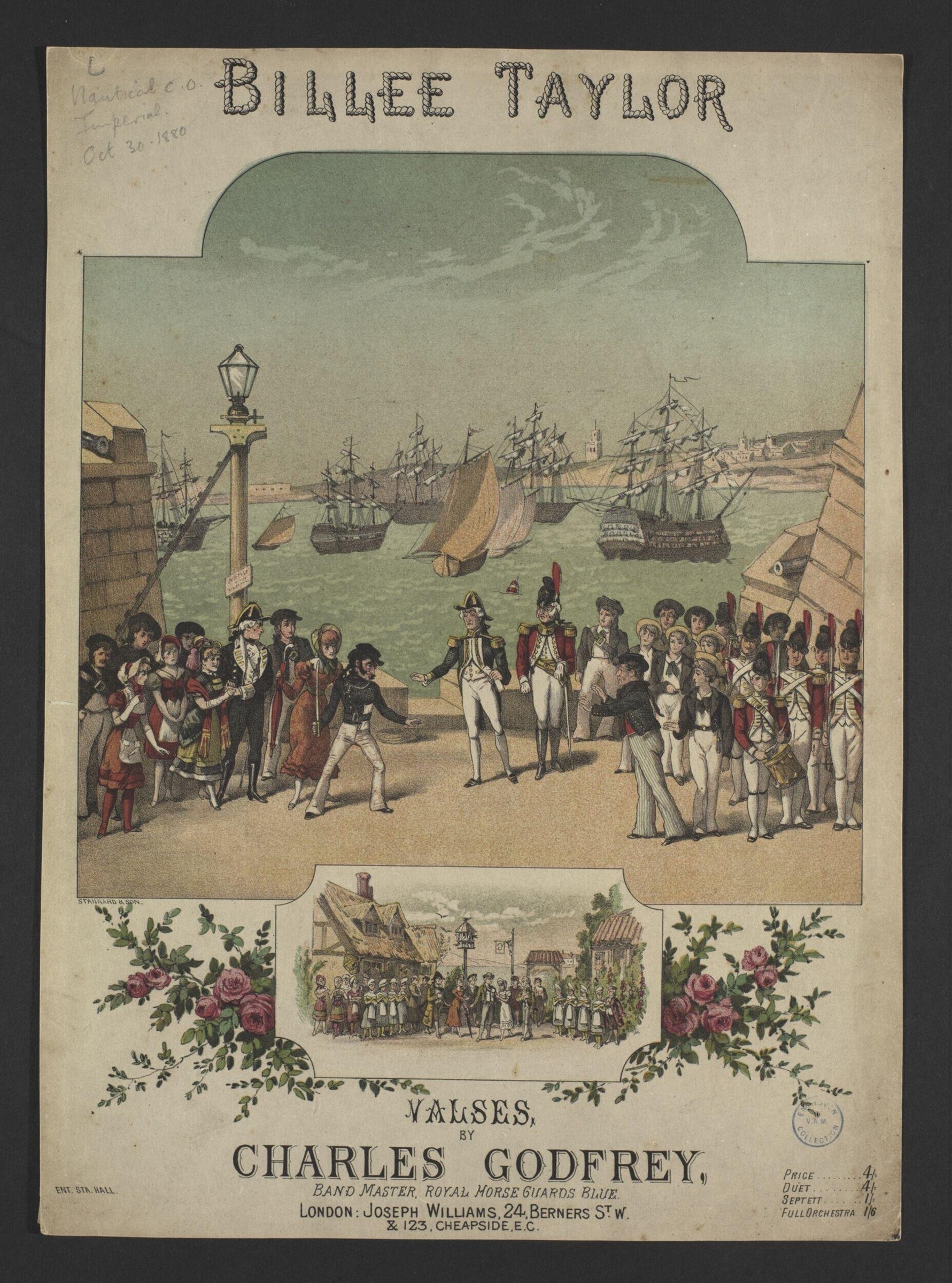
A bustling naval harbor scene dominates the center, with dozens of tall-masted sailing ships anchored in green-blue water under a clouded sky. The foreground is crowded with figures in early 19th-century dress — military officers in white breeches and tailcoats, civilians in colorful coats and hats, and women in high-waisted Regency gowns and bonnets. A tall lamp post stands at the water's edge, its beacon visible. The figures are clustered in loose groups, some appearing to gesture toward the ships, others standing in conversational knots. A smaller vignette below the main scene shows a street or village setting with buildings and more assembled crowds. The overall composition celebrates a naval occasion — possibly a departure, arrival, or military gathering — with the human activity on shore as prominent as the ships themselves.
The dancing
The figures stand in casual groupings rather than formal dance positions, though some pairs and small groups suggest social interaction. Bodies are upright and formally dressed in the Regency style, with women in empire-waist gowns and men in military dress or tailcoats. Arms are held naturally at the sides or gesturing in conversation; there is no synchronized movement or choreographic frame. The crowd conveys ceremony and occasion rather than coordinated dance, though the gathering itself may involve social dancing as part of the celebration.
The dance depicted
This is not a dance scene in the choreographic sense, but rather a social gathering at a significant moment — likely a military or naval occasion in Regency-era England where social dancing would have been a typical accompaniment to such festivities. The print appears to commemorate an actual event (possibly connected to the naval victories of the Napoleonic period), and such occasions would have included ball dances, particularly country dances and quadrilles, as part of the celebration. The image shows the spectacle and assembly rather than the dancing itself.
How it was made
This is a hand-colored engraving or etching, evident from the fine linear hatching visible in the ships' rigging and the formal compositional structure. The coloring — greens in the water, flesh tones, reds and blues in the uniforms and gowns — appears to be applied by hand after the print was made, a common practice for popular prints of the period. This technique allowed for wide circulation among the middle and upper classes; such prints were affordable, collectible, and often commemorated significant social and military occasions for domestic display.
About this work
This is a commemorative hand-colored engraving titled *Billee Taylor*, credited to Charles Godfrey (identified as 'Bano Master, Royal Horse Guards Blaize') and published in London by Joseph Williams around 1820. It depicts a naval gathering of the Regency era, likely marking a military occasion or the departure of a fleet, with hundreds of figures assembled on shore amid tall ships. The print belongs to a tradition of popular, hand-colored engravings that documented public spectacles and significant national moments for a broad urban audience. It is more social and political document than dance record, yet it captures the context in which social dancing was central to such occasions — the dress, the formality, the assembly of officers and civilians that would have culminated in ballroom or public dancing.
How to look at it
Notice the formal arrangement of bodies despite the casual grouping: everyone is dressed formally, standing upright, oriented toward the ships or toward each other in conversation. The print captures the spectacle of a civic moment — the ships, the crowds, the uniforms — but freezes the scene in a moment of assembly and anticipation rather than in motion. Look at the dress of the women in particular: the high-waisted empire-silhouette gowns, the small bonnets, the pale fabrics are exactly the costume in which Regency social dances were performed. The scene is one of ceremony and formality that would have led to dancing, though the dancing is not shown.
The artist
Charles Godfrey is identified in the print as 'Bano Master, Royal Horse Guards Blaize.' He was a popular engraver and print maker working in London in the early 19th century, producing commemorative and satirical engravings for a mass market. The style and subject matter suggest he worked in the tradition of topical and occasion-based prints that were bought and displayed by the prosperous middle class as records of current events.
The period
This engraving dates to the Regency period (c. 1811–1820), a time of naval confidence and imperial expansion following British naval victories in the Napoleonic Wars. Social dancing during this era was dominated by the quadrille (recently imported from France), the English country dance, and the cotillion. Large public gatherings like the one depicted would have been occasions for public balls and assemblies, where these dances were performed. The hand-colored engraving was a primary medium for circulating images of such occasions to a reading and collecting public.
Where it lives
The work is held as a print in the V&A collection. It was published by Joseph Williams at 24 Berners Street, London, and 125 Cheapside. The price listed on the print (4 shillings plain, 6 shillings colored, with orchestral arrangement available) indicates it was sold as a popular print for domestic use and display, likely also available as sheet music.
Questions about this work
Is this actually a dance scene?
Not in the choreographic sense. It is a commemorative engraving of a naval or military occasion at which social dancing would have taken place, but the print shows the assembly and gathering rather than the dance itself. It documents the social context and formal dress in which Regency-era dancers performed.
What is the 'Billee Taylor' of the title?
The title likely refers to a specific naval occasion or vessel, though the engraving was also issued with musical arrangements, suggesting it may have been tied to a popular song or theatrical piece of the period. The print commemorates an actual event significant enough to warrant publication and hand-coloring for sale to the public.
What can this tell us about dance in this period?
The formal dress, the military presence, the civic importance of the occasion, and the large assembly all indicate the context in which social dances like the quadrille and country dance were performed. The print shows the world from which dancers came and the occasions that prompted dancing, even though it does not depict the dance itself.
More dance artwork





