49 works in this view — arrow keys or swipe to move between them.
Dance in Art
Été 1939
Ana de Pombo
- Collection:
- Fashion design
- Source:
- Victoria and Albert Museum
- Rights:
- Rights vary by item — check the source record before reusing this image. Source record ↗
- Recorded as:
- V&A — check rights per item
This drawing is evidence of how fashion design in the pre-war atelier world engaged with ideas of movement, display, and the theatrical body. It shows a designer thinking visually about how a garment would be experienced in motion—how the skirt would move, how the silhouette would read in space, what gesture and posture the dress invited or enabled. For anyone studying the relationship between costume, fashion, and staged or social movement in the twentieth century, this is a primary source.
What you are looking at
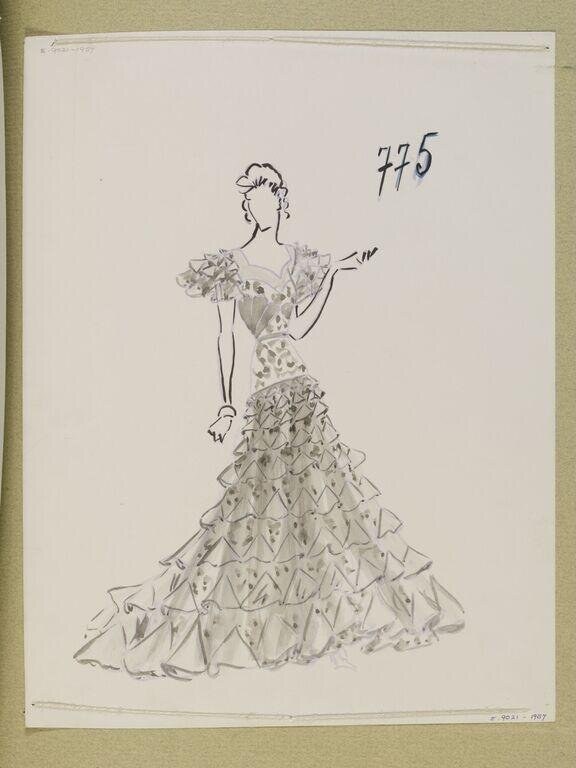
A fashion design sketch in graphite depicting a woman in an elegant evening gown, rendered in a loose, gestural style typical of mid-twentieth-century atelier drawings. The figure is shown in three-quarter view, her body angled and her posture animated—she holds a bouquet of flowers in one raised arm and extends her other arm in a graceful, open gesture. Her head is turned back over her shoulder, creating a sense of movement and engagement with an implied viewer or companion. The dress dominates the composition: a fitted bodice with horizontal striped or textured patterning gives way to a voluminous skirt constructed from geometric, triangular facets or appliqués that create a layered, sculptural silhouette. The triangular elements increase in density and size toward the hem, suggesting both volume and structural complexity. The sketch is unfinished in places—the face is lightly indicated, the arms are spare line-work—while the designer's attention concentrates on the architecture of the skirt. The catalogue number 775 appears in the upper right; a date mark is barely visible at the lower right.
The dancing
The figure adopts an open, engaged stance with weight shifted to one leg, creating an S-curve from hip to shoulder. Both arms are raised and extended, framing the upper body; the lifted arm with the bouquet suggests a moment of presentation or celebration, while the other arm extends outward in a gesture of openness or movement. The head is thrown back, creating visual momentum. The draughtsmanship is confident but economical—the designer is far more invested in the garment's form than anatomical precision.
The dance depicted
This is not a document of dance. It is a fashion design drawing, possibly for an evening gown or ball dress intended for a formal social or theatrical occasion. The animated pose and the moment chosen—an uplifted, celebratory gesture—suggest a designer imagining the garment in motion, or positioning it for maximum visual impact. The title 'Été 1939' (Summer 1939) places the work in the final peacetime season of Europe before the Second World War, when high fashion was still vital and social occasions still feasible. The open posture and the emphasis on the skirt's dramatic construction suggest a garment intended for a woman of standing at a significant social event—a gala, wedding, or formal reception—where the dress would read as a unified, spectacular form from a distance.
How it was made
This is a pencil or graphite sketch on paper, the standard medium for fashion design studio work in the twentieth century. The technique is line-and-wash, with tonal shading used to indicate volume in the skirt and texture in the striped bodice; the minimal shading of the face and limbs contrasts with the detailed development of the garment itself, a common prioritisation in design practice. The sketch appears to be a finished presentation drawing rather than a preliminary study—the kind of drawing a designer would show a client or use in a workroom to communicate the final concept. Such drawings were not typically exhibited as independent artworks but remain invaluable historical documents of how designers conceptualised movement, silhouette, and impact.
About this work
Ana de Pombo's sketch captures a moment of imagined motion and celebration in a haute couture gown from the summer of 1939, in the months before the war transformed European life. The drawing is a designer's tool—a way of seeing the garment in space and time, animated by gesture and by the body that would wear it. It belongs in a dance gallery not because it documents a dance, but because it demonstrates how fashion designers in the theatrical world understood and deployed the language of the moving body. The open arms, the turned head, the lifted stance, and the voluminous skirt all speak to a designer thinking in terms of performance, spectacle, and the body in motion through space. Fashion and dance are closely allied arts in this period; both required an understanding of how fabric and flesh move together, and both were tools for creating moments of beauty and impact in social and theatrical life.
How to look at it
Pay attention to the asymmetry and animation in the pose: this is not a static display of a dress on a stand, but a moment of engagement and movement. Notice how the designer has used the raised arm and turned head to suggest not just motion but emotion—celebration, confidence, or the pleasure of wearing something beautiful. Then look at the skirt: the triangular facets are not merely decorative but structural, and the way they increase in size and density toward the hem creates a sense of weight and substance. The designer is imagining how this skirt would move, how it would catch light, how it would read to an observer. The unfinished face and limbs tell you what the designer cared about most.
The artist
Ana de Pombo was a Spanish fashion designer active in the 1930s and 1940s. Very little is recorded of her practice or biography. She worked in the atelier tradition at a moment when Spanish fashion design was beginning to develop an international presence, though the Spanish Civil War (1936–39) and the subsequent isolation of the Franco regime severely disrupted cultural life and international exchange. Her work survives mainly in the form of such design sketches, which are preserved as working documents of the atelier rather than as finished artworks.
The period
In 1939, European high fashion was reaching the end of the 1930s silhouette: bias-cut gowns, soft draping, and increasingly structural evening wear that used novel techniques of cutting and construction to create dramatic skirts and bodies. The geometric, faceted skirt in Pombo's design—built from triangular elements—reflects this moment of experimentation with three-dimensional tailoring and architectural form. At the same time, theatrical costume design and haute couture were closely intertwined; designers created gowns for opera, ballet, and theatre as well as for private wear, and the language of movement and spectacle was central to both worlds. The drawn line, gestural and urgent, was the designer's immediate language, a sketch made quickly to capture an idea before it dissolved.
Where it lives
The drawing is held in a fashion design collection, catalogued as item 775. It is a working sketch from a designer's studio or atelier, not a finished artwork for exhibition. The source is noted as 'va'—likely an archive or institutional holding. Such sketches were typically kept in studio files or workroom archives, and their survival in institutional collections reflects a relatively recent recognition of fashion design drawings as documents worthy of preservation.
Questions about this work
Is this a dance costume design?
No. This is a fashion design for an evening gown or formal dress, not a costume for stage performance. However, it demonstrates the close relationship between fashion and theatrical design in this period: the designer is thinking in terms of how the body moves, how the garment will be seen and admired in motion, and what kind of moment or gesture it invites. In 1939, these concerns were shared across fashion and theatre.
Why is it in a dance gallery if it is not dance?
Because it is evidence of how movement, gesture, and the body in space were central to how designers—even fashion designers—thought about their work. It shows the vocabulary and visual language that connected theatrical costume, social dress, and dance in the early twentieth century. Understanding how dance and fashion were entangled helps us see both more clearly.
What does 'Été 1939' mean, and why does the date matter?
'Été 1939' means 'Summer 1939' in French. The date is significant because it is one of the last moments of peacetime in Europe before the Second World War. This sketch captures a brief window when such elaborate, expressive, joyful gowns were still being designed and worn, before war transformed social life and fashion. It is a historical marker of a world that was about to disappear.
More dance artwork





