49 works in this view — arrow keys or swipe to move between them.
Dance in Art
Été 1933
Madeleine Wallis
- Collection:
- Fashion design
- Source:
- Victoria and Albert Museum
- Rights:
- Rights vary by item — check the source record before reusing this image. Source record ↗
- Recorded as:
- V&A — check rights per item
For dance historians and costume specialists, this sketch documents how 1930s fashion design was fundamentally informed by movement—how designers engineered garments specifically to flutter, swirl, and respond to the body in action. The exaggerated ruffles and bias-cut construction reveal the designer's assumption that the wearer would move, dance, and perform in this piece. It is a rare surviving design sketch that shows the intersection of high fashion, theatrical costume, and the social dancing of the interwar period.
What you are looking at
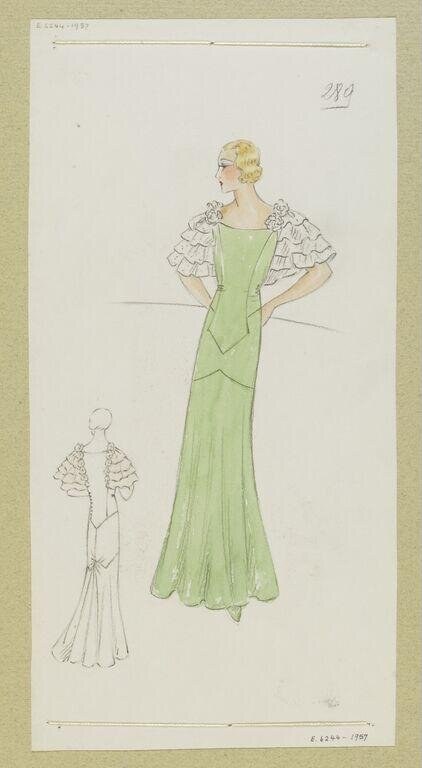
A fashion design sketch in watercolor and ink showing two views of an evening gown. The larger figure, rendered in profile facing left, wears a floor-length gown in pale green with a dramatically flared hemline that pools at the ankles. The bodice is fitted and simple, with a scoop neckline; the defining feature is the cape-like shoulder piece—a structured ruffle or tier of crisp white fabric that erupts from the shoulders in multiple layered ruffles, creating volume and drama across the upper back and arms. The figure has blonde bobbed hair in the style of the 1930s and stands with one hand on the hip. A smaller sketch to the left shows the back view of the same garment, emphasizing the architectural construction of the ruffled shoulder cape and the long, bias-cut skirt. The overall effect is theatrical and movement-conscious, designed to create visual impact with motion.
The dancing
The primary figure stands in a relaxed contrapposto pose, weight slightly shifted, with one arm at the hip in a pose of casual elegance. The stance is upright but not rigid, with the figure looking away over the shoulder. The secondary sketch emphasizes silhouette and the engineering of the garment's structure rather than bodily movement. Neither figure is dancing; both are presentation poses for the dress itself. The proportions and elongation are typical of 1930s fashion illustration convention.
The dance depicted
This is not a depiction of dance, but rather a couture design that was created with movement and performance in mind. The exaggerated shoulder ruffles, the fluid bias-cut skirt, and the overall silhouette suggest a garment designed for evening wear, social dancing, or theatrical costume. The dramatic cape-like ruffles would move and flutter with motion, making this a dress engineered for the body in action. The design vocabulary—theatrical volume, sleek fitted bodice, long dramatic lines—echoes the aesthetics of 1930s stage costume and ballroom fashion.
How it was made
This is a fashion design sketch in watercolor and ink on paper. The primary garment is rendered in pale green watercolor with careful attention to drapery and volume; the structural ruffles are outlined in fine ink line work. The technique is rapid and confident, typical of working designer sketches made for production or presentation, rather than finished illustration for publication. The use of two views (front and back) indicates this was a working drawing for a seamstress or pattern maker. The fluid watercolor application contrasts with precise structural line work, allowing the designer to communicate both the visual effect and the garment's construction.
About this work
This is a couture evening gown design by Madeleine Wallis, dated 1933, created during the height of the Art Deco era when fashion design intersected closely with theatrical costume and ballroom culture. The garment exemplifies the sophisticated engineering and theatrical sensibility of 1930s haute couture, with its architectural shoulder ruffles and sleek, bias-cut silhouette. While not a dance scene per se, the dress was clearly conceived as a garment for movement—for dancing, performing, or the social spectacle of evening events where dance and fashion were inseparable. The design preserves a moment when couture was at its most experimental with volume, line, and the relationship between the body and fabric.
How to look at it
Look first at the shoulder ruffles: notice how they are structured in distinct layers and how they extend from the arm itself, creating a silhouette that would catch light and air with every movement. The bias-cut skirt is drawn to show how it would cling to the body and yet flow at the hem. The pose itself—standing with hand on hip—is a presentation stance designed to show how the garment would look on an actual body. The smaller sketch emphasizes the back view and the three-dimensional structure of the cape, showing that Wallis was thinking through how this would look from all angles when in motion.
The artist
Madeleine Wallis was a French couture designer working in Paris during the interwar period, when Paris was the undisputed capital of fashion design and when haute couture was closely integrated with theatrical and ballroom culture. Wallis's design work exemplifies the sophisticated technical skill and theatrical sensibility that characterized Parisian fashion houses of the 1930s. The sketch is held in a fashion design collection, indicating it is part of the archival record of working design practice rather than finished illustration.
The period
The 1930s saw a radical transformation in evening wear and ballroom fashion. The drop waistlines and loose silhouettes of the 1920s gave way to fitted bodices, bias-cut skirts that clung to the body, and dramatic architectural elements at the shoulders and neckline. This was the era of the Hollywood bias-cut gown and the sophisticated ballroom standard—a time when evening wear was expected to move with the wearer and to facilitate rather than constrain motion. The vogue for theatrical ruffles and exaggerated shoulders reflected both Art Deco aesthetics and the direct influence of stage costume on street and ballroom fashion. The rise of ballroom dancing as a central social ritual meant that evening wear was fundamentally designed for the dance floor.
Where it lives
The work is held in a fashion design collection and catalogued with a source attribution of 'va' (likely the Victoria & Albert Museum, London, a major repository of historical fashion design drawings). It is catalogued as a design object rather than a finished artwork, indicating it was a working sketch made for production purposes.
Questions about this work
Is this a design for stage costume or street wear?
It could be either, or both. The 1930s saw a collapse of the boundary between theatrical costume and sophisticated evening wear—both were designed for maximum visual and kinetic impact. The ruffles and silhouette suggest evening wear for social dancing, but the theatrical drama would also suit a stage performance. Wallis was designing for a world in which evening dress was inherently theatrical.
What would this dress look like in motion?
The layered shoulder ruffles would flare and flutter with every turn and gesture. The bias-cut skirt would cling to the body and then swing outward at the hem, creating a fluid, elegant line. The overall effect would be one of controlled drama—the garment engineered to move with the dancer, not against them.
Why is the watercolor green if we don't know the actual color?
The designer chose pale green for this sketch, which was likely the intended color, or at least the color Wallis wanted to show for this particular design version. Fashion sketches often use the actual intended color to help clients and seamstresses visualize the finished garment.
More dance artwork





