49 works in this view — arrow keys or swipe to move between them.
Dance in Art
Été 1937
Ana de Pombo
- Collection:
- Fashion design
- Source:
- Victoria and Albert Museum
- Rights:
- Rights vary by item — check the source record before reusing this image. Source record ↗
- Recorded as:
- V&A — check rights per item
Fashion design sketches like this one offer vital evidence of how dancers and ballroom participants were dressed in the 1930s: the silhouettes available to them, the constraints and possibilities built into the garment, and the ideal of the body those garments implied. The elaborate ruffled skirt and fitted bodice of this gown would have moved distinctly differently from earlier or later styles, shaping how the wearer could turn, step, and carry themselves on the dance floor.
What you are looking at
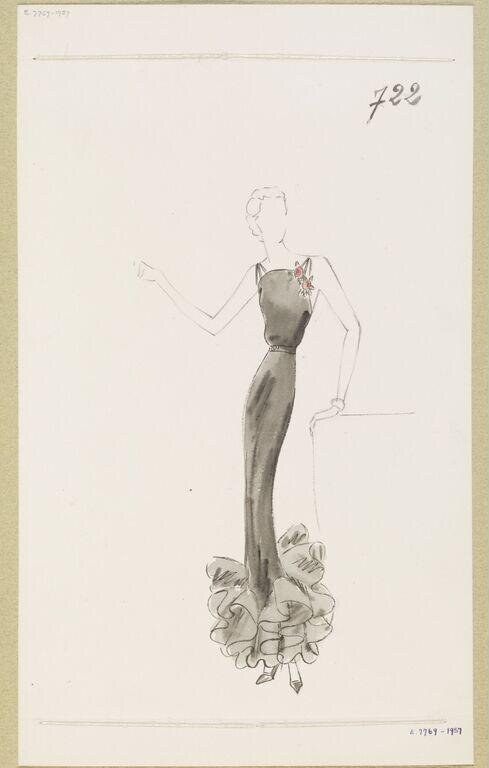
A fashion design sketch presenting an elegant evening gown rendered in graphite and wash. The figure is shown from approximately waist up, rendered in a loose, gestural style typical of design drawings. The dress itself is the focus: a fitted, sleeveless gown in dark gray or charcoal tone, with what appears to be a corseted bodice and a dramatically voluminous skirt rendered in swirling, sculptural folds. The skirt extends downward in a series of elaborate ruffles or tiers, creating a cone-like silhouette that suggests movement and lightness despite the garment's structural complexity. A small floral corsage or brooch detail is visible at the neckline. The figure's head is sketched minimally, almost abstracted, and tilted slightly as if in a moment of ease or turning. The background is entirely white, focusing all attention on the silhouette and construction of the garment. The drawing is dated summer 1937 (Été 1937), inscribed in the upper right corner.
The dancing
The figure is elongated and elegant, captured in a three-quarter pose with the body angled slightly. The head, rendered with minimal detail, appears to turn or tilt upward, suggesting a moment of light movement or poise rather than active dance. The arms are sketchily drawn, one extending outward in a relaxed gesture. The posture conveys fashion-model bearing—a studied ease and awareness of the body in space—rather than the committed weight distribution and muscular engagement of a dancing body.
The dance depicted
This is a fashion design rather than a record of dance. While the garment's construction and the figure's pose suggest the kind of elegant evening wear that might have been worn at formal balls or society dances in the 1930s, the sketch does not depict an actual dance event, partnership, or choreographic moment. The drawing is concerned with the structure, volume, and visual drama of the gown itself—how it moves with the body—rather than with documenting dance practice or performance.
How it was made
Graphite and wash on paper, executed in the working method of 1930s fashion design. The technique is economical and assured: the dress is rendered in careful detail with tonal wash to show volume and fall, while the figure itself is sketched lightly and abstractly. This approach—treating the garment as the primary subject and the body as its armature—was standard practice in haute couture and fashion houses. The sketch appears to be a design proposal or working drawing for a specific commission or collection, not a finished artwork for public exhibition.
About this work
This is a fashion design sketch by Ana de Pombo from summer 1937, presenting an elaborate evening gown with a fitted dark bodice and dramatically ruffled skirt. While the figure's elegant, composed pose and the gown's construction suggest the world of formal 1930s ballroom culture, the work itself is not a depiction of dance but rather a design proposal. The sketch documents the silhouette and construction of a dress intended to be worn at society events—the kind of ballroom occasions where such garments would have been seen in motion. The work belongs in a dance archive not as evidence of choreography or technique, but as a record of how the fashion and material culture of the dance world shaped the body and its presentation in that era.
How to look at it
Attend to the relationship between the gown's structure and the figure's implied movement. The swirling, tiered ruffles are drawn to suggest how fabric behaves in motion—they radiate outward from the body as if the wearer has just turned or is about to move. The minimal rendering of the figure's limbs and head contrasts sharply with the elaborate detail of the dress, revealing the designer's priorities: the garment itself is the subject, and the body is the means by which it comes alive. Notice how the corseted waist and full skirt would constrain and shape the dancer's movement, determining what kinds of steps and turns were possible.
The artist
Ana de Pombo was active as a fashion designer in the 1930s, working in the haute couture tradition. Little is widely documented of her practice beyond surviving design sketches held in fashion archives. Her work belongs to the period of European fashion design between the wars, when the profession was becoming increasingly specialized and design sketches were valued as intellectual and commercial property in their own right.
The period
In 1937, the ballroom and formal evening-wear world was at a specific moment. The 1920s and 1930s saw dramatic changes in women's silhouettes—from the dropped waistlines and looser cuts of the 1920s toward a return to more fitted, corseted forms in the 1930s. This gown, with its dramatic ruffled skirt and fitted bodice, reflects that return to structured femininity. Simultaneously, competitive ballroom dancing was becoming increasingly codified and popular across Europe and North America, establishing the standardized hold, frame, and movement technique that would define the sport by mid-century. The evening gowns worn in ballroom contexts were essential to the visual spectacle of the dance.
Where it lives
The sketch is held in a fashion design collection, reflecting its status as a working design document rather than a finished artwork. The inscription 'Été 1937' (Summer 1937) and the catalog marking suggest this is a dated design from a specific season, likely intended for a particular client or collection.
Questions about this work
Is this a sketch of a real dance?
No. This is a fashion design proposal for an evening gown, not a record of an actual dance event or performance. However, the gown itself was clearly intended for ballroom and formal social-dance contexts in 1930s high society. The sketch documents the garment itself rather than the dancing body wearing it.
What would this dress have been worn for?
Gowns of this construction and elegance were worn to formal balls, evening dances, and high-society social events throughout Europe in the 1930s. The fitted bodice and full ruffled skirt were characteristic of the period's ballroom fashion, and the dramatic silhouette would have been enhanced by movement—particularly the spins and turns of dances like the waltz or foxtrot.
Why is this in a dance archive?
Fashion design is a crucial part of dance history. The silhouettes, materials, and construction of dance costumes and ballroom wear directly shape how dancers move, what movements are possible, and how the dance looks to an observer. Understanding the design and evolution of dance wear is essential to understanding how dances were actually performed in different periods.
Who was Ana de Pombo?
De Pombo was a fashion designer working in the 1930s haute couture tradition. Beyond her surviving design sketches, little is widely documented of her career. Such designers were often independent practitioners working on commission for wealthy clients or fashion houses, creating the elegant evening wear essential to elite social life.
More dance artwork





