49 works in this view — arrow keys or swipe to move between them.
Dance in Art
Été 1937
Ana de Pombo
- Collection:
- Fashion design
- Source:
- Victoria and Albert Museum
- Rights:
- Rights vary by item — check the source record before reusing this image. Source record ↗
- Recorded as:
- V&A — check rights per item
This work demonstrates how ballet—its posture, gesture, and visual language—shaped the design and presentation of high fashion in the 1930s. For dancers and dance historians, it is evidence of ballet's reach beyond the stage into the broader culture of elegance and feminine refinement. For fashion historians, it shows a designer consciously deploying balletic vocabulary to make a garment appear more desirable and more beautiful.
What you are looking at
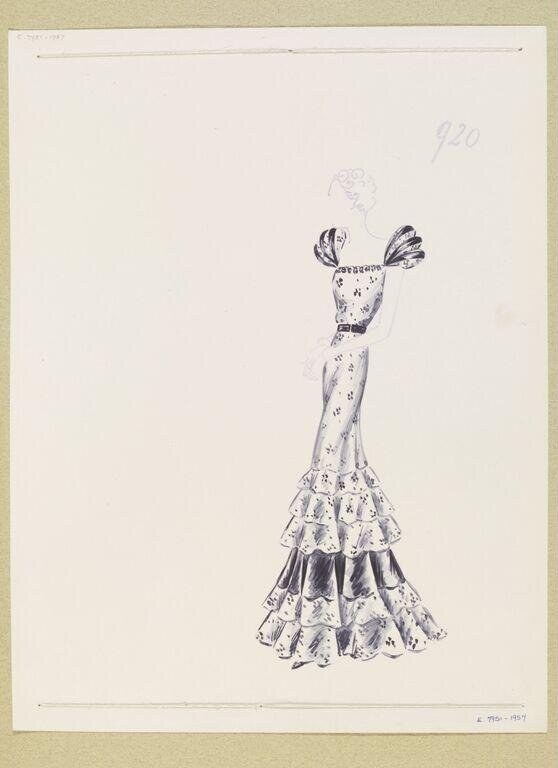
A single female figure dominates the composition, drawn in ink with precise linear hatching. She stands in a elegant S-curve contrapposto, her weight shifted to one leg, the other relaxed. Her body is exceptionally elongated and mannequin-like, with an impossibly slender waist cinched by a decorative band or belt. She wears a fitted, sleeveless bodice patterned with small repeated motifs (likely floral or abstract), which extends from her shoulders down to her hips. Below this sits a voluminous, dramatically tiered skirt that flares dramatically from the waist, composed of at least three distinct ruffled or layered tiers rendered in bold black ink and detailed hatching. The skirt's construction suggests movement and lightness, as if caught mid-swirl. Her arms are raised expressively to shoulder height or above, with long hands and fingers extended outward in a graceful, splayed gesture—the right arm slightly higher than the left. Her head is small, tilted slightly upward, with a simplified face. The overall effect is one of elongated elegance and fashionable modernism.
The dancing
The figure's posture is fundamentally theatrical and balletic: the weight is distributed in a clear contrapposto stance, with the body line following a graceful S-curve from feet to head. The raised arms with extended fingers suggest a classical or romantic ballet port de bras—open, expansive, and gestural rather than functional. The extreme elongation and the refined hand positions indicate training or at least an artist's understanding of balletic line and deportment. The silhouette is deliberately artificial, prioritizing elegance and fashion over anatomical realism, which was characteristic of haute couture illustration of the period.
The dance depicted
This is unmistakably a fashion design drawing of a ball gown or formal evening dress from 1937, presented through the body and gesture language of theatrical ballet. While not a documentary record of actual dance, the illustrator has used balletic posture and arm position to present the garment as if worn by a trained dancer. The raised arms and lifted carriage suggest the wearer's body would move through space with balletic refinement; the silhouette is designed to flatter balletic proportions—long legs, narrow waist, open port de bras. This was standard practice in haute couture illustration of the 1930s, when fashion designers frequently employed balletic vocabulary and poses to convey elegance and movement.
How it was made
This is a pen-and-ink fashion illustration, most likely drawn by hand with pen or brush on paper. The artist has used consistent linear hatching to build form and shadow, particularly dense in the skirt's ruffles and in the bodice pattern. The technique suggests commercial or haute couture illustration work—a professional medium designed for reproduction in fashion journals or as a design record. The precision of the line work and the economy of means indicate a trained illustrator, not a fine artist experimenting with the figure. The drawing's clarity and the absence of color suggest it may have been prepared for reproduction or archive purposes.
About this work
This is a 1937 fashion illustration by Ana de Pombo depicting a tiered evening gown through the posture and gestural language of classical ballet. The garment itself—with its fitted bodice and dramatically flared, multi-layered skirt—belongs to the history of formal dress, but the drawing's choice to present it through a balletically trained figure and balletic port de bras reveals the intimate relationship between dance and fashion in early 20th-century design culture. Couture designers and illustrators of this period routinely borrowed from ballet's visual vocabulary to convey elegance, refinement, and the body's capacity for beautiful movement. This drawing sits at the intersection of dance and fashion history, documenting both an object and an aesthetic ideology.
How to look at it
Observe the pose first: this is not how an ordinary person would stand. The weight distribution, the arm position, the slight backward tilt of the head—all read as balletic training. Notice how the illustrator has used the garment's construction (the tiered skirt, the fitted bodice) to reinforce that balletic line, making the dress inseparable from the body it adorns. The small scale of the head and the elongation of the limbs are conventions of fashion illustration, exaggerating balletic proportion; the raised arms, even though they hold the dress fabric, echo the classical port de bras. The drawing asks you to imagine this dress in motion, worn by a moving body—balletic movement.
The artist
Ana de Pombo was a fashion illustrator working during the 1930s, a period when couture illustration was a sophisticated and highly skilled profession. Little biographical information is readily available, but her work evidences the professional standards of haute couture drawing of the era—precise line work, sophisticated use of pattern and texture, and a clear understanding of how fabric moves on a trained body. She worked in the idiom of high fashion illustration, where elegance of line and understanding of garment construction were paramount.
The period
The 1930s were a golden age of haute couture illustration, and fashion design drawings of this caliber were circulated among wealthy clients, in fashion journals, and as design records. Simultaneously, this was the interwar period when ballet—particularly through the continued influence of the Ballets Russes (which had reformed after Diaghilev's death in 1929) and the popularity of ballet in society—was a dominant reference point for elegance and modern movement. The balletic ideal of the female body—long-limbed, narrow-waisted, graceful—was the template against which fashionable bodies were measured and dressed. Evening wear of the period, particularly after the silhouette began to relax slightly in the mid-to-late 1930s, often featured dramatic skirts and emphasized the elevated, refined carriage of a trained dancer.
Where it lives
The work is held in the V&A's fashion design collection, which preserves couture drawings, sketches, and design records alongside garments themselves. This drawing would have functioned as a design document or a presentation drawing for a client—a record of the garment's structure and a vision of how it would appear when worn.
Questions about this work
Why is the figure drawn in a ballet pose if this is a fashion illustration, not a dance image?
This is a standard convention of high fashion illustration, especially in haute couture. Designers and illustrators of the 1930s regularly used balletic posture to convey elegance, refinement, and the garment's capacity for beautiful movement. The balletic ideal was so dominant culturally that depicting a formal dress through a balletically trained body made the garment more desirable and more beautiful. It was a form of visual rhetoric: to show a woman in balletic posture was to promise elegance.
Is this a drawing of an actual dancer or an actual dress?
Neither and both. This is a design drawing—a fashion illustration—showing an imagined or planned garment. The figure is a template or a model, not a portrait of a specific person. However, the garment would have been made and worn, and the balletic posture is how the illustrator imagined it would be worn and how it would move.
What does the tiered skirt tell us about how the dress would move?
The layered, ruffled construction was designed to move with a wearer's body—flaring on turns, swaying with the walk, creating visual drama and lightness. This was especially important for evening wear intended for dancing. The illustrator has caught the skirt as if in motion, suggesting the garment's responsiveness to the body and its suitability for the ballroom.
More dance artwork





