49 works in this view — arrow keys or swipe to move between them.
Dance in Art
Été 1938
Ana de Pombo
- Collection:
- Fashion design
- Source:
- Victoria and Albert Museum
- Rights:
- Rights vary by item — check the source record before reusing this image. Source record ↗
- Recorded as:
- V&A — check rights per item
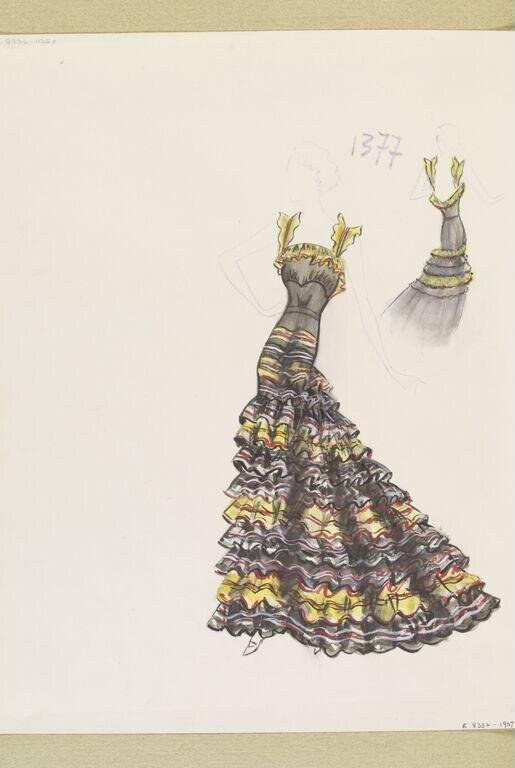
This sketch documents the relationship between fashion design and dance practice in 1938—how a couture house understood the body, movement, and freedom of expression of its era. The expressive gesture and engineered volume reveal that dance was not incidental to evening wear; it was central to how women's formal bodies were imagined and dressed.
What you are looking at
A fashion design sketch in watercolor and ink, likely for an evening gown titled *Été 1938* (Summer 1938). The drawing shows a woman's torso and arms, with hands raised in an expressive gesture suggesting movement or celebration. The figure wears a dramatic tiered ball gown with horizontal stripes alternating between deep plum or charcoal and golden yellow, creating a bold color contrast that emphasizes volume and silhouette. The skirt flares dramatically from the waist with multiple layers of ruffled or pleated tiers, each edged in gold, creating a cascading, undulating effect. The bodice appears fitted and structured. Above the main figure, to the upper right, is a smaller sketch of a single arm and hand in a raised position, possibly a study for gesture or proportion. The drawing style is elegant and assured, with careful attention to fabric texture and the play of light on the ruffled surfaces. The background is cream or pale paper, allowing the saturated colors of the dress to dominate.
The dancing
The raised arms and open hand position suggest a moment of exuberance or freedom—the body is upright and elongated, with shoulders back. The gesture is uncontained and celebratory rather than constrained. The second study of the arm in the upper right indicates the artist's focus on capturing an elevated, extended arm pose. The proportions emphasize verticality and lift, with the torso and arms forming an open frame.
The dance depicted
While this is a fashion design rather than a scene of actual dance, the raised-arm gesture and the energy of the pose suggest the kind of movement and freedom associated with 1930s social dance and evening wear. The dramatic tiered construction and dynamic silhouette are characteristic of gowns designed for movement—ballroom, swing, or social dancing. The design appears to embody the optimism and motion of dance rather than to document a specific style or partnership.
How it was made
This is a watercolor and ink drawing on paper, likely a couture or haute couture design sketch. The medium allows for swift, confident line work combined with saturated color washes, appropriate to fashion illustration where the designer must communicate both silhouette and fabric effect rapidly. The use of both medium and outline suggests a professional atelier practice, where such sketches served as working documents for construction and as visual records for clients or the fashion house archive.
About this work
This is a fashion design sketch by Ana de Pombo for a 1938 summer evening gown. The work captures the spirit of movement and liberation associated with 1930s social dance through its dynamic silhouette, exuberant gesture, and bold color blocking. The tiered, ruffled construction is engineered for the body in motion—the kind of dress that invites and enables dancing. As a couture sketch, it sits at the intersection of fashion, design, and the material culture of dance, showing how evening wear and performance costume were conceived as a single aesthetic project in the pre-war era.
How to look at it
Notice the raised arms and open hand position—this is not a static dress form, but a body caught in or poised for movement. Observe how the tiered construction of the skirt creates momentum: each horizontal stripe and ruffled tier is slightly offset, as if captured mid-swing. The color contrast between deep plum and gold is not decorative alone; it makes the form of the dress and the motion legible from a distance. The secondary sketch of the arm above suggests the designer's focus on how the dress would frame and enhance the raised-arm gesture of a dancer in motion.
The artist
Ana de Pombo was a Spanish fashion designer working in the 1930s. Little is recorded of her practice or life, but this sketch demonstrates the professional competence and aesthetic sophistication of the Spanish couture world in the pre-Civil War period. The sketch belongs to the atelier tradition of European high fashion, where elaborate drawings served both as design documents and as luxury objects in their own right.
The period
In the 1930s, evening wear was inseparable from social dance—the waltz, foxtrot, and various forms of swing and ballroom dancing were dominant leisure activities for the middle and upper classes across Europe. Fashion houses designed gowns explicitly for movement on the dance floor. The bold color blocking and dramatic silhouette of this design reflect the modernist aesthetics of 1930s fashion, while the exuberant gesture speaks to the era's embrace of youth culture, jazz, and social freedom. The Second World War would end this era of haute couture and unburdened evening wear within a few years of this sketch.
Where it lives
This work is held in the Fashion Design collection and comes from the V&A (Victoria and Albert Museum) source. It is catalogued as a design sketch, a working or presentation drawing from a couture atelier.
Questions about this work
Is this a real dress, or just a sketch?
This is a design sketch—a professional drawing made by a fashion designer to communicate her vision to clients, seamstresses, and the atelier team. Such sketches were often highly finished and beautiful objects in their own right. Whether this particular design was constructed and worn is not recorded.
Why are the arms raised like that?
The raised-arm pose was typical of evening wear design sketches in this period because it showed the dress in motion and demonstrated how it would move when a woman was dancing or gesturing. It is also a confident, celebratory pose that conveys the mood and energy the designer wanted the wearer to feel and project.
What dance would someone wear this dress to?
A dress of this style and formality in 1938 would have been worn to balls, formal dances, and nightclub evenings where ballroom dances like the waltz and foxtrot, and newer swing styles, were common. The dramatic volume and bold colors suggest a dress for a woman who wanted to stand out and move freely.
Who was Ana de Pombo?
Ana de Pombo was a Spanish fashion designer active in the 1930s. Her work is scantily documented in English-language sources, but her sketch demonstrates the skill and modernist aesthetic sense of the Spanish couture world before the Civil War interrupted artistic and commercial life.
More dance artwork





