49 works in this view — arrow keys or swipe to move between them.
Dance in Art
Hiver 1938
Ana de Pombo
- Collection:
- Fashion design
- Source:
- Victoria and Albert Museum
- Rights:
- Rights vary by item — check the source record before reusing this image. Source record ↗
- Recorded as:
- V&A — check rights per item
For historians of dance and performance, this sketch documents the formal evening wear that constrained and enabled the movement of dancers and ballroom participants in the late 1930s. The tiered construction, while visually dramatic, would have created significant weight and volume at the hemline, affecting stride, turn, and the carriage of the body—making it essential context for understanding how people actually moved in the formal contexts where dance occurred. The sketch also shows the labor and precision of couture garment-making at a moment when such dress was a marker of class and access.
What you are looking at
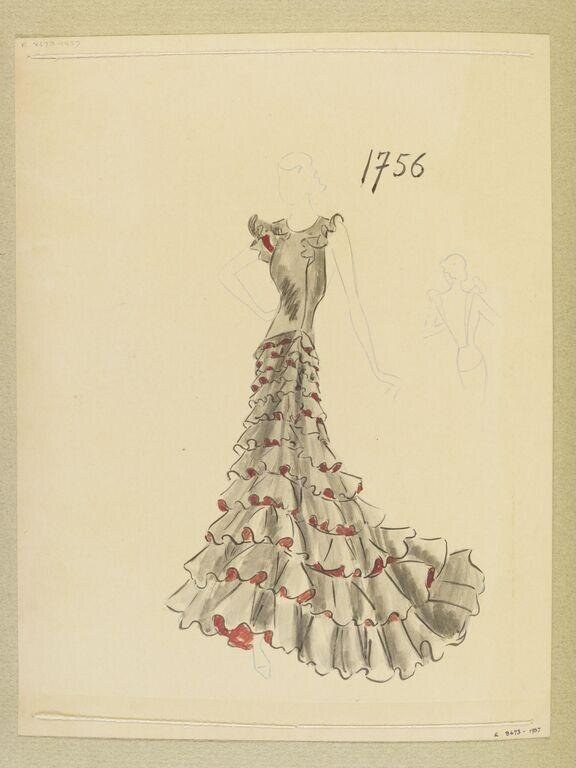
A fashion design sketch of an evening gown labeled 'Hiver 1938' (Winter 1938). The figure is rendered as a stylized female form in three-quarter view, shown from roughly the waist up, with elegant elongated proportions typical of fashion illustration. The gown itself dominates the composition: a striking tiered construction of layered ruffles or flounces that cascade from the fitted bodice down the full length of the skirt. Each tier is trimmed or accented with red ribbon or binding, creating a rhythmic vertical striping effect across the otherwise pale, cream-colored fabric. The bodice appears fitted with draped or ruched detailing at the shoulders, and the neckline is rendered with elegant simplicity. The sketch uses pencil for the structural lines and the figure, with red coloring applied to the ribbon details for accent. Two smaller, lighter figure sketches appear in the upper right, possibly indicating alternative poses or proportions under consideration. The drawing is executed with the confident, economical line work characteristic of professional couture design from this period.
The dancing
The primary figure is a simplified fashion croquis—an idealized, elongated female silhouette typical of 1930s haute couture illustration. The pose is frontal and static, with the body positioned to display the garment rather than to suggest movement or dance. The arms are sketched lightly and appear to frame the dress. The smaller sketches to the right show similar standing poses from different angles, all designed to present the volume and construction of the gown to a viewer or client. This is not a depiction of dance movement, but rather a presentation of garment design.
The dance depicted
This work does not depict dance. It is a fashion design sketch—a working drawing for a couture garment intended for evening wear. The tiered ruffle construction and the formal, static presentation indicate a garment designed for display or formal occasions, not for movement or performance. While evening gowns may be worn to dance, the image itself documents dress design, not dancing bodies or choreography.
How it was made
The work is a mixed-media fashion sketch executed in pencil and colored pencil or watercolor on paper. The structural lines, proportions, and details of the garment are drawn in graphite with careful, practiced line work; the figure is simplified and schematic, following couture illustration conventions. The red ribbon or trim details are rendered in red media, likely colored pencil or diluted watercolor, applied with precision to indicate placement and visual emphasis. This is the standard working method of professional fashion houses during the 1930s, executed as a design proposal rather than a finished presentation drawing. Such sketches were typically created for in-house reference, client approval, or workshop instruction.
About this work
This is a fashion design sketch by Ana de Pombo for an evening gown dated 1938, held in the Victoria and Albert Museum's fashion collection. It represents the haute couture practice of the late 1930s, a moment when Paris and European fashion capitals were defining the silhouettes and details of formal wear in the final pre-war years. The tiered ruffle construction shows the period's taste for volume and decorative layering, achieved through complex seaming and trim work rather than through gathered or pleated fabric.
The sketch exists in this collection not as a record of dance, but as evidence of how evening wear was conceived and communicated within the fashion industry. The work belongs in a gallery of dance in art because costume is inseparable from performance—this gown would have been worn by women attending balls, galas, and theatrical events, and may well have been worn while dancing. Understanding the constraints and possibilities of such garments helps illuminate the relationship between dress and movement in early twentieth-century social and theatrical contexts.
How to look at it
Attend first to the structure of the garment itself: how many tiers of ruffles there are, how the red trim divides and organizes the visual field, and how the construction moves from a fitted bodice to a dramatically expanded skirt. This construction method—layered and trimmed rather than gathered—required significant skill and material cost. Note the lightness of the figure drawing compared to the precision of the garment details: the designer's priority is the dress, not the body. The smaller sketches to the right record the designer's process of working through proportions and viewing angles. These are working drawings, not finished renderings, and they show the practical thinking of a couture house preparing a design for execution.
The artist
Ana de Pombo was a fashion designer active in the 1930s. Little biographical information survives in readily accessible sources, but her presence in the V&A collection indicates that her work was regarded as significant enough to document and preserve. The sketch style and the sophistication of the design suggest training in professional couture houses, possibly in Paris or another major fashion center. The work is dated to a period when women designers, while fewer in number than their male counterparts, were increasingly influential in haute couture and ready-to-wear production.
The period
The year 1938 marked the final full year of fashion before World War II reshaped European society and disrupted the couture trade. In these final peacetime years, Parisian and European haute couture remained the apex of fashion production, characterized by refined silhouettes and skilled craft. The late 1930s saw a return to greater volume and femininity after the more austere styles of the early Depression years—evening wear in particular emphasized decoration, layering, and luxurious fabric treatment. The tiered ruffle construction of this gown is typical of the period's taste for hand-applied trim and complex construction. Socially and culturally, formal evening wear and ballroom dancing remained central to elite social life in Europe, even as political tensions mounted. The gown would have been worn to events where social dancing was a primary activity.
Where it lives
The work is held in the Victoria and Albert Museum, London, in its fashion design collection. It is catalogued as a fashion design object rather than a work of fine art, reflecting its original purpose as a working drawing within the couture industry. The accession number format and collection housing suggest it was acquired as part of the V&A's systematic documentation of twentieth-century fashion history and production methods.
Questions about this work
Why is a fashion design sketch in a gallery of dance in art?
Costume is integral to dance history. Evening wear like this gown was worn by dancers, ballroom participants, and spectators at formal events where dance occurred. The constraints and possibilities of such garments—the weight of the hem, the restricted stride, the visual drama of the tiered construction—directly affected how bodies moved. Understanding the dress is essential to understanding the choreography and social dance of the period.
What does the red trim indicate?
The red lines mark the placement of ribbon, binding, or contrasting trim that would be hand-applied to the garment during construction. This was a labor-intensive form of decoration typical of haute couture. The red colored-pencil markings on the sketch indicate to the workshop exactly where and how much trim to apply, making this a technical instruction to craftspeople as much as a design visualization.
Who wore gowns like this?
Evening gowns of this construction and quality were worn by wealthy women attending formal events: balls, galas, theater openings, and elite social gatherings. These were the primary contexts for ballroom dancing in the 1930s. The cost and complexity of the garment meant it was accessible only to the upper classes.
What happened to the design—was it produced?
The catalogue record does not indicate whether this design was executed or remained a sketch. Many designs are developed and discarded during the creative process. Without additional documentation, we cannot know whether this became an actual garment or remained a study.
More dance artwork





