49 works in this view — arrow keys or swipe to move between them.
Dance in Art
Hiver 1939-40
Ana de Pombo
- Collection:
- Fashion design
- Source:
- Victoria and Albert Museum
- Rights:
- Rights vary by item — check the source record before reusing this image. Source record ↗
- Recorded as:
- V&A — check rights per item
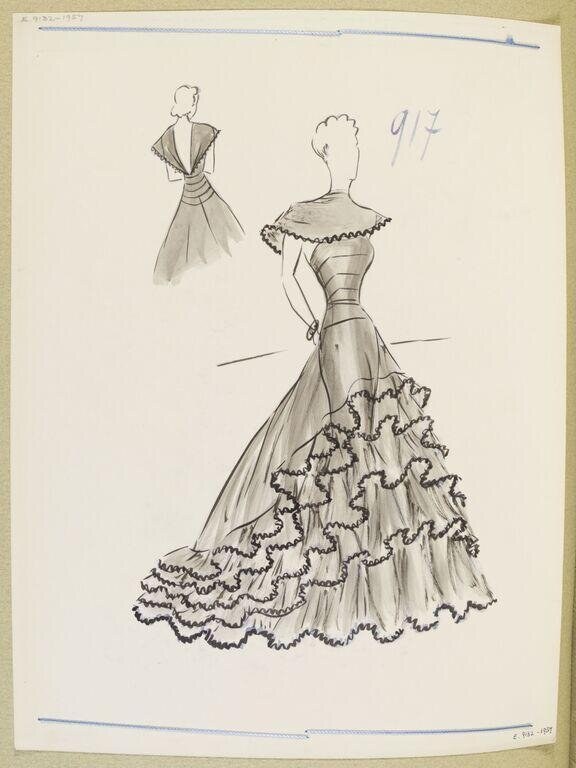
While not a depiction of dance, this sketch is historically significant as a record of how evening wear was designed during a moment when formal dancing (ballroom, social, and theatrical) continued under wartime constraints. The tiered skirt and corseted silhouette of the lower gown represent the construction and proportional ideals that dancers would have worn and moved within at formal events of the era. For costume historians and scholars of mid-century fashion, it documents a designer's working method and the garment types in circulation.
What you are looking at
Two fashion design sketches on a single sheet, both depicting evening gowns from the 1939–40 season. The upper sketch shows a back view of a woman in a fitted dress with a structured jacket or bodice, drawn in light outline with minimal shading. The lower and more elaborate sketch presents a rear three-quarter view of an off-shoulder ballgown with a dramatically tiered and ruffled skirt that cascades in multiple tiers to a full train. The skirt is rendered with dense cross-hatching to suggest volume and texture; the bodice is corseted and fitted tightly at the waist, with the neckline finished in what appears to be lace or ruched fabric. The figure in the lower sketch stands with weight slightly forward, one hand at the hip, presenting the dress in a formal display pose typical of fashion illustration. Both drawings are executed in graphite pencil on cream paper; the lower sketch is labelled in blue ink with what appears to be a style or sample number.
The dancing
The figures are rendered as fashion croquis—stylized, elongated female forms used to display garments rather than to represent human anatomy. Both stand in frontal or near-frontal stance with minimal articulation of limbs; the focus is entirely on the silhouette and structure of the dress. The upper figure is shown full-length from behind, emphasizing the jacket line. The lower figure adopts a more dynamic pose with one arm bent and hand resting near the hip, a gesture common in 1930s–40s fashion illustration to convey elegance and poise. Neither figure conveys active movement; they are static presentation poses.
The dance depicted
This work does not depict dance. It is a fashion design sketch, not a representation of dancers or choreographed movement. The figures are costume display forms, not performers captured in motion or a narrative moment of dance.
How it was made
The sheet combines graphite pencil drawing with blue ink notation. The upper sketch is lightly rendered with outline and minimal wash; the lower is more densely worked, with cross-hatching and parallel lines used to indicate the texture and volume of the tiered skirt. This is a working design drawing, likely created as part of a designer's seasonal collection development. The sketch technique—rapid, economical line with selective shading—was standard practice in mid-twentieth-century fashion studios and suggests this was a professional working document rather than a finished presentation piece.
About this work
This is a fashion design sketch by Ana de Pombo for the winter 1939–40 season, showing two evening gown silhouettes rendered in graphite and ink on paper. The work belongs to the collection as a document of costume and dress history rather than as a dance artwork per se; it is included because it records the formal evening wear of the period in which dance was performed and because fashion illustration—particularly the design of stage costume—intersects with dance history and practice. The sketch demonstrates the materials, methods, and aesthetic priorities of mid-century fashion design during the Second World War.
How to look at it
Attend to the construction of the skirt in the lower sketch: the parallel horizontal lines and cross-hatching are the designer's notation of how the fabric is to be cut and arranged—each tier is a separate ruffle or flounce sewn to a base. The tight corseting of the waist and the delicate treatment of the neckline contrast sharply with the abundance of the skirt below, a design principle that was both visually striking and restrictive to movement. The pose of the figure—hand at hip, slight forward tilt—is a convention of fashion illustration meant to suggest elegance and the drape of the fabric in wear, not an actual movement or dance position.
The artist
Ana de Pombo was a fashion designer working in the mid-twentieth century; the sketch is catalogued within a fashion design collection, suggesting she was a professional practitioner producing designs for manufacture or commission. No further biographical information is available from the record.
The period
This sketch dates to the winter of 1939–40, the opening phase of the Second World War, a period when fashion continued despite rationing and military disruption in many European regions. The formal evening wear depicted here—particularly the elaborate tiered skirt—represents the persistence of pre-war luxury silhouettes during a period when such garments were increasingly rare and restricted. Ballroom dancing and formal social dance continued during the war, though often in modified contexts. The design reflects the aspirational aesthetic of the period: structured, feminine, and labor-intensive in construction.
Where it lives
The sketch is held within a fashion design collection and is identified as a working drawing from the designer's studio. It was catalogued with a date of 1939 and carries a catalogue or style notation in ink, suggesting it was part of a professionally maintained design archive.
Questions about this work
Why is a fashion sketch in a gallery of dance?
While this work does not depict dance, it documents the garments worn by dancers and social dancers during a specific historical moment. Costume is integral to dance history, and fashion design sketches record how bodies were shaped and constrained by the clothes they wore. The collection includes such works to illuminate the material context in which dance took place.
Could someone dance in a dress like this?
The lower gown, with its heavily tiered skirt and corseted waist, would severely restrict movement. It was designed for standing, sitting, and slow promenade rather than vigorous or rhythmic dance. A ballroom dancer in formal evening wear of this type would be limited to a close, upright frame and small, controlled steps—precisely the aesthetic of formal ballroom dancing of the era.
What does the cross-hatching mean?
The parallel lines and cross-hatching are a designer's shorthand notation indicating texture, fabric weight, and how fullness is achieved in the garment. In this case, they suggest the layering and ruffling of the skirt and the depth of each tier. This is a working sketch, not a finished illustration, so the notation is compressed and technical.
More dance artwork





