49 works in this view — arrow keys or swipe to move between them.
Dance in Art
Été 1939
Ana de Pombo
- Collection:
- Fashion design
- Source:
- Victoria and Albert Museum
- Rights:
- Rights vary by item — check the source record before reusing this image. Source record ↗
- Recorded as:
- V&A — check rights per item
Fashion design documents like this are often overlooked in dance history, yet they are essential evidence of how dancers and ballroom-goers moved in practice. The construction of this skirt—with its tiers and ruffles—directly affected the mechanics of turning, traveling, and the visual spectacle of movement. This sketch also documents the work of Ana de Pombo, a designer whose practice intersected costume design, fashion, and theatrical aesthetics during a crucial moment in 1930s European fashion and dance culture.
What you are looking at
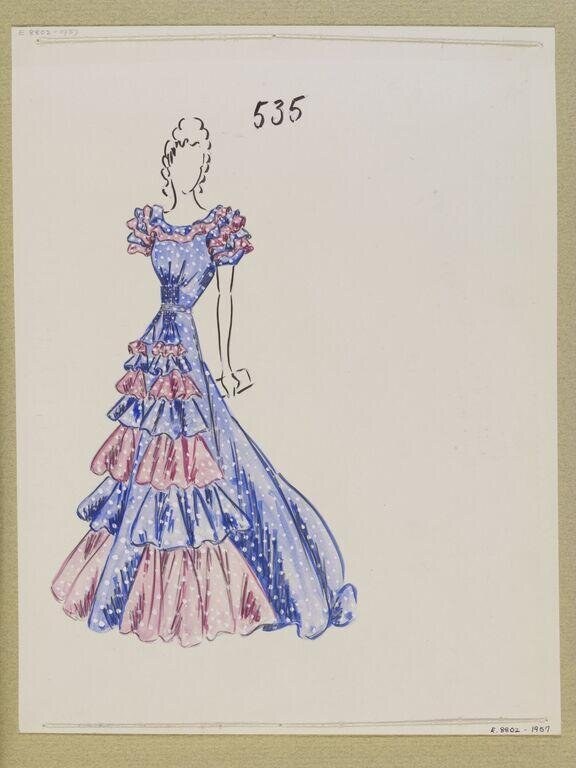
A fashion design sketch for an evening gown titled Été 1939 (Summer 1939), rendered in ink with watercolor. The figure is drawn in a simplified, elegant line style typical of haute couture illustration—a single female form shown from the front in a three-quarter stance, with the head tilted slightly and rendered as a minimal outline. The gown dominates the composition: a full-skirted evening dress with a fitted bodice and dramatic tiered skirt constructed from alternating bands of periwinkle blue and dusty rose or mauve fabric. The skirt layers cascade from the waist in a series of ruffled or flounced tiers, creating volume and movement, with the layers growing progressively wider as they descend. The bodice features short puffed sleeves in a contrasting patterned or textured fabric—suggesting embroidery or beading in blue and coral tones. The waistline is tightly cinched, emphasizing the silhouette favored in 1930s couture. A trailing skirt panel or train extends to the right, adding dynamism to what would otherwise be a static presentation. The illustration is rendered with confident, economical line work for the figure and more detailed color work for the dress itself, using the watercolor medium to create subtle gradations and suggest the movement of silk or similar luxury fabric.
The dancing
The figure is presented as a fashion croquis—a stylized representation designed to showcase the garment rather than depict actual human anatomy in naturalistic proportion. The pose is upright and formal, with minimal indication of actual dance movement or bodily action. The left arm hangs loosely at the side; the right arm is similarly relaxed. The stance suggests a standing position, not an active step or turn. The head is tilted and rendered with elegant simplicity, gazing downward in a pose conventional to fashion illustration of the period. There is no indication of weight transfer, balletic turnout, or dynamic line through the body that would suggest the figure is actually dancing.
The dance depicted
This is a fashion design, not a document of dance itself. However, the gown's construction—particularly the tiered, ruffled skirt and the dramatic silhouette—belongs to the tradition of evening wear designed for ballroom dancing in the late 1930s. The voluminous skirt would move fluidly during social dancing, whether waltz, foxtrot, or tango. The fitted bodice and short puffed sleeves reflect Art Deco and 1930s modernist design principles applied to formalwear. While the sketch does not depict a specific dance or dancer in motion, it documents the material culture of dance practice: the dress would have been worn in ballroom or theatrical contexts, and its construction reveals assumptions about how an aristocratic female dancer or socialite would move.
How it was made
This is a fashion design sketch in ink and watercolor on paper. The technique is characteristic of haute couture design practice in the 1930s: rapid pen drawing to establish the silhouette and figure, followed by careful watercolor application to indicate color, fabric character, and the play of light across draped material. The watercolor allows for subtle color transitions and suggests the luminosity of silk under stage or ballroom lighting. Fashion sketches like this circulated among couture houses, atelier seamstresses, clients, and sometimes in fashion publications; this particular sketch was part of the collection of Ana de Pombo, suggesting it may have been a presentation piece or sample from a designer's studio. The technique was the industry standard for communicating design intent before the widespread use of photography for fashion.
About this work
This is a fashion design sketch for an evening gown dated 1939 by the artist Ana de Pombo. Though not a depiction of dance itself, it documents the formal wear worn for ballroom dancing and social events in the late 1930s. The gown's construction—a fitted bodice with decorative short sleeves and a dramatically tiered, ruffled skirt in alternating colors—shows how designers engineered clothes to move with the dancer's body. The sketch exemplifies the couture design process and reveals the material conditions under which theatrical and social dancing took place during this period. The work belongs in a dance collection not because it depicts movement, but because it preserves a crucial artifact of how dancers and socialites were dressed and how that dress shaped the body's capacity for motion.
How to look at it
Attend to the engineering of the skirt: notice how the tiers overlap and how the color alternation creates rhythm and visual momentum even in a static image. The way the watercolor is applied—lighter at the edges of each tier, darker in the folds—suggests how silk would catch light and shadow as the dancer moved through a turn. The proportions of the figure relative to the skirt are exaggerated in the fashion-illustration convention, elongating the legs and emphasizing the garment's dominance. The downward gaze and relaxed arm position are characteristic of fashion-sketch convention, designed to draw the eye to the dress itself rather than to suggest a specific moment of dance.
The artist
Ana de Pombo was a fashion and costume designer active in the 1930s whose practice spanned haute couture and theatrical design. The holding collection lists her work as Fashion design, suggesting she may have worked for or maintained a design studio or atelier. Her sketch practice—evident in the style and confidence of this work—places her among professional couture designers of the period. Beyond this, biographical details are not readily available in the record.
The period
The late 1930s were a period of sophisticated elegance in formal ballroom wear, even as Europe approached war. Art Deco and modernist design principles—evident in the clean lines, geometric color blocking, and stylized silhouette here—had fully penetrated high fashion by 1939. Evening gowns of this period were engineered for movement: the tiered skirts allowed for the full extension and turn required by waltz, foxtrot, and Latin dances. Simultaneously, theatrical dance (particularly ballet and music-hall revue) influenced evening wear design; the decorative, embellished bodice and sculptural sleeves suggest theatrical influences. This was also the last moment of pre-war European couture luxury; the Second World War would dramatically interrupt both high fashion and ballroom culture.
Where it lives
The work is held as part of a Fashion design collection. The catalogue record identifies it as coming from a source marked 'va' (likely an archival or institutional code). It was assigned an accession or inventory number (535) and a record number (2062, 1967), suggesting it has been formally accessioned into an institutional collection.
Questions about this work
Is this a drawing of a dancer?
No, it is a fashion design sketch—a blueprint for a garment. The figure is stylized and posed in the conventional way fashion designers present clothes: standing still, with minimal gesture. However, the dress itself was designed to be worn while dancing, particularly in ballroom contexts, and its construction directly reflects how it would move.
What dance would this dress have been worn for?
The fitted bodice and voluminous tiered skirt are characteristic of formal ballroom wear from the late 1930s. A woman wearing this gown would likely have danced waltz, foxtrot, tango, or quickstep at a formal ball or society event. The skirt's construction—with its ruffles and tiers—was designed to move fluidly during these dances.
What is the medium?
The sketch is executed in ink and watercolor on paper, the standard technique for haute couture design presentation in the 1930s. The ink establishes the silhouette and figure, while watercolor indicates color, fabric character, and the play of light across the dress.
Who was Ana de Pombo?
Ana de Pombo was a fashion and costume designer active in the 1930s. Beyond the works in this collection, limited biographical information is currently available. Her practice appears to have encompassed both haute couture and theatrical costume design.
More dance artwork





