49 works in this view — arrow keys or swipe to move between them.
Dance in Art
Été 1939
Ana de Pombo
- Collection:
- Fashion design
- Source:
- Victoria and Albert Museum
- Rights:
- Rights vary by item — check the source record before reusing this image. Source record ↗
- Recorded as:
- V&A — check rights per item
The gown represents the material culture and body aesthetics of 1930s ballroom society—the silhouettes, fabrics, and ideals that shaped how dancers moved and were seen in formal social spaces. For fashion and dance historians, this design document offers concrete evidence of how the dressed body was conceived on the eve of World War II, and how garment construction directly enabled or constrained movement in social dancing.
What you are looking at
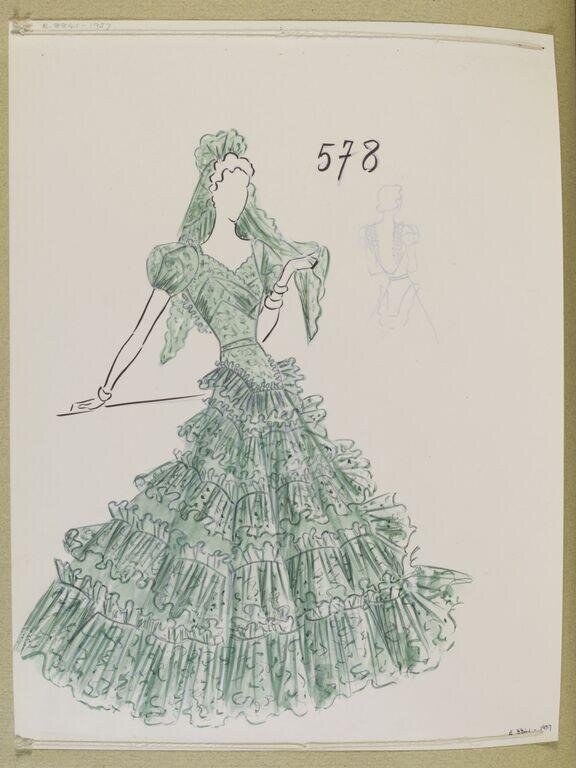
A single female figure dominates the composition, shown from roughly the waist up, posed against a plain cream background. She wears an elaborate 1930s evening gown with dramatic architectural construction: a fitted bodice with puffed short sleeves and what appears to be beaded or sequined detailing across the chest, and an extraordinarily voluminous skirt composed of deeply pleated or fluted layers that cascade downward in a sculptural, almost shell-like formation. The skirt's rippling texture creates strong shadow lines that emphasize its three-dimensional structure. The figure holds a long cigarette holder in her extended right hand, a gesture characteristic of interwar sophistication, while her left hand rests near her body. Her hair is styled in period waves, and her pose is elegant and self-possessed—the bearing is aristocratic rather than athletic. The drawing is executed in green ink with considerable precision in the rendering of fabric texture, particularly in the intricate pleating of the skirt.
The dancing
The figure's stance is poised but static—no active movement or weight shift is evident. The extended arm with the cigarette holder creates a diagonal line across the composition, a fashionable gesture of the period. The posture suggests a moment of social presentation or display rather than any choreographic movement. There is no indication of dance technique, weight distribution for turning or traveling, or engagement of the body as a moving instrument.
The dance depicted
This is not a depiction of dance. It is a fashion design drawing—a couture sketch showing a proposed evening gown. The figure is a mannequin or idealized female form presented for the purposes of garment visualization, not a dancer in motion. The static, three-quarter pose is entirely conventional for fashion illustration of the period; it exists to display the garment's silhouette and construction rather than to capture any moment of choreography.
How it was made
The work is a pen or ink drawing, executed in green ink on cream or off-white paper. The medium is characteristic of professional fashion design documentation: quick-drying, precise, and reproducible. The technique shows considerable control in rendering the complex pleating of the skirt through careful hatching and line work; the artist understood textile structure and how to suggest fabric weight and dimension through mark-making. This is a working drawing or presentation sketch, the kind that would be circulated within haute couture ateliers or shown to potential clients; its refinement and clarity suggest it was made by a professional trained in fashion illustration.
About this work
This is a couture evening gown design by Ana de Pombo, dated summer 1939. The work documents a moment of extraordinary sophistication in 1930s fashion at the very threshold of World War II—a gown whose architectural ambition and opulent material construction represent the aspirational luxury of the pre-war interwar elite. While not itself a dance image, the gown is of historical interest to dance historians because such couture garments were central to ballroom culture, social dancing, and the aesthetic presentation of the body in motion during the 1930s. Ballroom dancers and society figures would have worn such pieces at public dances, galas, and private events; fashion and dance were inseparable aspects of the same social world. Pombo's design captures the precise moment when such garments still represented the height of accessible luxury before the interruption of war.
How to look at it
Attend first to the skirt's construction—the repeated pleating is not decorative but structural, engineered to hang in a particular way and to move in a controlled, architectural manner. The cigarette holder is a period detail that signals the intended wearer's social status and the contexts in which such a gown would be worn (evening social events, galas, ballrooms). Notice also the restraint in the upper body: the fitted bodice and controlled sleeve proportion contrast sharply with the skirt's exuberance, a design principle typical of 1930s couture that kept the dancer's upper frame controlled while allowing the lower body freedom in movement.
The artist
Ana de Pombo was a fashion illustrator and couture designer active in the 1930s. Nothing is recorded of her training or broader practice; this drawing is the sole entry point to her work in the catalogue. The precision and professional finish of the sketch suggest formal training in fashion design and illustration, possibly at a European atelier during the interwar period.
The period
In 1939, European high fashion was reaching a peak of technical complexity and material richness even as political crisis deepened. The extraordinary pleating and construction evident in this gown—which would have required significant hand labor—represents the last moment of unconstrained luxury before wartime shortages and rationing fundamentally altered garment production and silhouette. In ballroom culture, the late 1930s saw codification of standard dances (Foxtrot, Waltz, Quickstep, Tango) and the rise of competitive ballroom dancing; gowns like this one were designed to move within the frames and patterns of these formal dances while displaying technical virtuosity in tailoring.
Where it lives
The work is held in a fashion design collection as a historical design document, catalogued as part of a broader archive of interwar couture. The catalogue reference number 578 and the notation "Été 1939" (Summer 1939) suggest this was part of a designer's portfolio or a client collection organized by season and year.
Questions about this work
Why is this in a gallery about dance?
Couture garments were integral to ballroom and social dance culture in the 1930s. Dancers wore such gowns, and their construction directly shaped movement possibilities. Fashion design documents offer historians evidence of the dressed body in social and formal dance contexts, and of the material culture that surrounded dancing elites.
Could this gown actually be danced in?
Yes. The pleated skirt, while elaborate, was designed to move; the structured pleating would actually catch air and motion in favorable ways during Foxtrot, Waltz, or similar dances. The fitted bodice and controlled upper body would allow a ballroom dancer's frame to remain stable while the skirt created visual drama in spinning or traveling movements.
Who was Ana de Pombo?
Little is documented about her beyond this drawing. She was a professional fashion illustrator working in the 1930s, likely trained in European couture design. This sketch is currently the only recorded work in public collections.
More dance artwork





