49 works in this view — arrow keys or swipe to move between them.
Dance in Art
Hiver 1937-38
Ana de Pombo
- Collection:
- Fashion design
- Source:
- Victoria and Albert Museum
- Rights:
- Rights vary by item — check the source record before reusing this image. Source record ↗
- Recorded as:
- V&A — check rights per item
The work matters to fashion history and to the study of women's dress in the 1930s, but there is no evidence from the image or the record that it relates to dance history. If de Pombo worked as a costume designer for ballet or theatrical dance, that context would need to be established from sources outside this drawing.
What you are looking at
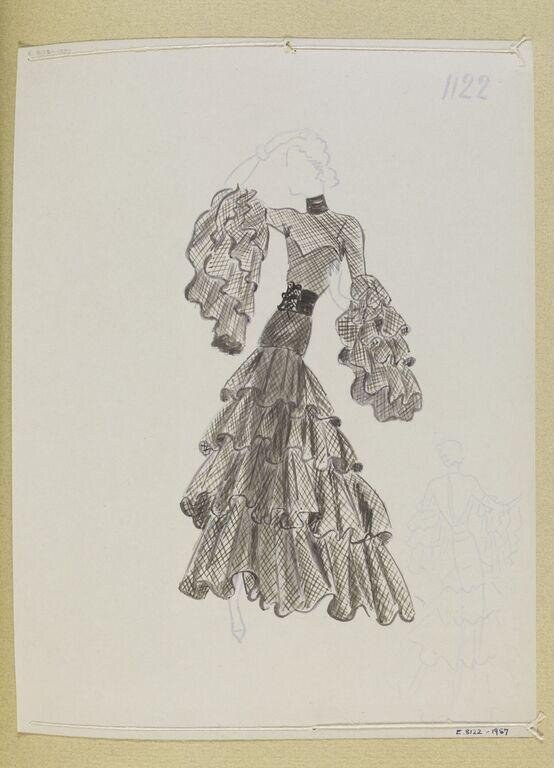
A fashion design sketch in pen or ink showing a single female figure in three-quarter view, the body rendered summarily with minimal facial detail. The figure wears an elaborate winter ensemble composed of a fitted bodice with a dark belt and a voluminous skirt with deep, irregular pleats or tiers that cascade to the ankle. The upper garment features a plaid or checked pattern with crosshatching, while the skirt shows similar patterned detailing in its construction. The sleeves are notably full and gathered, with ruffled or flounced cuffs that extend past the wrists. The overall silhouette is characteristic of late 1930s fashion—the high waistline, the theatrical volume in the lower skirt, and the exaggerated sleeve treatment typical of that period. The sketch is executed with loose, sketchy linework that emphasizes volume and fold over anatomical precision, a technique that allows the designer to convey movement and the desired spatial presence of the garment.
The dancing
The single figure stands with weight centered, posed to display the garment rather than to depict a specific moment of movement. The body is treated as a form for drapery rather than as a dancer's instrument—the stance is frontal and static, the arms held away from the body to display the sleeve treatment. There is no suggestion of a closed hold, weight transfer, or the kinetic geometry that characterizes dance imagery.
The dance depicted
This is a fashion design and does not depict dance. The figure is a dressmaker's model—a static presentation of a winter garment proposal—not a dancer or a choreographed moment. The title *Hiver 1937-38* (Winter 1937-38) indicates a seasonal fashion collection or sketch, not a dance work.
How it was made
The work is executed in pen or ink on paper, a standard technique for fashion design sketches of the period. The loose, economical linework with selective crosshatching for pattern and shading was the conventional approach to rapid design presentation: quick enough to iterate ideas, precise enough to communicate construction details to a seamstress or manufacturer. This is a working drawing, not a finished illustration, intended for an atelier or fashion house rather than public circulation.
About this work
This is a fashion design sketch by Ana de Pombo from 1937–38, showing a winter garment proposal with the silhouette and construction details characteristic of late 1930s couture. The sketch records an idea for an ensemble—a fitted, belted bodice with full sleeves and a dramatically pleated skirt. While the drawing technique and the figure's pose are those of fashion design practice, the work belongs in a gallery of dance in art only if Ana de Pombo was known to design costumes for theatrical or dance performance, or if the garment's theatrical volume and constructed drama were part of dance costume practice of the period. The catalogue record does not indicate either context.
How to look at it
Attend to the construction lines and hatch marks that indicate the intended texture and layering of the fabric—the plaid of the bodice, the pleating of the skirt. Notice how the designer has left the figure's anatomy minimal and summary, focusing all visual interest on the volume and drape of the garment. The loose linework is not carelessness but precision of another kind: it communicates the designer's intention quickly and allows a seamstress to read proportions and seam lines at a glance.
The artist
Ana de Pombo is not identified in the record beyond her name and the attribution. The title and date suggest work in the Paris fashion world of the 1930s, a period of intense experimentation in haute couture, but without further documentation this remains a supposition.
The period
The sketch dates to 1937–38, a moment when European fashion, particularly in Paris and Prague, was responding to political upheaval and economic uncertainty by intensifying the drama of silhouette and construction. The exaggerated proportions—the full sleeves, the sculptural skirt—reflect the period's turn toward theatrical presentation and away from the streamlined bias-cut dresses of the early 1930s. In parallel, European ballet and theatrical dance were developing increasingly elaborate scenic and costume vocabularies, but there is no direct evidence linking this sketch to that world.
Where it lives
The work is held as a fashion design in the V&A collections (source: va). It is catalogued as a fashion object rather than as dance-related material, and there is no indication in the record of theatrical or costume context.
Questions about this work
Is this a dance costume design?
There is no evidence in the image or the catalogue record that this is a dance costume. It is a fashion design for a winter garment in the commercial couture tradition. The static pose and the emphasis on drape and construction detail are those of fashion illustration, not dance imagery.
Why is this in a dance gallery if it is not dance?
This should not be in the gallery without additional documentation. If Ana de Pombo designed costumes for theatrical or dance performance, or if this sketch was later adapted for dance use, that context would need to be recorded and linked in the catalogue. At present, the image and record do not support the inclusion.
What does the title mean?
*Hiver* is French for winter. The dates 1937–38 indicate this was part of a seasonal collection proposal, likely presented to clients or manufacturers in the autumn of 1937 for the winter months to follow.
More dance artwork





