49 works in this view — arrow keys or swipe to move between them.
Dance in Art
Été 1934
Madeleine Wallis
- Collection:
- Fashion design
- Source:
- Victoria and Albert Museum
- Rights:
- Rights vary by item — check the source record before reusing this image. Source record ↗
- Recorded as:
- V&A — check rights per item
For fashion historians, this work documents the silhouettes and proportions of 1930s evening wear at a moment when the bias cut and fluid draping were defining innovations. For historians of dance and social practice, it shows the kind of garment that dancers of the 1930s would have worn to ballrooms and nightclubs, evidence of the material culture surrounding swing, lindy hop, and ballroom dancing in the interwar era.
What you are looking at
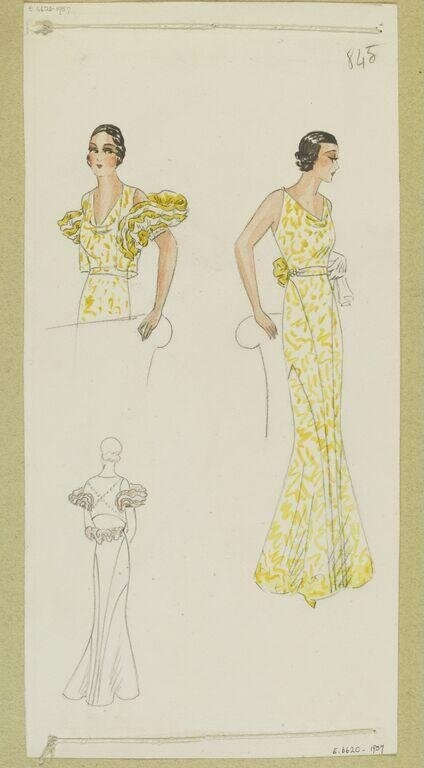
Three fashion design sketches arranged vertically on cream paper, all depicting women's evening wear in yellow printed fabric with coordinating geometric or floral patterns. The two finished sketches show front and three-quarter views of the same design: a floor-length gown with a fitted waist, draped hip detail, and a fluid skirt that extends into a train. The figure on the left wears a shorter version with dramatic puffed sleeves and a V-neckline, shown in front view with the model's hand at her side holding a small circular object, possibly a clutch or compact. The figure on the right displays the full-length evening gown in profile, showing the elegant line of the garment and the sweep of the hem. A third sketch below shows a preliminary line drawing, possibly exploring draping or alternative proportions. The sketches employ minimal color—yellow watercolor or gouache for the fabric, with black ink for outlines and details—and demonstrate the practiced hand of a commercial fashion illustrator working in the 1930s idiom.
The dancing
All three figures are drawn in the elongated, elegant proportions typical of 1930s fashion illustration—high foreheads, slender necks, and attenuated limbs. The standing figures display the contrapposto stance conventional to fashion drawing of the period, with weight shifted to one leg and the opposite hip angled. The figure on the left has her arm relaxed at her side in a natural stance that suggests the garment is meant for movement; her face is rendered in three-quarter view. The right-hand figure stands in strict profile, presenting the garment's silhouette. Neither figure gestures toward dance; they are presentation poses designed to show the cut and drape of the clothing rather than any physical action.
The dance depicted
This work does not depict dance. It is a fashion design document, likely a proposal or presentation sketch for a couture or ready-to-wear collection. The title suggests the sketches were made in summer 1934 and may have been intended for a seasonal line. The garments themselves—evening gowns with trained skirts and refined proportions—belong to formal ballroom wear of the period, and such dresses would certainly have been worn for dancing at balls and nightclubs. But the sketches show no dancers, no movement beyond the controlled stance of a fitting model, and no indication of a specific dance style or genre.
How it was made
Watercolor or gouache with pen and ink on paper. The artist has applied a flat wash of yellow-gold to the fabrics, leaving the paper showing through for highlights and using fine black line-work to define seams, pleats, and pattern details. The economical technique—minimal color, maximum clarity of line—is characteristic of commercial fashion illustration of the 1930s, where the goal was to communicate design intent quickly to manufacturers, retailers, and potential clients. This was a reproducible, practical mode of design documentation rather than fine art, circulated among the fashion industry as part of seasonal collections.
About this work
This is a set of three fashion design sketches by Madeleine Wallis, created in 1934 and held in the V&A's fashion design collection. The sketches present variations on an elegant evening gown in a bright yellow printed fabric, rendered in the fluid, linear style of 1930s couture illustration. While the garments belong to the world of formal ballroom dress and would have been worn by dancers in contemporary nightclubs and society balls, the sketches themselves are concerned with construction, proportion, and the visual presentation of cloth—not with dance movement or choreography.
How to look at it
Look at the precision of the line-work: the way seams are indicated with a single fine stroke, the way pleats and gathering are suggested rather than elaborated. Notice the constraint of the color palette—yellow, black, and the paper's white—and how much design information the artist conveys within those limits. The three-quarter and profile views are chosen specifically to show the garment's shape from the most flattering and informative angles. The sketches are a conversation with manufacturers and retailers, not with dancers, but they are nonetheless evidence of how dance and fashion culture interpenetrated in the 1930s.
The artist
Madeleine Wallis was a fashion illustrator and designer working in the 1930s, active in the London fashion world during a period of significant change in dress design and illustration technique. The refined, economical line-work visible in these sketches suggests professional training and regular practice in commercial design drawing. Little is documented about her broader practice or career trajectory, but her presence in the V&A collection indicates professional recognition at the time.
The period
The summer of 1934 sits at a fascinating moment in fashion and social dance. The 1920s had brought dramatic informality to women's dress—dropped waistlines, shortened hemlines, the abandonment of corsetry—but by the early 1930s, a new silhouette was emerging. The bias cut, pioneered by designers like Madeleine Vionnet, created fluid, body-conscious evening wear that moved with the dancer. This was also the era of the swing ballroom, the nightclub, and the rise of social dancing as a major leisure activity for young middle-class women and men. The garments Wallis sketches—elegant, mobile, designed for movement—reflect that cultural moment perfectly, even if the sketches themselves are not concerned with depicting dance.
Where it lives
Held in the V&A's fashion design collection, catalogued as a work from 1934. The sketch is typical of the commercial design drawings that make up the bulk of fashion archives—working documents rather than finished artworks, preserved because they record the visual language and technical knowledge of the period's working designers.
Questions about this work
Why is a fashion design sketch in a gallery about dance?
Fashion and dance are inseparable historical subjects. The clothes people wore to dance—their cut, drape, and flexibility—shaped what movement was possible and comfortable. Conversely, changes in social dancing influenced fashion design. These sketches document the material culture of 1930s ballroom culture, even though they are not dance art themselves.
What dance would someone wear this dress to?
A gown like this was designed for evening dances—formal balls, nightclub dancing, and ballroom social events. In 1934, that would include lindy hop, swing, foxtrot, waltz, and the various ballroom styles then fashionable. The bias-cut drape and trained hem are features that allowed for movement across all of these styles.
Is this dress by a famous designer?
Madeleine Wallis is not widely known today, but her presence in the V&A's fashion collection indicates she was a professional illustrator and designer working in London in the 1930s. Many skilled designers and illustrators of the period are not remembered by name, though their work shaped the visual culture of their era.
More dance artwork





