49 works in this view — arrow keys or swipe to move between them.
Dance in Art
Hiver 1938
Ana de Pombo
- Collection:
- Fashion design
- Source:
- Victoria and Albert Museum
- Rights:
- Rights vary by item — check the source record before reusing this image. Source record ↗
- Recorded as:
- V&A — check rights per item
This work belongs in a dance collection not as choreography or a dance scene, but as material evidence of the garments that shaped how people danced in the 1930s ballroom. The design of the skirt—its weight, volume, and layering—directly dictates how a dancer moves in it; understanding the costume is essential to understanding the movement. Pombo's sketch is a primary document of the relationship between fashion design and social dance practice.
What you are looking at
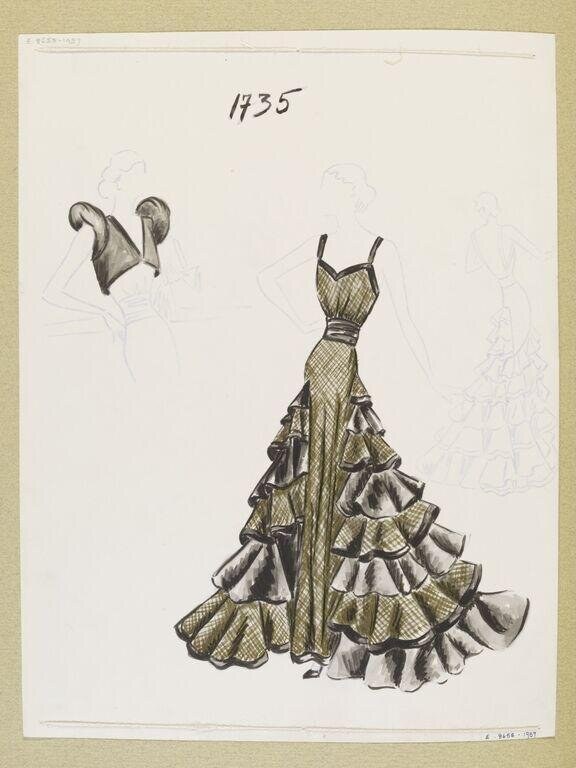
This is a fashion design sketch for an evening gown titled *Hiver* (Winter) of 1938. The drawing shows a full-length woman's dress viewed from behind, rendered in ink with cross-hatching for shading and texture. The gown features a fitted bodice with thin shoulder straps and a dramatically voluminous skirt composed of layered, ruffled tiers that cascade down from the waist and trail onto the ground. The fabric appears to be patterned (cross-hatched to suggest a textile weave), while the ruffles are rendered in bold shadow to create depth and movement. At upper left, a separate detail sketch shows what appears to be a draped shoulder or sleeve element in a darker tone. The sketch is annotated with the number 1435, suggesting a design catalog or collection reference. The drawing technique and style are characteristic of 1930s haute couture illustration, with confident line work and attention to the silhouette and drape of the fabric.
The dancing
The figure is a fashion croquis—a stylized standing pose with minimal anatomical detail, used to showcase the garment rather than the body. The woman stands in a three-quarter rear view, weight evenly distributed. No actual bodily movement or dance posture is present; the figure exists as a static frame for the dress itself. The pose is utterly still and formal, the kind of presentation stance standard to fashion design.
The dance depicted
This is not a depiction of dance. It is a couture design sketch with no narrative, choreographic content, or evidence of movement beyond the volumetric potential of the skirt itself. The dress is designed to *move*—the tiered ruffles suggest the swirl and flow of a ballroom gown—but the figure wears it in stillness, as a presentation garment.
How it was made
The work is executed in pen and ink with cross-hatching for texture and tonal modeling. The technique is characteristic of haute couture illustration of the 1930s: economical line work, strategic shading to suggest fabric weight and drape, and a detail sketch showing construction or a particular feature. This manner of drawing was used for design documentation and possibly for presentation to clients or in fashion publications. The crisp, confident line work suggests a trained fashion illustrator's hand.
About this work
Ana de Pombo's *Hiver* is a 1938 evening gown design sketch—a working drawing in the idiom of Paris haute couture. The gown itself is designed for movement and spectacle: the layered, tiered skirt would create dramatic swirl and rustling in a ballroom setting, and the fitted bodice with delicate straps evokes the formal evening wear of the 1930s. Though not a dance scene per se, the dress is a costume object, engineered for the body in motion and the social dance contexts in which it would be worn. The sketch documents design intention rather than dance itself, but it is material evidence of how fashion and ballroom culture were interwoven in this period.
How to look at it
Study the skirt construction: the layering of the ruffles creates a silhouette that would move in concentric waves as the wearer turned or stepped. The cross-hatching on the fabric suggests a textured weave—perhaps a silk or wool that would catch light and show movement. The detail sketch at upper left, though small, indicates the designer's attention to how the garment's elements—here, probably a sleeve or shoulder drape—would function in three dimensions. The rear view is deliberate: it shows the back of the dress, the aspect a partner would see in a closed ballroom hold.
The artist
Ana de Pombo is documented here only as a fashion designer active in 1938. No further biographical information is available from the catalogue record. The style and confidence of the sketch suggest professional training and practice in haute couture design illustration, likely in Paris or a major European fashion center during the interwar period.
The period
The 1930s were the height of the Art Deco evening gown and the social ballroom era. The silhouettes of this decade—fitted bodices, long skirts, dramatic use of fabric—were engineered for the formal dances of the ballroom: waltz, foxtrot, and quickstep. The tiered, ruffled skirt of *Hiver* is particularly suited to the rotational movement and swirl of these dances. Fashion illustration itself was a major art form and publishing industry in Paris, where the most prestigious couture houses presented their collections through both runway shows and illustrated design sheets circulated in fashion magazines and to wealthy clients.
Where it lives
The work is held in a fashion design collection, sourced as VA (likely the Victoria and Albert Museum, London, which holds extensive fashion archives). The catalog number 1435 suggests it was accessioned as part of a larger donation or collection of design sketches, possibly from Pombo's studio or a collection of 1930s couture documentation.
Questions about this work
Why is a fashion design sketch in a dance collection?
Costume is fundamental to how dance is performed. The cut, weight, and movement of a garment shape how a dancer moves through space. This sketch documents what a ballroom dancer would have worn in 1938 and is evidence of how fashion and dance practice were inseparable in this era.
What dance would this dress have been worn for?
A gown of this formality and silhouette would have been worn for formal ballroom dancing—waltzes, foxtrots, quicksteps, and other standard dances of the 1930s ballroom. The layered skirt is designed to create visual and kinetic drama as the wearer turned and moved across the floor.
Who was Ana de Pombo?
The catalogue record provides no biographical detail beyond her name and the date and nature of this work. She was a fashion designer active in 1938, likely based in a major European fashion center. Further research would be needed to establish her full practice and career.
More dance artwork





