49 works in this view — arrow keys or swipe to move between them.
Dance in Art
Été 1939
Ana de Pombo
- Collection:
- Fashion design
- Source:
- Victoria and Albert Museum
- Rights:
- Rights vary by item — check the source record before reusing this image. Source record ↗
- Recorded as:
- V&A — check rights per item
Fashion design drawings are primary sources for understanding how garments constrained or enabled dance, and how dancers' bodies shaped fashion. This drawing shows us that a designer in 1939 was thinking about the dress not as a static object but as an apparatus for social dancing—the ruffled skirt construction, the corseted frame, the proportions, all depend on an imagined moving body.
What you are looking at
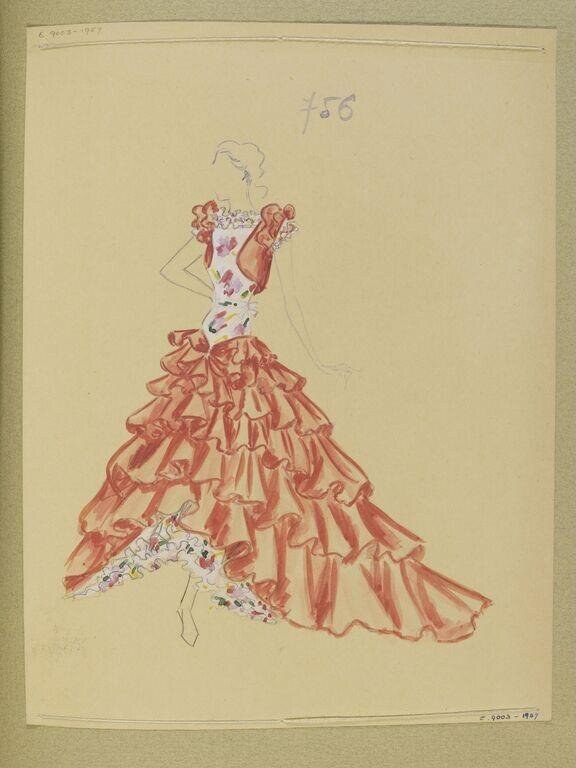
A fashion illustration of a woman in an elaborate evening gown, rendered in watercolor and ink on cream paper. The figure is shown in a three-quarter pose, her body oriented to the left, with her head tilted gracefully upward. She wears a white or pale corset-style bodice with puffed short sleeves and a fitted waist, decorated with small floral sprigs. The focal point is the voluminous skirt, constructed from layers of deep coral or rose-red silk organized into dramatic ruffles and knife pleats that cascade from the waist to create an expansive silhouette. The hem is finished with a band of the same floral pattern visible on the bodice. The woman's simplified face and bare legs—sketched lightly in pencil—emphasize that this is a fashion design study rather than a finished portrait. The composition centers entirely on the dress and its sculptural volume; the figure exists primarily as an armature for displaying the garment's construction and movement.
The dancing
The drawn figure is schematic rather than anatomical—a wireframe for displaying drapery. The posture is upright and frontal, the left arm raised and bent at the elbow, the right arm at rest; both are rendered as minimal outlines. The head is tilted back slightly, a gesture of elegance and display. The legs are barely indicated, just two light pencil lines. The entire visual weight of the composition rests on the dress, which is rendered with far greater articulation than the body it clothes.
The dance depicted
This is not a depiction of dance but rather a fashion design study. However, the title *Été 1939* (Summer 1939) and the date align with the haute couture culture of 1930s Paris, when evening wear was designed for social dancing and ballroom events. The voluminous ruffled skirt, the corseted silhouette, and the theatrical presentation suggest a dress intended for formal dancing—likely ballroom or social waltz and foxtrot contexts—though no actual movement or choreography is shown. The garment itself is the subject; the figure is incidental.
How it was made
Watercolor and ink on paper, with pencil underdrawing visible in the figure's outline and legs. The technique combines precise ink line work for the dress structure with loose, gestural washes of coral and deep red pigment to suggest the volume and fall of the fabric. The white paper is left bare for highlights and the pale bodice. This mixed-media approach was standard for haute couture design drawings in this period—rapid, economical, and intended for production communication rather than exhibition. The style reflects the commercial illustration practices of 1930s Paris couture houses.
About this work
This is a fashion design drawing from 1939 Paris by Spanish designer Ana de Pombo, depicting a summer evening gown with an architecturally complex ruffled skirt in coral silk. It belongs in a gallery about dance in art because haute couture evening wear of this era was inseparable from ballroom dancing—the dress was designed for movement in closed-hold ballroom frames, and its cut and construction were calibrated for the specific dynamics of 1930s social dance. The garment itself is a kind of frozen choreography: the ruffles and pleats anticipate the turns and sway of a waltz or foxtrot, and the volume of the skirt speaks to a moment in fashion when evening dress was literally engineered for the dance floor.
How to look at it
Attend first to the garment's engineering: the ruffles are not sewn haphazardly but arranged in a mathematical pattern of pleats and folds that create volume without weight. Notice how the sketch captures the moment of potential movement—the skirt is not hanging passively but appears ready to swell and lift in a turn. The contrast between the minimal, lightly sketched body and the lavishly detailed dress is revealing: the designer is not interested in the dancer's anatomy or expression, only in how the dress will perform when set in motion. The pencil underdrawing of the legs emphasizes that this is a working document, not a finished artwork.
The artist
Ana de Pombo was a Spanish fashion designer active in 1930s Paris during the height of the art déco and early haute couture era. Little biographical information is currently recorded, but her work appears in the fashion archive as part of the interwar design documentation. She worked in the idiom of elegant evening wear for the affluent international clientele of Paris couture houses.
The period
In 1939, on the eve of World War II, Paris couture was at its apex. Evening wear was designed for an explicit social purpose: ballroom dancing in hotels, clubs, and private houses. The silhouette of the late 1930s favored a corseted bodice and dramatically full skirt—a style that both required and facilitated the closed-hold ballroom dances (waltz, foxtrot, tango) that dominated elite social life. The ruffled, structured skirt was both fashionable and functional, allowing the wearer to move freely in the flowing patterns of ballroom technique while maintaining visual drama. Fashion and dance were locked together in the social rituals of the period.
Where it lives
The work is held in the Fashion Design collection (source: VA, the Victoria and Albert Museum in London). It is catalogued as part of the museum's archive of twentieth-century fashion illustration and design documentation.
Questions about this work
Was this dress actually worn?
The record does not indicate whether this design was executed or remained a study. Fashion design drawings document both realized pieces and proposals that never reached production. The presence of the work in a museum collection suggests it had some significance, but whether the dress was made cannot be determined from the drawing alone.
What dances would someone wear this to?
In 1939, an evening gown of this formality and volume would have been worn to ballroom dancing events: the waltz, foxtrot, tango, and quickstep were the dominant ballroom dances. The corseted bodice enforces an upright frame consistent with standard ballroom posture, and the ruffled skirt was designed to move within the constrained patterns of closed-hold partnered dance.
Why is the figure so sketchy compared to the dress?
In professional fashion illustration, the garment is the subject and the body is secondary. The minimal, schematic rendering of the figure lets the viewer focus entirely on the dress's construction, volume, and line. The light pencil legs emphasize that this is a working design document, not a finished portrait.
More dance artwork





