49 works in this view — arrow keys or swipe to move between them.
Dance in Art
Hiver 1937-38
Ana de Pombo
- Collection:
- Fashion design
- Source:
- Victoria and Albert Museum
- Rights:
- Rights vary by item — check the source record before reusing this image. Source record ↗
- Recorded as:
- V&A — check rights per item
Fashion design sketches are rarely included in dance history, yet they are primary sources for understanding how dancers and performers were dressed, and how designers imagined the body in motion. This work documents the aesthetic dialogue between clothing and performance in the late 1930s, a moment when theatrical modernism and fashion design were inseparable.
What you are looking at
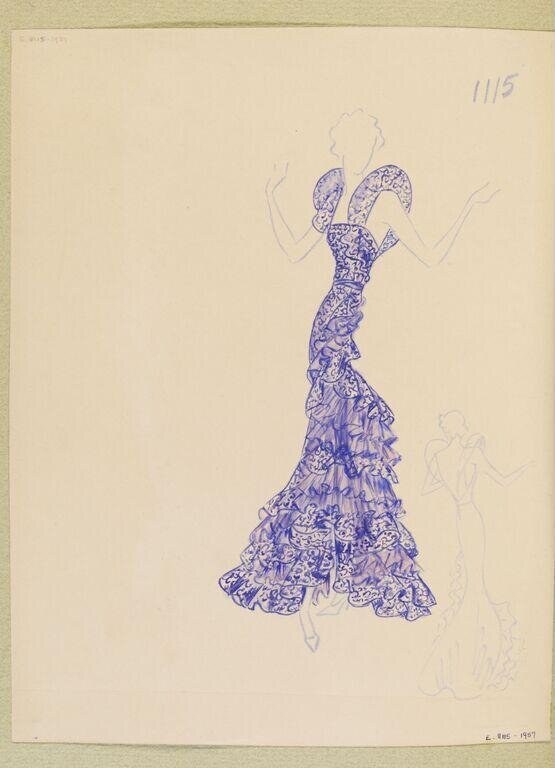
A fashion design sketch in blue ink on cream paper, depicting a tall, slender female figure in an elegant evening gown. The figure stands in a dynamic pose with both arms raised expressively and the head tilted back, suggesting movement or theatrical presentation. The gown features a fitted bodice with intricate patterning and a dramatically voluminous skirt that flares from the waist, covered in dense decorative motifs—possibly floral or abstract designs rendered in the same blue ink. The skirt dominates the composition, cascading to the ground in multiple tiers or ruches. The figure's bare shoulders and long neck are emphasized by the fitted upper garment. Two additional sketched figures appear faintly on the right side of the page, suggesting preliminary studies. The overall effect is that of a striking evening or performance costume, captured in a moment of elegant repose or theatrical display.
The dancing
A single primary figure dominates, rendered as an idealized fashion illustration with elongated proportions typical of mid-twentieth-century design drawing. The pose is open and expansive: both arms are raised symmetrically away from the body at shoulder height or above, with hands relaxed or gestural. The head is tilted back, the spine extended. The stance suggests weightlessness or a moment between movements—neither planted nor actively stepping. The torso is upright and narrow; the legs are long and vertical. This is the posture of display rather than active dance technique—the body is presented to the viewer rather than executing a step.
The dance depicted
This is not a dance notation or study of choreography, but rather a fashion design for theatrical or evening wear. The raised-arm pose and the dramatic presentation suggest a garment intended for performance—possibly for a dancer, revue performer, or society event attendee photographed or displayed in movement. The silhouette and the expressiveness of the pose align with 1930s theatrical fashion, when designers created costumes for cabaret, musical theatre, and society balls. Without a documented performance context, the specific dance genre cannot be identified; the work documents costume design practice rather than dance itself.
How it was made
This is a pen-and-ink drawing on paper, rendered in blue fountain pen or similar medium on a lightweight cream or ivory stock—the material of a working design sketch or presentation drawing. The technique is linear and descriptive: the artist has used dense parallel hatching and layered cross-hatching to create volume and pattern in the skirt, while keeping the bodice and upper body more lightly defined. The faint secondary figures suggest this was a working sheet, possibly for exploring variations or for a client presentation. The spontaneity and finish level suggest a designer's working sketch rather than a finished artwork, reflecting the ephemeral status of fashion illustration.
About this work
This is a fashion design sketch by Ana de Pombo, dated 1937, showing an evening gown rendered in blue ink. The drawing documents the designer's concept for a dramatic theatrical or formal costume, captured in the moment of presentation through an expressive, arms-raised pose. The work belongs in a dance collection not because it depicts a dancer in motion, but because theatrical costume design is integral to the visual history of performance—particularly in the era of the Paris revue, the Ballets Russes, and modernist theatre, when fashion designers worked closely with choreographers and performers. The sketch is an artifact of the intersection between fashion and performance design in the 1930s.
As a working design document, it reveals the designer's process and the aesthetic values of the period: the emphasis on silhouette, the flirtation between structure and drape, and the expectation that clothing would be worn in moments of display and movement. The date places it in the interwar period when Paris-based designers were at the height of their influence, and when collaboration between costume designers and performers was central to modernist theatre and dance.
How to look at it
Attend first to the pose and what it communicates: the raised arms and tilted head suggest a moment of theatrical presentation or arrival, not a step or a sequence of movement. This is a costume meant to be seen and admired as much as danced in. Then examine the contrast between the fitted, patterned bodice and the explosive, decorative skirt: the designer has created a garment in which the lower body dominates visually, ensuring that movement—spinning, walking, gesturing—would make the skirt the focus of attention. The blue ink hatching in the skirt suggests texture, weight, and volume: this is a garment with presence.
The artist
Ana de Pombo was a Paris-based fashion designer active in the 1930s. Little biographical information is widely available, but her work reflects the cosmopolitan, modernist design sensibility of interwar Paris. Designers of this period often created costumes for theatrical productions, cabaret, and society events, and maintained close relationships with performers and theatre companies. De Pombo's sketch demonstrates the technical skill and inventive approach to silhouette that characterized high-end fashion design of the era.
The period
The 1937 date places this work at the tail end of the interwar period, a time of extraordinary ferment in both dance and fashion. The Ballets Russes had established costume design as a major art form; modernist theatre and avant-garde performance were thriving in Paris; and fashion designers were pushing toward greater freedom of movement and more theatrical silhouettes. Evening wear was expected to be worn in social and performance contexts where the body moved; the raised-arm pose De Pombo has chosen reflects this merger of fashion and performance. The sketch also dates from the period of the 1937 Paris Exposition Universelle, when design and modernism were celebrated as expressions of contemporary culture.
Where it lives
The work is held in the Fashion Design collection and is catalogued as part of a broader archive of design materials. The catalogue reference number 1115 and the source designation 'va' indicate it is part of an institutional holding; the format and style suggest it is part of a designer's working archive or a collection of mid-twentieth-century fashion sketches.
Questions about this work
Is this a study for an actual garment?
Most likely yes, though the sketch does not document a finished product. Working design drawings like this were used to develop ideas and to present concepts to clients, performers, or production teams. Whether this specific design was made into a garment is not recorded in the catalogue.
Why is this in a dance collection if it is fashion design?
Costume design is a core part of dance and performance history. This sketch documents how designers imagined bodies in movement and how theatrical fashion shaped the appearance of performers. Including costume designs in dance archives acknowledges that dance is a visual and material practice, not just movement.
What does the pose tell us about how the garment would move?
The raised-arm pose is a presentation pose—it shows the garment at its most expansive and dramatic. In actual performance or social wear, the skirt would move and drape differently depending on the wearer's actions. The designer has chosen to show the garment's visual potential, not its everyday behavior.
More dance artwork





