49 works in this view — arrow keys or swipe to move between them.
Dance in Art
Hiver 1937-38
Ana de Pombo
- Collection:
- Fashion design
- Source:
- Victoria and Albert Museum
- Rights:
- Rights vary by item — check the source record before reusing this image. Source record ↗
- Recorded as:
- V&A — check rights per item
For historians of dance costume and theatre design, this sketch documents the haute couture aesthetic that shaped how performers—especially women in ballet and musical theatre—dressed and moved in the 1930s. The extreme elongation, the emphasis on fluid fabric and asymmetrical drape, and the theatrical presentation pose reveal how fashion design and dance practice informed one another during this period.
What you are looking at
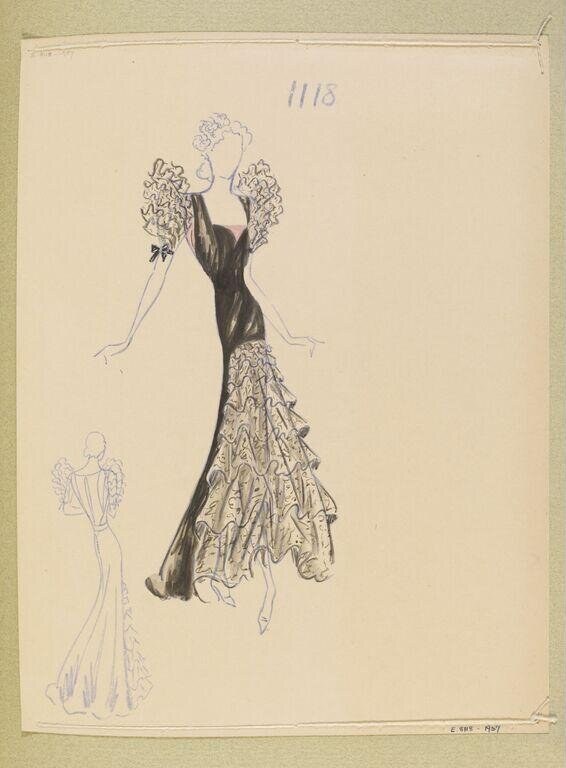
A fashion design sketch in ink and pencil showing two female figures in evening wear. The larger, central figure dominates the composition: she stands in three-quarter view with an elongated, elegant silhouette characteristic of 1930s haute couture. Her gown features a deep V-neckline, a fitted bodice in dark (likely black) fabric, and a dramatically voluminous skirt with elaborate pleating or ruching that cascades from the hip. The skirt appears constructed from a patterned or textured textile and trails extensively at the hem. Her arms extend outward with fingers splayed in an expressive gesture; her head is turned upward with an stylized face rendered in light pencil. Elaborate floral or feathered shoulder pieces or epaulettes frame the neckline. To the left, a smaller sketch shows a similar figure in profile, rendered more summarily. The drawing is executed on cream paper with accession number visible (1113, c.596-1937) and demonstrates the fluid linework and gestural economy typical of haute couture design sketches of the period.
The dancing
The primary figure is rendered with elongated proportions—a hallmark of fashion illustration—emphasizing vertical line and elegant extension rather than anatomical realism. Her outstretched arms with spread fingers suggest movement or a moment of presentation rather than a functional dance hold. The second, smaller figure repeats the pose in a more schematic way, as if documenting the design from multiple angles. Neither figure shows weight distribution, foot position, or any specific dance technique; the gesture appears ornamental and theatrical rather than functionally choreographic.
The dance depicted
This is a costume design rather than a dance scene, and it does not depict dance or a dancer in motion. The raised arms and outward-facing pose are theatrical presentation gestures—the moment a model or performer might strike to display the garment to an audience—rather than steps or technique. The work documents the design and construction of a winter evening gown, not a choreographed movement or dance style.
How it was made
The sketch is executed in ink and pencil on paper, the standard medium for haute couture design during the 1930s. This technique allowed rapid notation of silhouette, fabric detail, and proportional relationships without the labour of full rendering. The ink outlines the primary forms while pencil indicates secondary details, shading, and the secondary figure; this layering is typical of design practice where clarity of line was essential for pattern-makers and seamstresses. The sketch was created for workshop use rather than public display, which explains its directness and economy of line.
About this work
This is a fashion design sketch by Ana de Pombo dated 1937–38, titled 'Hiver' (Winter), documenting a haute couture evening gown in the Parisian style of the late 1930s. The sketch shows a woman in a dramatically draped gown with elaborate pleating and shoulder embellishment, rendered in the fluid, elongated proportions characteristic of fashion illustration. Though the figure's pose is theatrical and expressive, this is a costume design document, not a depiction of dance or choreography. It belongs in a Gallery of Dance in Art not as a record of dance itself, but as evidence of how dance, theatre, and fashion intersected in the modernist period—the elaborate gowns designed for evening performances and the stylized poses by which they were displayed drew on gestural and compositional languages learned from theatrical dance.
How to look at it
Attend to the pose: the outward-facing stance with raised, splayed arms is not a dance step but a presentation moment—the attitude a model or performer would hold to allow the viewer to see the garment's construction and drape. Notice how the sketch prioritizes silhouette and fabric behaviour (the heavily pleated skirt) over anatomical detail. The secondary figure to the left shows how designers used repetition and variation to work through a design idea, much as a choreographer might sketch movement possibilities.
The artist
Ana de Pombo was a fashion designer working in Paris during the 1930s, a period of extraordinary innovation in haute couture and stage costume design. The sketch bears her hand in its confident linework and understanding of fabric construction. Little is recorded of her career, but her work appears in fashion archives and suggests participation in the intensive design culture of pre-war Paris, where costume design for theatre and dance was closely integrated with high fashion.
The period
The late 1930s saw an intensification of collaboration between fashion designers and theatrical producers. Designers such as Coco Chanel, Edward Molyneux, and others designed not only for evening wear but for ballet and revue. The Surrealist movement and the Ballets Russes had demonstrated that costume was not separate from choreography but integral to it. The elongated proportions and expressive gesture in this sketch reflect the influence of modernist stage design and the aesthetics of contemporary dance, even as it documents a commercial evening gown.
Where it lives
The work is held in the Fashion Design collection (identified as 'va' in the source field), likely the Victoria and Albert Museum's costume and fashion archives. The accession number 1113 (c.596-1937) dates the cataloguing to 1937 and indicates the sketch's immediate entry into institutional collection, suggesting it was acquired directly from the designer's studio or from a Parisian fashion house.
Questions about this work
Is this a dance design or a fashion design?
It is a fashion design—a sketch for a haute couture evening gown dated 1937–38. The figure's pose is theatrical and expressive but not choreographic. It appears in a Gallery of Dance in Art because costume design and dance were inseparable in the 1930s theatrical world; understanding how dancers were dressed requires understanding how designers conceived of the body in motion and presentation.
Why is the figure drawn so strangely elongated?
Fashion illustration of the period used extreme vertical elongation to emphasize elegance and allow viewers to focus on silhouette and fabric. The elongation is a convention of the medium, not a distortion of the body, and reflects the influence of modernist and Cubist aesthetics on design practice in the 1930s.
What does the title 'Hiver' (Winter) tell us?
The gown is designed for winter evening wear—hence the heavier fabrics, elaborate draping, and shoulder embellishment. Season was crucial to haute couture marketing; designers created seasonal collections, and winter gowns typically featured richer fabrics and more dramatic silhouettes than summer wear.
More dance artwork





