49 works in this view — arrow keys or swipe to move between them.
Dance in Art
Vénus
Madeleine Wallis
- Collection:
- Fashion design
- Source:
- Victoria and Albert Museum
- Rights:
- Rights vary by item — check the source record before reusing this image. Source record ↗
- Recorded as:
- V&A — check rights per item
This work matters to the history of dress and design rather than to the history of dance. It records the aesthetic ideals and construction techniques of 1930s couture at a moment of rapid technical innovation in fabric manipulation and silhouette.
What you are looking at
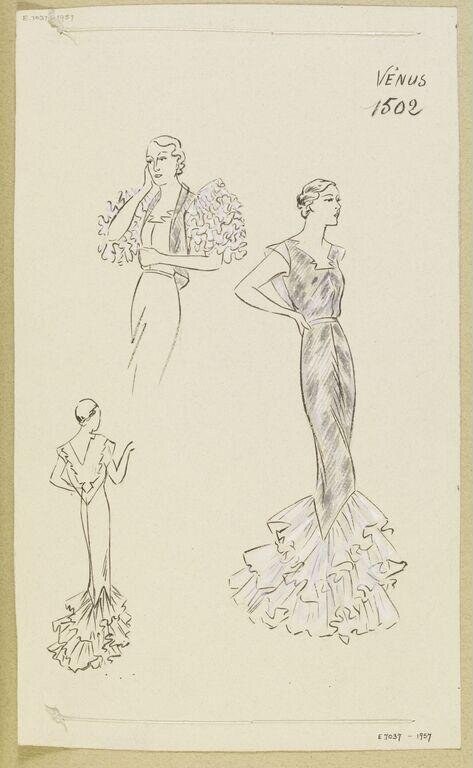
Three fashion figures are presented in a sketch style typical of early twentieth-century couture design. On the left stands a shorter, more compact figure in a low-waisted evening gown with pronounced ruching or gathering at the hip and a large decorative shoulder piece or capelet in what appears to be feathered or fringed fabric. The center figure wears a sleeveless, column-like evening dress with dramatic diagonal pleating or draping across the torso, and stands in a graceful contrapposto pose with one hand on the hip. The rightmost figure, tallest and most elaborate, wears a fitted gown with a mermaid silhouette that flares dramatically into a cascading ruffle at the hem, suggesting fabric in motion. The line work is economical and assured, typical of fashion illustration where the dress silhouette and movement are paramount. The page bears the inscription "VENUS 1802" in the upper right, a puzzling notation for a work dated to 1935.
The dancing
The three poses are static studies rather than dance positions. The central figure's contrapposto stance—weight shifted, hip cocked, hand placed assertively—suggests the classical theatrical poses of evening wear presentation. The rightmost figure's upright frame and slightly turned head recall the formal comportment expected of evening-dressed figures. None of the figures displays the alignment, turnout, or physical engagement characteristic of any codified dance form. The poses are couture presentation postures, the kinds of silhouettes a model or actress might hold to display evening gowns.
The dance depicted
This is not a dance image. The work documents fashion rather than movement or choreography. The figures are presented as static studies of couture evening wear, the kind of illustration that would appear in a fashion magazine or designer's portfolio. The poses are intentionally composed to show the drape and silhouette of the gowns, not to depict any specific dance technique, social dance, or theatrical movement.
How it was made
The work is executed in pen and ink line drawing on paper, a technique ideal for fashion illustration where rapid, assured linework could convey both the structure of the garment and the figure beneath it. The economical use of hatching and shading indicates light and volume without obscuring the clarity of the silhouette—a practical approach for reproduction in fashion journalism or design documentation. The medium's immediacy and precision made it the standard for couture houses and fashion illustrators of the interwar period.
About this work
This is a fashion design study by Madeleine Wallis, not a dance artwork. It depicts three evening gown designs in the pen-and-ink technique standard to 1930s haute couture illustration. The work belongs to the V&A's fashion design collection, where it documents the silhouettes and structural details of women's evening wear at a moment when the dropped waistline and bias-cut draping of the 1930s were displacing the rigid columnar gowns of the previous decade. While the poses have a theatrical quality and the work has circulated among images of dance, it records fashion rather than choreography.
How to look at it
Attend to the silhouettes rather than the poses. Notice how each dress is constructed differently: the first achieves volume and movement through gathered side seams and dramatic shoulder dressing; the second uses diagonal pleating to create visual interest on an otherwise columnar form; the third abandons the flapper's straight hang and instead embraces the curves of the body before releasing the fabric in a controlled ruffle. These are not poses for dance but frames for showing how fabric behaves on the human form.
The artist
Madeleine Wallis was a fashion illustrator and designer active in the early twentieth century. She worked in the tradition of couture-house illustration, creating designs and technical studies for commercial fashion production. Little is currently recorded of her wider practice or biographical details.
The period
The 1930s saw dramatic shifts in evening wear. The rigid, high-waisted gowns of the 1920s gave way to fluid, bias-cut designs that exploited the weight and movement of materials like silk crepe and charmeuse. The mermaid silhouette visible in the rightmost figure—fitted at the bodice and hip, flaring at the knee or below—became a signature evening-wear shape of the mid-to-late 1930s. Fashion illustration of the period was itself undergoing change, with photographers beginning to challenge the supremacy of the drawn illustration, yet the pen-and-ink sketch remained the fastest and most flexible tool for documenting design ideas.
Where it lives
The work is held in the V&A's fashion design collection, catalogued as a couture design study. The notation "VENUS 1802" inscribed on the sheet remains unexplained and does not align with the work's likely 1935 date or its documented provenance.
Questions about this work
Why is this work in a gallery about dance?
It is arguably not a dance image at all, but rather a fashion design study. The work may have been catalogued or filed with dance materials due to its theatrical quality, the theatrical contexts in which evening wear is sometimes displayed, or archival proximity to actual dance designs. It serves as a reminder that formal evening wear and theatrical costume can look visually similar while serving entirely different purposes.
What does the inscription 'VENUS 1802' mean?
The inscription is unexplained. The date 1802 contradicts the work's likely production date in the 1930s, and the title 'Venus' does not correspond to any known couture collection or design line by Wallis. This discrepancy is recorded but not resolved by the available catalogue information.
Who would have used these designs?
These are couture designs from a fashion house or designer's studio. They would have been used as references for seamstresses, as portfolio pieces to show potential clients, or as proposals for new designs. The pen-and-ink line and economical rendering suggest they were working drawings rather than presentation pieces for wealthy clients.
More dance artwork





