49 works in this view — arrow keys or swipe to move between them.
Dance in Art
Été 1937
Ana de Pombo
- Collection:
- Fashion design
- Source:
- Victoria and Albert Museum
- Rights:
- Rights vary by item — check the source record before reusing this image. Source record ↗
- Recorded as:
- V&A — check rights per item
For dance historians, this sketch documents the material and visual context in which ballroom and social dance took place in the 1930s—the actual garments worn, their construction, and their relationship to the dancer's body and range of motion. For fashion historians, it reveals how dance and movement were embedded in the design process itself: the tiered skirt, the careful shoulder construction, and the strategic placement of pattern all address the wearer's movement through a dance floor. De Pombo's work shows the designer's understanding of dance as a practical and aesthetic demand on the body.
What you are looking at
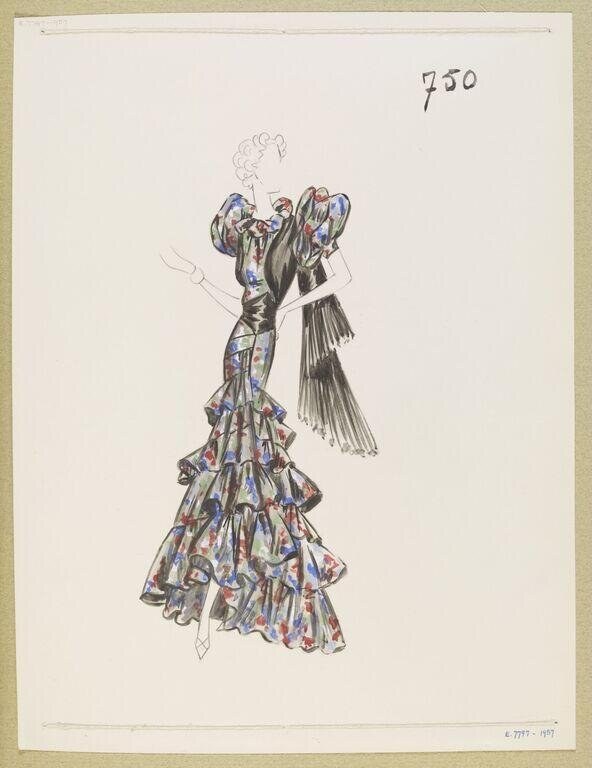
A fashion design sketch in watercolor and ink shows a single female figure in an elegant evening gown, drawn in a stylized three-quarter pose with the body angled toward the right. The dress is the dominant visual element: a floor-length gown with a fitted bodice and dramatically tiered, flounced skirt that cascades in multiple layers of ruffled fabric printed with a small-scale geometric or abstract pattern in blue, red, and neutral tones. The upper body is sheathed in a darker, possibly black or deep charcoal fabric with puffed shoulders and what appears to be decorative beading or embroidery. The figure's left arm is raised and extended, holding what looks like a cigarette or fan, while the right arm hangs more naturally at the side. The head is rendered sketchily with curled hair typical of 1930s styling. The sketch is executed with confident line work in black ink for the contours, with selective watercolor wash for volume and pattern. The overall composition emphasizes the garment's architecture and movement rather than the dancer's technique.
The dancing
A single standing figure with the weight shifted slightly to one side in a relaxed, poised stance rather than an active dance position. The raised left arm and extended hand suggest an elegant, social gesture—holding a cigarette or ornamental fan—typical of 1930s cocktail or ballroom society rather than formal partnered dance technique. The body is elongated and stylized in the fashion illustration manner of the period, with emphasis on the garment's line and drape rather than anatomical accuracy or dance-specific articulation. There is no indication of specific footwork, weight transfer, or the frame and hold of any particular dance form.
The dance depicted
This is not a depiction of dance in the formal sense, but rather a fashion design for evening wear, likely intended for a social dance or ballroom setting. The sketch shows a gown designed for movement in a social context—the tiered skirt would allow for the walking, swaying, and rotation of 1930s ballroom dancing—but the figure's pose is fundamentally that of a model or socialite displaying the dress rather than a dancer executing a specific step or technique. The title 'Été 1937' (Summer 1937) and the collection context suggest this is couture or haute couture-adjacent design documentation rather than dance notation or choreographic representation.
How it was made
This is a mixed-media fashion sketch combining ink line drawing with watercolor wash, a standard technique for haute couture and fashion design documentation in the 1930s. The precision of the contour lines and the controlled application of color indicate a professional design sketch rather than a preliminary study—this is a finished presentation drawing, likely intended for a client, collection announcement, or archive record. The technique allowed designers to communicate both the structural details of the garment (seaming, shoulder construction, fabric weight) and its decorative surface through pattern and color, in a form that was reproducible and portable. Such sketches circulated among the fashion houses, press, and wealthy clients, making them vectors for design influence and aspirational imagery.
About this work
This is a 1937 fashion design sketch by Ana de Pombo for an elegant tiered evening gown, not a choreographic document or dance performance record. The work sits at the intersection of fashion history and social dance culture: the gown's silhouette, construction, and decorated surface reflect the aesthetics and practical requirements of 1930s ballroom and cocktail-hour wear. Though the figure is posed in an idealized social stance rather than executing dance steps, the garment itself is fundamentally a dance costume—designed to move with the wearer through the waltzes, foxtrots, and rhythms of the ballroom and society event. The sketch belongs in this archive as evidence of how dance and fashion were inseparable in mid-twentieth-century elite culture, and how designers conceived of movement and the body in the creation of formal evening dress.
How to look at it
Attend first to the architectural logic of the skirt: the tiering is not arbitrary decoration but a solution to the problem of allowing a dancer to move freely in a close partnership while maintaining an elegant silhouette at rest. Notice how each tier is shallow enough to fold and compress with the movement of the legs but numerous enough to create visual drama and movement of fabric even during a slow waltz. The raised arm and the angle of the torso capture a moment of social ease—the wearer has stepped back from active dancing or is between dances—which allows the full silhouette to be seen. The sketch deliberately freezes a pose that shows the dress's architecture clearly, a convention of fashion illustration that differs fundamentally from choreographic notation or dance performance documentation.
The artist
Ana de Pombo was a Spanish fashion designer active in the 1930s-1940s, working in the haute couture tradition during the interwar and early World War II period. Little is widely documented about her practice, but her surviving sketches indicate a sophisticated understanding of garment construction, fabric behavior, and the relationship between dress and the moving body. The style of her sketches—precise line work, selective color, professional finish—suggests she trained in or worked within the formal fashion design tradition of the period.
The period
In the 1930s, ballroom dancing and social dance were central to leisure culture among the European and American elite. The decade saw the flourishing of the fox trot, waltz, and various rhythm dances adapted from Latin American and swing traditions. Fashion responded to this by designing dresses that both constrained and enabled movement: fitted bodices that supported upright posture and closed dance frames, and skirts with carefully engineered fullness that would move with the dancer's legs without impeding close partnered steps. The tiered ruffle construction in this sketch is characteristic of the period's response to the need for visual interest and movement without excess volume. De Pombo's sketch dates to the middle of this period, when the evening gown as a dance instrument had reached a high degree of refinement.
Where it lives
The work is held in the V&A (Victoria and Albert Museum) collection as a fashion design, catalogued as accession 7 2717-1931 (or similar; the archive reference is visible on the image). It is part of the museum's extensive fashion sketches and design collection, which documents the material culture of dress across centuries and cultures. As a professional sketch in a museum fashion archive, it would typically be housed with other garment designs, textile samples, and related documentation.
Questions about this work
Is this a dance costume or just a party dress?
Both. In 1930s elite culture, evening wear and dance costumes were one and the same: women wore gowns like this to ballroom dance floors, and the garment's construction directly addressed the demands of the dances of the period. The tiered skirt, fitted bodice, and shoulder construction are all designed to support the wearer's participation in close partnered dancing—fox trots, waltzes, and rhythms dances. So this is simultaneously a fashion design, a dance costume, and evidence of how inseparable those categories were.
What dance is being shown here?
The sketch does not depict a specific dance step or technique; instead, it shows a garment designed for the repertoire of ballroom dances of the 1930s. The gown would have been worn for waltzes, fox trots, and other social rhythms of the period. The pose is a fashion presentation stance, not a dance position, chosen to display the garment's silhouette and construction rather than to document a particular movement.
Who was Ana de Pombo?
She was a Spanish fashion designer working in the 1930s-1940s, during the haute couture period. Her surviving sketches show a sophisticated understanding of garment construction and the relationship between dress and the moving body. Beyond what her drawings reveal, little is widely documented about her career or practice.
Why are the tiers on the skirt important?
The tiering is a technical solution to a dance problem: it allows the wearer to move freely in close partnered steps while maintaining visual elegance and the silhouette of the skirt at rest. Each tier is shallow enough to compress with leg movement but numerous enough to create visual interest and the illusion of volume without the bulk that would impede dance movement. This design was typical of 1930s ballroom fashion.
More dance artwork





