49 works in this view — arrow keys or swipe to move between them.
Dance in Art
Été 1939
Ana de Pombo
- Collection:
- Fashion design
- Source:
- Victoria and Albert Museum
- Rights:
- Rights vary by item — check the source record before reusing this image. Source record ↗
- Recorded as:
- V&A — check rights per item
The sketch documents the aesthetic of late-1930s evening wear at a moment when fashion and dance were intimately connected—these gowns would have been worn to balls, nightclubs, and formal dances, and the silhouette directly constrained and defined how a woman could move. The tiered ruffle construction suggests lightness and motion even in a static pose, reflecting contemporary ideals of elegance in dance and ballroom culture.
What you are looking at
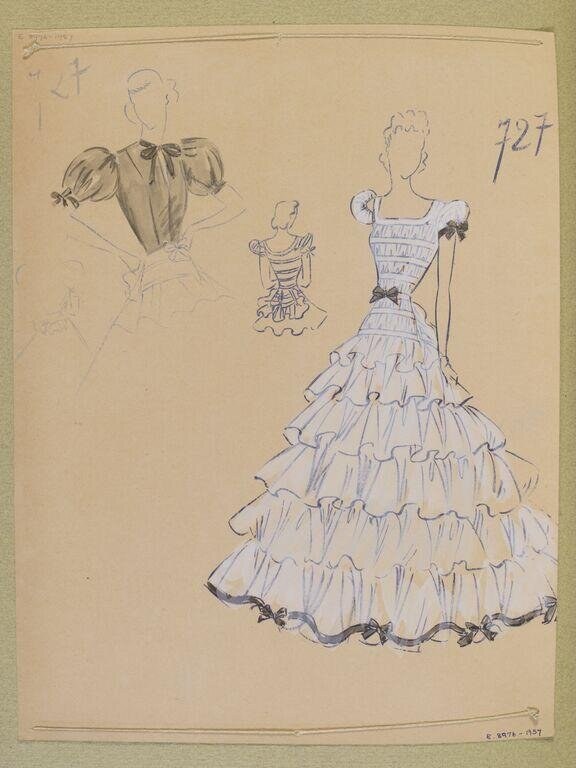
A fashion design sketch presenting three female figures in evening wear, arranged vertically to show different garments and silhouettes. The largest figure at right wears an elaborate ball gown with a fitted bodice featuring a square neckline and short puffed sleeves, the skirt composed of multiple horizontal tiers of ruffles or flounces that create dramatic volume and movement. The bodice is cinched at the waist with what appears to be a bow or decorative closure. Two smaller figures above show variations: one in a simpler day dress or cocktail dress with similar tiered construction, and one in a blouse with gathered sleeves and cinched waist. The sketch is rendered in ink with watercolor wash, capturing the translucency and weight of the fabrics through layered strokes. The figures are headless or minimally rendered in the head, with the focus entirely on the body and dress construction—a typical approach in haute couture design work.
The dancing
The primary figure stands in a relaxed, neutral pose with one arm extended downward and the other at rest, displaying the full silhouette of the gown. The body is rendered as a simple columnar form—the sketch prioritizes the drape and structure of cloth over anatomical detail or movement. The two smaller studies show similar static poses, with emphasis on the neckline, sleeve construction, and waist treatment. There is no sense of kinetic energy or dance movement; these are fashion stands, not dancers in motion.
The dance depicted
This is not a depiction of dance. The figures are dress forms in static display poses used by couturiers to show garment construction and silhouette. The tiered ruffle skirt and fitted bodice are consistent with evening wear of the late 1930s, but the arrangement and purpose are purely sartorial. The title 'Été 1939' (Summer 1939) indicates this is a seasonal collection design, not a record of choreography or performance.
How it was made
A sketch in ink and watercolor on paper, typical of haute couture design practice. The medium allows rapid notation of silhouette and drape; watercolor washes suggest fabric weight and surface texture without laborious detail. The technique—economical line, strategic color, headless figures—is diagnostic of fashion illustration for professional use rather than exhibition or publication. Such sketches circulated within the atelier and between client and maker.
About this work
This is a fashion design drawing, not a dance image, showing three variations of evening wear from a 1939 collection by Ana de Pombo. The largest figure displays a ball gown with a fitted, square-necked bodice and an exuberant tiered ruffle skirt—a silhouette typical of late-1930s formal wear. The work belongs to the history of fashion design and costume, not to dance as performance or choreographic art. It is of interest to this gallery only insofar as elaborate formal dress of this kind was worn at dances and shaped the body's capacity for movement on the dance floor.
How to look at it
Attend to the construction of the skirt: the horizontal tiers suggest both fabric economy (separate pieces) and visual drama (repetition and shadow). The fitted bodice and small puffed sleeves create an hourglass silhouette that was fashionable in the 1930s. The sketch is not concerned with how a person would actually stand or dance in the dress—that is left to the wearer and the viewer to imagine. The power of the image lies in the silhouette and the promise of movement implied by the ruffle structure.
The artist
Ana de Pombo was a fashion designer active in the 1930s. The sketch style and notation are consistent with professional couture practice of the period. Little is known of her broader practice or career trajectory from available records.
The period
In 1939, as Europe moved toward war, formal evening wear remained a marker of elegance and social standing, particularly in circles that frequented ballrooms and dance venues. The silhouette—fitted bodice, cinched waist, voluminous skirt—reflected the prevailing aesthetic of the late 1930s, a period when ballroom dancing (waltz, foxtrot, tango) remained central to elite social life. Fashion design and dance were inseparable in this milieu; the gown was both an object of design and a medium through which the dancer's body was presented and moved.
Where it lives
Held in a fashion design collection, catalogued as a work of design from 1939. The accession or collection identifier is not fully recorded.
Questions about this work
Is this a dance image?
No. It is a fashion design sketch showing evening wear, not a depiction of dancers or choreography. It belongs in this gallery because the gown's silhouette and construction directly shape how a body could move on the dance floor, and because such formal dress was inseparable from ballroom culture in the 1930s.
What is the tiered ruffle skirt?
A construction technique in which the skirt is built from multiple horizontal layers of ruffled or flounced fabric, each tier overlapping the one below. This creates volume, movement, and visual interest while allowing the skirt to catch light and shadow. It was a signature feature of formal evening wear in the late 1930s.
When would someone wear this dress?
For formal evening occasions—balls, galas, nightclub entertainment, or social dances. The quality of the fabric and construction suggests this was haute couture or high-end ready-to-wear, worn by women of means in elite social circles where ballroom dancing was still a primary form of entertainment.
More dance artwork





