49 works in this view — arrow keys or swipe to move between them.
Dance in Art
Boléro
Madeleine Wallis
- Collection:
- Fashion design
- Source:
- Victoria and Albert Museum
- Rights:
- Rights vary by item — check the source record before reusing this image. Source record ↗
- Recorded as:
- V&A — check rights per item
This drawing shows the reach of dance into commercial visual culture and fashion design—a dimension of dance's cultural authority often overlooked in favor of theatrical or fine art responses. *Boléro*'s impact was so immediate and so pervasive that it became a language for elegance itself; a fashion designer in 1935 could invoke it in a dress without explanation, confident the reference would be read. The work also documents the intersection of modernism, exoticism, and the female body in the 1930s, and reveals how dance performance was mediated through fashion for a broad, purchasing public.
What you are looking at
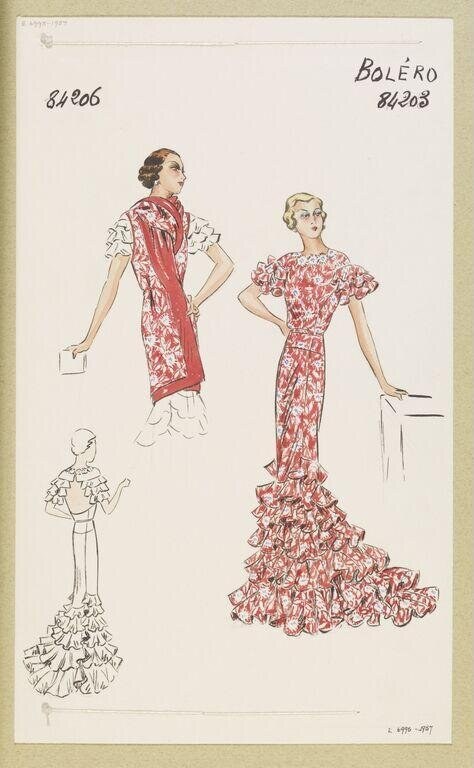
This is a fashion design drawing presenting three versions of a woman's dress inspired by or styled for Boléro. The left figure is shown in profile, wearing a red patterned dress with a dramatic draped red shawl or stole across one shoulder and down the back; she holds a small rectangular object (a clutch or cigarette case) and wears her hair in a neat 1930s wave. The center figure is a small sketch of the dress on a simplified croquis. The right figure, drawn in full frontal view, wears the same red patterned fabric cut as a fitted, floor-length gown with a pronounced tiered ruffle hemline that fans dramatically outward—a silhouette designed to evoke the swirling skirts of Spanish dance. The dress has short sleeves and is cinched at the waist. All three presentations showcase the print pattern, a red-and-white floral or ornamental design. The drawing is executed in ink and watercolor on cream paper, with the artist's name (Wallis) printed at top right and catalogue numbers at top left and center.
The dancing
The bodies here are fashion figures, not dancers in motion—elongated and stylized in the croquis tradition rather than anatomically realistic. The left figure's pose emphasizes the drape and flow of the shawl, with the arm extended to show the garment's movement. The right figure stands in a static three-quarter pose to display the front and side of the gown, the ruffled skirt arranged to suggest volume and movement even in stillness. Neither figure is captured mid-step or in an actual dance position; they are mannequins for displaying how the dress interprets or channels the aesthetic of Boléro.
The dance depicted
The title and the design make clear this is a fashion response to *Boléro*, almost certainly the 1928 ballet choreographed by George Balanchine to Ravel's score, which premiered in Paris and became one of the most iconic works of the 20th century. The dress is not a costume for performance but a commercial garment inspired by the ballet's visual impact and sensibility—the red Spanish-influenced palette, the dramatic draping, and above all the swirling, ruffled hemline that references the folk and flamenco vocabulary Balanchine incorporated. In fashion terms, this is a designer's translation of theatrical romance into wearable form, made when Boléro fever was gripping Paris and European fashion was hungry to capture its elegance and exoticism.
How it was made
The work is a design drawing in the haute couture tradition, executed in ink with watercolor washes to suggest the printed pattern and color of the proposed fabric. This technique—a hybrid of structural line drawing and painterly rendering—was standard practice in 1930s fashion houses and design studios. The method allowed for rapid ideation and presentation to clients, manufacturers, or dressmakers; it served as both working document and sales tool. The relatively small scale, the notational quality of the croquis, and the presence of catalogue numbers indicate this is a working drawing from a design archive or a couture house rather than a finished artwork intended for exhibition.
About this work
This is a fashion design drawing, not a painting or theater image, but it documents the profound influence of *Boléro* on 1930s visual culture and commercial design. The drawing shows how a single theatrical work—in this case, one of the most celebrated ballets of the modern era—propagated into fashion, shaping how women's bodies were dressed and how silhouette itself became a form of cultural reference. The garment is a legible translation of the ballet's Spanish-inflected glamour into a wearable narrative. For a gallery of dance in art, this piece reveals the afterlife of dance performance in other media and markets: how dance shapes not only painting or sculpture, but the everyday objects—clothes—through which people inhabited and expressed the aesthetic world the ballet opened to them.
How to look at it
Read this drawing as a translation exercise: look at what details the designer chose to carry from the ballet into the dress, and what she altered for wearability. The ruffled hemline is the keynote—it is the most obviously dance-inspired element, evoking the swirling movement of the Boléro costume without requiring the performer's body to achieve it. The color and print pattern anchor the design in the visual world of the ballet. The shawl or stole in the left figure, draped diagonally across the body, suggests both Spanish tradition and the fluidity that ballet had made fashionable. Notice, too, how the designer uses elongation and posture—the lifted carriage, the extended arm—to invoke the dancer's silhouette even in a static presentation.
The artist
Madeleine Wallis was a fashion designer working in Paris in the 1930s. Beyond the information recorded in the V&A accession, little is known of her practice or career within widely available sources. The drawing style and the reference number system suggest she was either an independent designer creating for couture houses or a designer employed within a major atelier. The precision of her line and her understanding of garment construction (visible in the way she renders the drape and the ruffle) indicate formal training in fashion design or dressmaking.
The period
In the 1930s, Paris was the undisputed center of fashion, and the city was also home to the Ballets Russes and its aftermath—a period of intense experimentation in modern choreography and set design. Boléro, premiered in 1928, was already a canonical success by the time this design was drawn; it represented not experimental modernism but rather a mature synthesis of classical technique with a new sensibility toward costume, color, and theatrical production. In this period, fashion designers routinely drew on theatrical and art-world developments; cross-pollination between the stage and the couture salon was expected and celebrated. The Spanish theme and the romantic, slightly exotic quality of 1930s fashion also reflects the broader cultural fascination with non-European aesthetics—in this case, Mediterranean and flamenco traditions—that modernism had made fashionable.
Where it lives
The drawing is held in the V&A collection, catalogued as a fashion design. The accession numbers and the presence of Wallis's name suggest this is part of an archive of commercial fashion design, likely acquired as a record of 1930s couture practice.
Questions about this work
Is this a costume for the Boléro ballet?
No. This is a commercial fashion design inspired by Boléro, intended to be made and sold as a women's dress for everyday wear (or evening wear). It translates the ballet's visual language into a garment for the consumer market. Theater costumes are constructed differently and are rarely documented in this fashion-design format.
Who danced Boléro originally?
The ballet was created by George Balanchine in 1928 to Maurice Ravel's 1928 score of the same name. It premiered at the Paris Opéra. Balanchine's original cast is not universally documented, but the work has been danced continuously since and is now in the repertory of many companies worldwide.
Why would a fashion designer reference a ballet in a dress design?
By the 1930s, balletic aesthetics had become synonymous with elegance and modernity in high fashion. A designer could invoke a famous ballet to signal sophistication and cultural awareness to clients, and to lend prestige and a narrative to the garment. The ruffled hemline and the color palette were instantly readable as Boléro-inspired to a fashionable Parisian customer.
Could this dress actually be danced in?
The tiered ruffle would move beautifully and does suggest movement, but it was designed for a woman's body in stillness or in the slow, upright walking and posing typical of evening wear and fashion presentation. It is inspired by dance, not designed for it.
More dance artwork





