49 works in this view — arrow keys or swipe to move between them.
Dance in Art
Thérésina
Madeleine Wallis
- Collection:
- Fashion design
- Source:
- Victoria and Albert Museum
- Rights:
- Rights vary by item — check the source record before reusing this image. Source record ↗
- Recorded as:
- V&A — check rights per item
Fashion design drawings from this period are essential evidence for understanding how dancers were clothed for formal ballroom and exhibition dancing, and how the material culture of dance shaped and was shaped by contemporary fashion. Wallis's precise and confident illustration technique shows how professional designers communicated volume, pattern, and structure to makers and clients, making visible the material realities of performance wear that photographs alone cannot fully capture.
What you are looking at
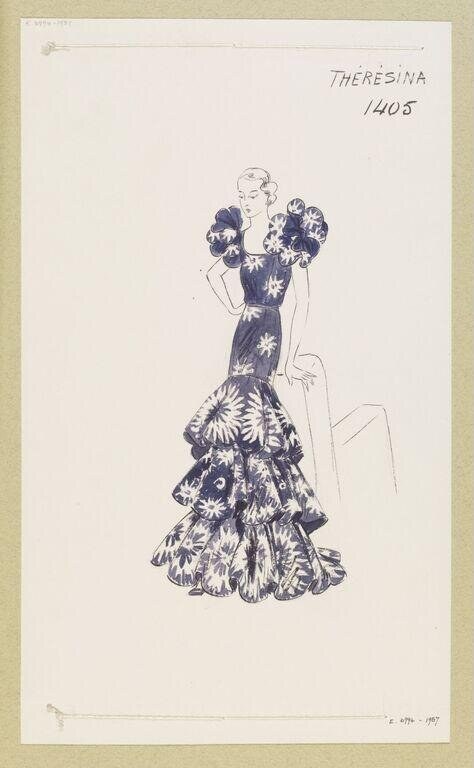
A single figure stands in a ballroom or theatrical setting, shown in three-quarter view against a plain background. The dancer wears a striking evening gown dominated by a voluminous skirt composed of layered ruffles or flounces that billow outward dramatically from the waist to the floor, creating a tiered silhouette. The skirt is patterned with large floral or daisy motifs in dark ink. The bodice is fitted and sleeveless, with characteristic puffed shoulders in the style of the 1930s. The figure's arms are raised to frame the face with bent elbows, hands near the head in a graceful, composed pose. The hair is styled in the close-waved fashion typical of the era. The drawing is executed in pen or ink with flowing, confident lines that define both the contours of the body and the gathered structure of the elaborate skirt.
The dancing
The single figure stands upright in a frontal pose with a slight contrapposto weight distribution. Both arms are raised symmetrically, elbows bent, with hands positioned near or framing the face—a pose suggesting poise, confidence, or a moment of presentation. The upper body is relatively still and vertical, while the lower body is entirely consumed by the volume of the skirt, which extends from the natural waist in structured layers. The pose is static and formal rather than dynamic or mid-movement; the body line emphasizes verticality and elegance rather than the mechanics of any particular step.
The dance depicted
This is a fashion design rather than a record of live dance, but the work documents how evening wear in the 1930s was conceived for ballroom and formal theatrical contexts. The silhouette—a narrow, fitted bodice with dramatically gathered or ruffled skirt—is consistent with the gowns worn for ballroom dancing of the period, particularly in formal and exhibition contexts. The style suggests garments designed for Waltz, Foxtrot, or other American Smooth dances popular in the 1930s, though the primary purpose appears to be fashionable presentation rather than functional dance wear. The theatrical composition and careful design indicate this is a haute couture conception rather than a working dancer's gown.
How it was made
This is a pen or ink drawing on paper, executed with clean, decisive lines and minimal shading. The artist has used the fluidity of the medium to define both the silhouette of the figure and the internal structure of the skirt through parallel hatching and curving strokes that suggest gathered fabric and pattern. The technique is characteristic of fashion illustration of the 1930s, where the goal was to communicate line, volume, and the play of patterned fabric rather than to render photographic detail. The drawing's economy and confidence suggest it is a working design drawing, likely created for presentation to a client or for production purposes.
About this work
Thérésina is a fashion design drawing by Madeleine Wallis, dated 1935, documenting an elaborate evening gown conceived for formal ballroom and theatrical wear. The work is a pen or ink illustration of a single figure wearing a fitted, sleeveless bodice and a voluminous, multi-tiered skirt decorated with large floral motifs. The pose is formal and stationary, emphasizing the silhouette and the dramatic construction of the garment rather than the body's capacity for movement. As a fashion design from the height of the 1930s ballroom era, the work testifies to how dance wear and formal evening dress were integrated, and to the role of fashion illustration in shaping the visual culture of ballroom dancing.
How to look at it
Attend to the contrast between the fitted, vertical line of the bodice and the explosive volume of the skirt below. The artist has chosen to emphasize the architectural quality of the garment rather than the narrative of dance—this is a presentation pose, not a moment of movement. Look at how the floral pattern runs across the ruffles in a way that would break and reform with each step, and how the multiple layers would create weight and momentum. The formal frontal pose and the framing of the face with the hands is a compositional device that treats the wearer as an object of beauty and fashion rather than as an agent of movement.
The artist
Madeleine Wallis is documented here only by this drawing and the attribution in the catalogue record. She appears to have been a fashion designer or illustrator working in Paris or London during the 1930s, during the height of art deco and the modernist fashion movements. Without further documentation, her broader practice and career cannot be assessed; the work survives as a single example of her hand.
The period
The 1930s was the golden age of ballroom dancing in Europe and America, when formal dance instruction and exhibition dancing were central to fashionable social life and entertainment. The aesthetic of the period combined art deco geometry and the modernist embrace of streamlined silhouettes with a residual formality in evening wear. Fashion and dance were closely entangled; the silhouettes that designers created constrained and enabled certain movements, and dancers and designers collaborated (sometimes explicitly, often implicitly) to define the look of each era's ideal body. The voluminous, heavily gathered skirt shown here is characteristic of 1930s ballroom wear, which prioritized dramatic visual effect and the play of fabric in movement over strict functionalism.
Where it lives
The work is held in the Fashion design collection of the Victoria and Albert Museum, recorded under accession number 6.4790-1957. It is a drawing on paper, not mounted or framed in the museum's records.
Questions about this work
Is this a sketch for an actual garment, or a fantasy design?
Fashion illustrations of this quality and finish were typically working designs intended for production or for presentation to clients. The confidence of the drawing and the practical details (the way the skirt is structured in layers, the fit of the bodice) suggest this is a real garment, likely made or intended for an actual wearer. However, the drawing alone cannot confirm whether a garment was produced.
Why are the shoulders so puffed?
Puffed shoulders were a dominant silhouette of late 1930s fashion, visible across evening wear, day dresses, and coats. In ballroom wear, they created a broader frame for the upper body and allowed for the unobstructed arm movement that waltz and foxtrot require. They were also markers of modernity and fashion-consciousness.
How would a dancer move in this skirt?
The voluminous ruffled skirt would create considerable momentum and visual drama with even modest movement, which was the point of the design. For ballroom dancing, the dancer's legs are largely concealed, so the skirt's movement becomes the primary visual register of the dance. The weight and gathering would require active control to keep the skirt from tangling or dragging.
Who was Madeleine Wallis?
Little is currently known about Wallis beyond this drawing. She appears to have been a professional fashion designer or illustrator working in the 1930s. If you have information about her practice or biography, the museum would welcome additional documentation.
More dance artwork





