49 works in this view — arrow keys or swipe to move between them.
Dance in Art
Été 1937
Ana de Pombo
- Collection:
- Fashion design
- Source:
- Victoria and Albert Museum
- Rights:
- Rights vary by item — check the source record before reusing this image. Source record ↗
- Recorded as:
- V&A — check rights per item
Fashion design sketches are primary documents of how garments were conceived and communicated to makers. This sketch reveals not only the cut and construction of the garments but the material choices, color palette, and decorative strategy that gave 1930s evening dress its distinctive character. For historians of dress, design process, and the material culture of the period, such working drawings are as historically vital as finished garments.
What you are looking at
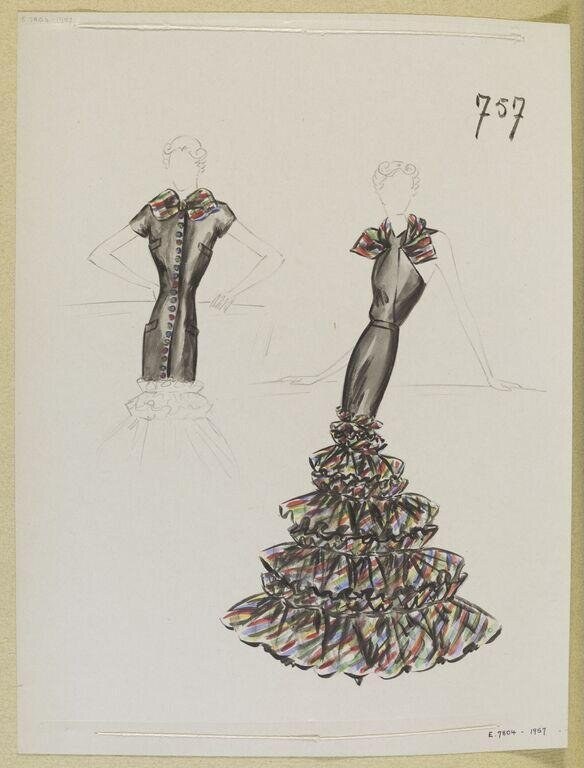
This is a fashion design sketch for two evening gowns, rendered in mixed media with watercolor and ink on paper. The left figure wears a dramatic floor-length dress in charcoal grey with a high neckline, short structured sleeves with colorful plaid or tartan trim in red, blue, and yellow, and a long column silhouette fastened down the front with buttons or closures. The right figure displays a more elaborate gown: a fitted bodice in grey with exaggerated puffed sleeves in the same plaid fabric, descending into a voluminous tiered skirt composed of multiple horizontal ruffles or flounces in coordinating plaid patterns, creating a spectacular skirt with significant volume and movement. Both figures are rendered as elegant croquis—elongated fashion illustration poses with minimal facial detail—set against a plain cream ground. The sketch emphasizes the silhouette and draping of the garments rather than anatomical precision.
The dancing
Both figures are depicted in stylized fashion-illustration posture with elongated proportions and simplified head forms. The left figure stands in an upright, frontal pose; the right figure adopts a three-quarter turn that displays the back and profile, allowing the full volume of the tiered skirt to unfold. Neither figure is captured in active movement or dance gesture. The poses are static and designed to showcase the architecture of the garments—the structural geometry of the sleeves and the cascading construction of the ruffled skirt.
The dance depicted
This work does not depict dance. The figures are fashion croquis used in garment design, positioned to display clothing construction and silhouette. They are not captured performing or in movement characteristic of any dance genre. The dramatic ruffled skirt and puffed sleeves suggest formality and occasion dress appropriate to evening wear, but there is no evidence of choreographic intention or dance technique.
How it was made
This is a mixed-media sketch executed in what appears to be ink line drawing with watercolor wash and colored pencil or gouache for the plaid trim details. The technique is rapid and gestural—characteristic of professional fashion design practice—allowing the designer to quickly establish silhouette and proportion while adding color notes to communicate fabric pattern and trim placement. The sketch is unfinished in places (note the abbreviated head forms and simple leg lines), which is typical of working drawings intended for internal design use or pattern-maker reference rather than exhibition or publication.
About this work
This is a professional fashion design sketch from 1937, inscribed 'Été 1937' (Summer 1937), by Ana de Pombo. It documents two evening gowns in the design stage, likely intended for haute couture or high-end ready-to-wear production. The work is held in a fashion design collection, marking it as a working tool of the design process rather than a finished artwork for display. The sketch demonstrates the design vocabulary of the 1930s—particularly the use of bold geometric pattern (plaid) as accent and the increasingly dramatic silhouette that would characterize late 1930s evening wear: the structured puffed sleeve and the architecturally constructed skirt with horizontally stacked ruffles.
How to look at it
Attend first to the silhouette: note how the designer has used the plaid trim to frame and structure the shoulders, and how the tiered ruffles of the right skirt create a stepped, pyramidal form that was enormously labor-intensive to construct. Observe the restraint of the left gown—simpler, more streamlined—against the ornamental complexity of the right. The sketch itself is economical; the designer has omitted most anatomical detail, knowing that pattern-makers and seamstresses would work from a more detailed technical specification. What is rendered here is the essential idea: the proportion, the trim placement, the silhouette idea.
The artist
Ana de Pombo was a fashion designer active in the mid-twentieth century. Very little biographical information is readily available; she is documented primarily through her design work held in museum collections. The style of her sketch—economical line work combined with selective color notation—is consistent with professional practice in European haute couture or advanced ready-to-wear design during the 1930s–1940s.
The period
The 1930s saw a dramatic shift in evening wear silhouette. The 1920s had emphasized the straight, unstructured line; by the mid-1930s, designers were reintroducing volume, structure, and ornament—particularly in the shoulder and skirt. The use of bold geometric prints (particularly plaids and tartans) was fashionable as a accent or trim, offering visual interest and ethnographic exoticism. The haute couture houses and advanced ready-to-wear producers of Paris, London, and other European design centers were experimenting with increasingly sculptural construction, evidenced in the structured puffed sleeves and tiered skirt construction shown here.
Where it lives
This work is held in a fashion design collection (catalogue source: va), suggesting it is part of a museum's costume or design holdings. The inscription and artist name are recorded in the catalogue, but no additional provenance or exhibition history is noted in the available record.
Questions about this work
Is this a sketch for a real garment or a design fantasy?
It appears to be a working design, likely intended for production. The level of specification—the placement of trim, the count and proportion of ruffles, the fastening detail—suggests the designer was communicating a garment to be made. Whether these specific designs were actually produced is not documented in the available record.
What is the plaid fabric in the trim?
The sketch indicates plaid or tartan as the trim pattern, rendered in watercolor or gouache in red, blue, and yellow over the grey groundwork of the gown. The sketch itself documents the color choice; the actual fiber content and weave structure would have been specified in technical drawings or fabric swatches sent to makers.
Why are both gowns shown on the same page?
This is standard design practice: presenting variations or related designs on a single sheet allows the designer and team to compare proportions, trim placement, and silhouette. The two gowns may be part of a collection shown to a client, or represent different approaches to a similar design problem (one restrained, one dramatic).
How do I know this is 1937 rather than the 1940s?
The inscription 'Été 1937' (Summer 1937) on the sketch establishes the date. The silhouette—particularly the proportions of the puffed sleeve and the tiered skirt—is consistent with mid-1930s evening wear; by the 1940s, wartime restrictions and changing aesthetics would have produced different forms.
More dance artwork





