49 works in this view — arrow keys or swipe to move between them.
Dance in Art
Design
Unknown
- Collection:
- Design
- Source:
- Victoria and Albert Museum
- Rights:
- Rights vary by item — check the source record before reusing this image. Source record ↗
- Recorded as:
- V&A — check rights per item
This work documents a historically specific moment in how Western designers conceptualized the plaza de toros—not as a bullfighting venue alone but as a modernist spectacle machine encompassing multiple performance traditions. For dance historians, it reveals the visual and architectural frameworks through which early-to-mid-twentieth-century designers integrated flamenco and other Spanish-language performance traditions into broader theatrical taxonomies.
What you are looking at
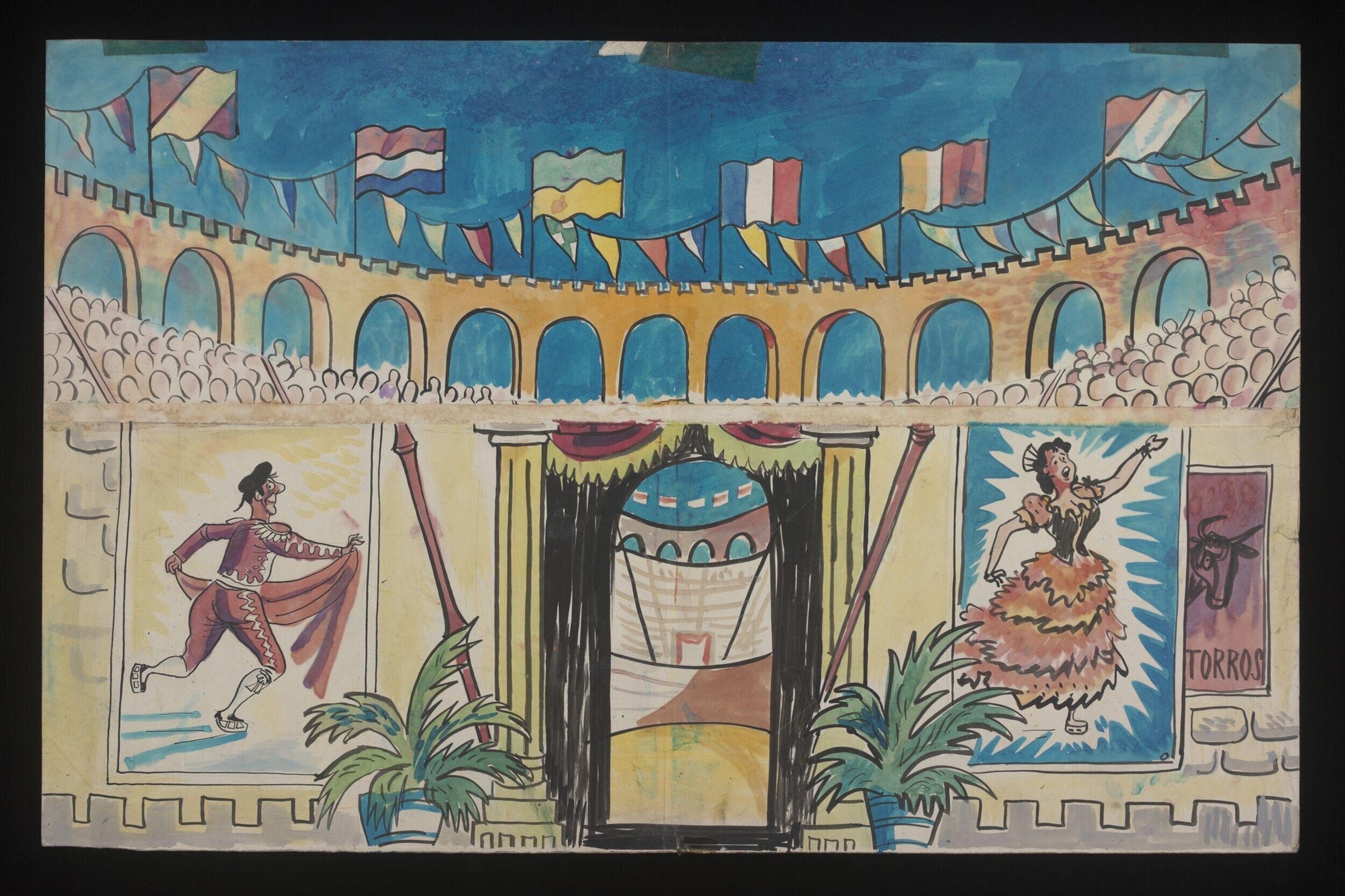
A stylized architectural design for a bullfighting arena (plaza de toros) rendered in watercolor and ink, dated 1954. The structure is a massive amphitheater with a fortified stone wall punctuated by regularly spaced arched openings in pale blue and ochre, topped with crenellations. Above the arena, decorative bunting in primary colors and various national flags (appearing to include Dutch, French, and Spanish colors) stretch across the upper reaches. The lower level is dominated by three large murals or paintings: on the left, a matador in burgundy and gold costume with a sweeping cape; in the center, what appears to be a hot air balloon or tethered aircraft; and on the right, a figure in feathered costume suggesting a dancer or performer. The composition treats the arena as a theatrical space, with potted palms flanking a central entrance. The entire design is rendered with bold black outlines and flat color zones, suggesting a maquette or architectural illustration rather than documentation of an actual performance.
The dancing
The left figure—a matador—is depicted in profile with legs in a dynamic lunging stance, one arm extended with the cape billowing behind in a characteristic muleta hold. The right figure wears a stylized feathered costume (possibly suggesting a flamenco or cabaret dancer) and appears to be in an upright, frontal pose. Neither figure is engaged with the other; both are isolated vignettes within the architectural frame, serving as emblematic rather than interactive presences. The scale and treatment suggest these are symbolic decorative elements or cartouches rather than a narrative scene of movement.
The dance depicted
This is not a depiction of dance proper but rather an architectural design that incorporates dance and performance imagery as ornamental elements within a plaza de toros. The arena itself was historically a venue for multiple performance traditions—bullfighting primarily, but also flamenco, circus, and theatrical spectacle. The feathered figure on the right may reference Spanish or Latin American theatrical dance tradition, possibly flamenco, though the stylization makes specific identification impossible. The work documents the plaza de toros as a multigenre performance space rather than focusing on any single dance form.
How it was made
Watercolor and ink on paper, rendered in a graphic design or architectural illustration style with bold black contour lines and flat color zones. The technique suggests this is a design proposal or maquette—possibly for a theatrical set, carnival installation, or architectural rendering—rather than fine art for exhibition. The flat, compartmentalized color and bold line work are consistent with mid-twentieth-century architectural and graphic design practice, and the style is reminiscent of Spanish or Latin American modernist design of the 1950s.
About this work
This 1954 design presents a plaza de toros as a theatrical machine for multiple performance traditions. The arena is conceived not as a static structure but as a decorated stage, with dance and performance imagery woven into its architectural ornament. The matador and feathered dancer are not the subject but rather emblematic figures that signal the plaza's role as a site where multiple bodily traditions—bullfighting, flamenco, circus arts—converge and are displayed.
The work is valuable as evidence of how mid-century designers conceived the relationship between architecture, spectacle, and performance tradition. By treating the arena as a canvas for decorative performance imagery, the design reveals assumptions about Spanish and Latin American performance culture—that the plaza de toros was not a single-purpose venue but a syncretic space where different traditions of bodily display were understood as related practices.
How to look at it
Attend first to the architectural frame: this is a design drawing, not a naturalistic view. The bold black outlines and flat color zones are conventions of modernist graphic design, not painterly rendering. Look at how the performance figures are positioned as isolated emblems within compartments—the matador and dancer are not interacting but are instead symbolic markers of what types of bodies and actions this space contains. Notice the flags: the inclusion of multiple national colors suggests this arena is conceived as a cosmopolitan spectacle space, a modern international venue rather than a provincial site.
The period
The 1954 date places this work in the post-Spanish Civil War period, when Franco's regime was beginning to market Spanish cultural imagery internationally. The plaza de toros had become emblematic of Spanish national identity, and modernist designers across Europe and the Americas were reframing it as a symbol of theatrical modernity rather than regional tradition. The incorporation of multiple performance traditions—bullfighting, flamenco, aviation spectacle—reflects the era's fascination with synthesizing "folk" and modern performance into unified aesthetic systems. Internationally, the 1950s saw renewed interest in Spanish culture and design among mid-century modernists, and this work sits within that curricular moment.
Where it lives
Held in a design collection (specific institution not recorded in the catalogue). The work is catalogued simply as "Design" with no medium specified, which is consistent with its status as an architectural or stage design proposal rather than a finished artwork intended for exhibition.
Questions about this work
Is this a real plaza de toros or an imaginary design?
Unknown from the image alone. The highly stylized rendering and the date (1954) suggest this is either a design proposal for a new arena, a modernist reinterpretation of an existing structure, or a theatrical set design. The work is not documentary in intent but rather conceptual—treating the arena as a design problem to be solved.
What is the figure on the right doing?
The figure in feathered costume appears to be in an upright, frontal stance suggesting theatrical display rather than active movement. It may reference flamenco tradition, cabaret performance, or carnival dress, but the stylization makes precise identification impossible. It functions as an emblematic figure—a sign that this space contains bodily traditions beyond bullfighting.
Why would a bullfighting arena need to advertise dance?
By the 1950s, the plaza de toros had become a multipurpose venue for various spectacles, not bullfighting alone. This design reflects that shift: it presents the arena as a modern theatrical space that could accommodate flamenco, circus acts, and other performance traditions alongside or instead of bullfighting. The design is advertising the venue's versatility and cosmopolitan character.
More dance artwork





