49 works in this view — arrow keys or swipe to move between them.
Dance in Art
Evening dress
Michael Sherard
- Collection:
- Evening dress
- Source:
- Victoria and Albert Museum
- Rights:
- Rights vary by item — check the source record before reusing this image. Source record ↗
- Recorded as:
- V&A — check rights per item
This dress is material evidence of postwar ballroom culture and the meeting of high fashion with performance. For dancers and historians, it shows how formal evening wear was engineered in the 1950s to support both the aesthetic and the physical demands of ballroom and theatrical dance. The asymmetrical hem is a particularly telling design choice—it signals a designer who understood that dancers needed visibility of footwork without sacrificing visual drama.
What you are looking at
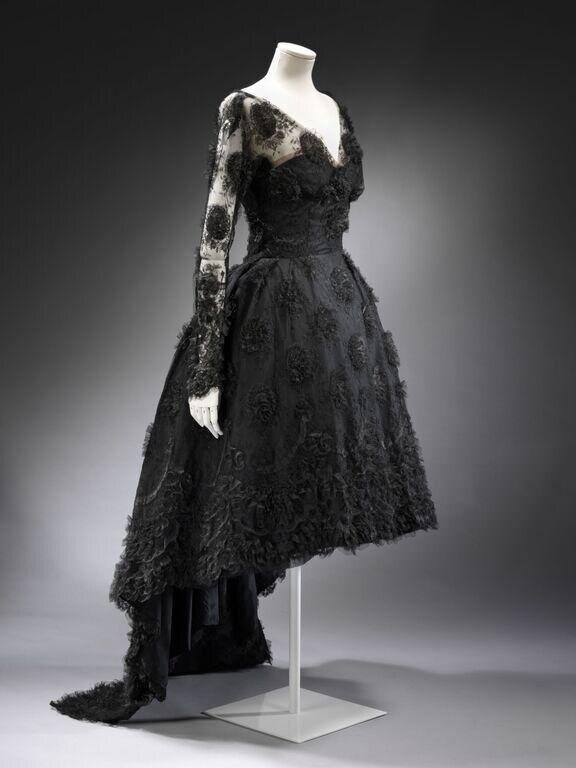
A black lace evening dress is displayed on a mannequin against a neutral gray backdrop, photographed from a three-quarter view. The dress features an elaborate overlay of black floral lace across the bodice and skirt, creating a striking textural contrast. The silhouette is fitted through the bust with a sweetheart neckline, transitioning to a full skirt with an asymmetrical hemline—shorter in front and dramatically longer at the back, where trained fabric extends across the base of the mannequin. The three-quarter-length sleeve is constructed from patterned lace and extends past the wrist. The overall composition emphasizes the dress's theatrical elegance: the lace catches light to reveal intricate floral and botanical motifs, while the asymmetrical hem suggests both formal occasion wear and performative drama. A white-gloved hand emerges from the left edge of the frame, anchoring the presentation as a dress object rather than a worn garment.
The dancing
No dancer is visible in the image. The dress is presented on a professional dress form—a headless mannequin—with the left arm extended forward at a modest angle. The draping and positioning suggest the potential movement of a wearer: the full skirt is positioned to show both its gathered volume and the length of the train, implying a theatrical silhouette designed for movement across a stage or dance floor. The gloved hand adds a note of formal presentation.
The dance depicted
This object is not a depiction of dance but a garment designed for dance or formal theatrical performance. The name 'Evening dress' and the date (1958) place it in the postwar era when such gowns were worn for ballroom dancing, theatrical performances, or high society events. The asymmetrical hem and dramatic train suggest a design responsive to movement—the shorter front allows footwork visibility while the extended back creates visual drama in motion or when photographed in profile. The lace construction and fitted bodice are consistent with 1950s ballroom competition attire or evening wear for theatrical performers who needed elegance with mobility.
How it was made
This is a three-dimensional textile object photographed in a museum or archive context. The photograph itself is a black-and-white studio image, likely taken for documentary purposes—possibly curatorial photography to record the dress in the collection. The even lighting and neutral ground remove context and emphasize the object's construction and design. The lace appears to be machine-made, a common industrial process by 1958, and would have been laboriously hand-sewn to the bodice and skirt base. The photograph's professionalism suggests this piece entered a significant collection during or shortly after its creation.
About this work
This is not a dance image but a material artifact: a black lace evening dress from 1958, designed for movement and formal occasion. The garment's construction—fitted bodice, full skirt, asymmetrical hemline, and patterned sleeves—reflects mid-twentieth-century ballroom and theatrical aesthetics. It appears in a museum or institutional collection and is documented here because the history of dance cannot be separated from the history of what dancers wore. The dress is evidence of how evening wear anticipated and accommodated the dancer's body and its motion.
The inclusion of performance dress in a dance archive recognizes that costume is itself a form of dance knowledge: the designer anticipated how a body would move in this garment, and the cuts, seams, and materials made certain movements possible or impossible, graceful or awkward. To understand how people danced in 1958 is also to understand what they wore.
How to look at it
Observe the construction from front to back: the shorter front hem allows clear sight lines to the legs and feet, essential for ballroom dancing where footwork is a primary visual element. The extended train at the back creates a very different silhouette when viewed in profile or from behind—dramatic and trailing, the kind of line that photographs spectacularly. Notice how the fitted bodice constrains movement at the torso while the full skirt offers freedom below the hip. The lace overlay, while ornamental, is deliberately integrated into the structure; it is not mere surface decoration but part of how the dress holds and moves. The white glove visible at the edge speaks to an entire protocol of formal wear and handling—this is not casual dress but a costume designed to be seen.
The artist
Michael Sherard is listed in the catalogue record as the creator of this evening dress, dated 1958. Beyond this attribution, no further information about his practice or training is recorded in the collection metadata.
The period
In 1958, evening wear and ballroom culture were inseparable from theatrical spectacle. The postwar era saw a flourishing of both competitive ballroom dancing and television dance programming, which drove fashion innovation in performance costume. Designers of evening gowns in this period worked with the understanding that their garments would be seen in motion—either in ballroom competitions, on stage, or in the newly dominant medium of television. The asymmetrical hemline visible here reflects a broader mid-century tendency toward architectural silhouettes that prioritized visible footwork while maintaining formal elegance. Lace, which had been rare and luxury-confined in earlier eras, was becoming more accessible through industrial production, making elaborate evening wear achievable for broader audiences.
Where it lives
This dress is held in the collection identified as 'Evening dress' in the source record marked 'va' (likely Victoria and Albert Museum or similar institutional code). It is catalogued as a museum object with accession metadata but minimal contextual record.
Questions about this work
Is this a costume for a specific dance or role?
The object record does not identify a specific production, role, or choreographic context. The dress is documented as a generic 'evening dress' from 1958. It may have been worn for ballroom competition, theatrical performance, or formal social dancing of the era. The asymmetrical hem and lace construction are consistent with any of these contexts.
Why is a dress in a dance gallery?
Performance costume is an integral part of dance history. How bodies move is inseparable from what they wear. This dress documents postwar ballroom and theatrical aesthetics, the engineering of movement through garment design, and the material culture of 1950s dance and formal wear.
Could someone actually dance in this?
Yes. The shorter front hem gives clear sight lines to the legs and allows footwork visibility. The full skirt has enough volume to move without restriction, and the fitted bodice supports upright posture and arm movement. The train at the back would trail dramatically as the wearer moved—a feature, not a flaw, in both ballroom and theatrical contexts.
How was this dress made?
The base appears to be a structured dress in a dark fabric, likely wool or similar, with black lace hand-sewn over the bodice and skirt in decorative floral patterns. The lace itself was probably machine-made industrially, but the application to the dress was skilled handwork. The asymmetrical hem suggests the train was deliberately designed and integrated into the pattern, not added afterward.
More dance artwork





