49 works in this view — arrow keys or swipe to move between them.
Dance in Art
Fashion design
Jules de Ban
- Collection:
- Fashion design
- Source:
- Victoria and Albert Museum
- Rights:
- Rights vary by item — check the source record before reusing this image. Source record ↗
- Recorded as:
- V&A — check rights per item
For scholars and curators of dance in visual culture, this work documents the inseparable relationship between fashion and ballroom practice in the interwar period: the silhouettes, materials, and idealized bodily proportions shown here are those that enabled and defined the dances danced in evening wear. The drawing offers concrete evidence of how couture designers understood and presented the moving female body in formal social contexts. It is also a rare example of a named designer's fashion presentation work from this period in a dance archive context.
What you are looking at
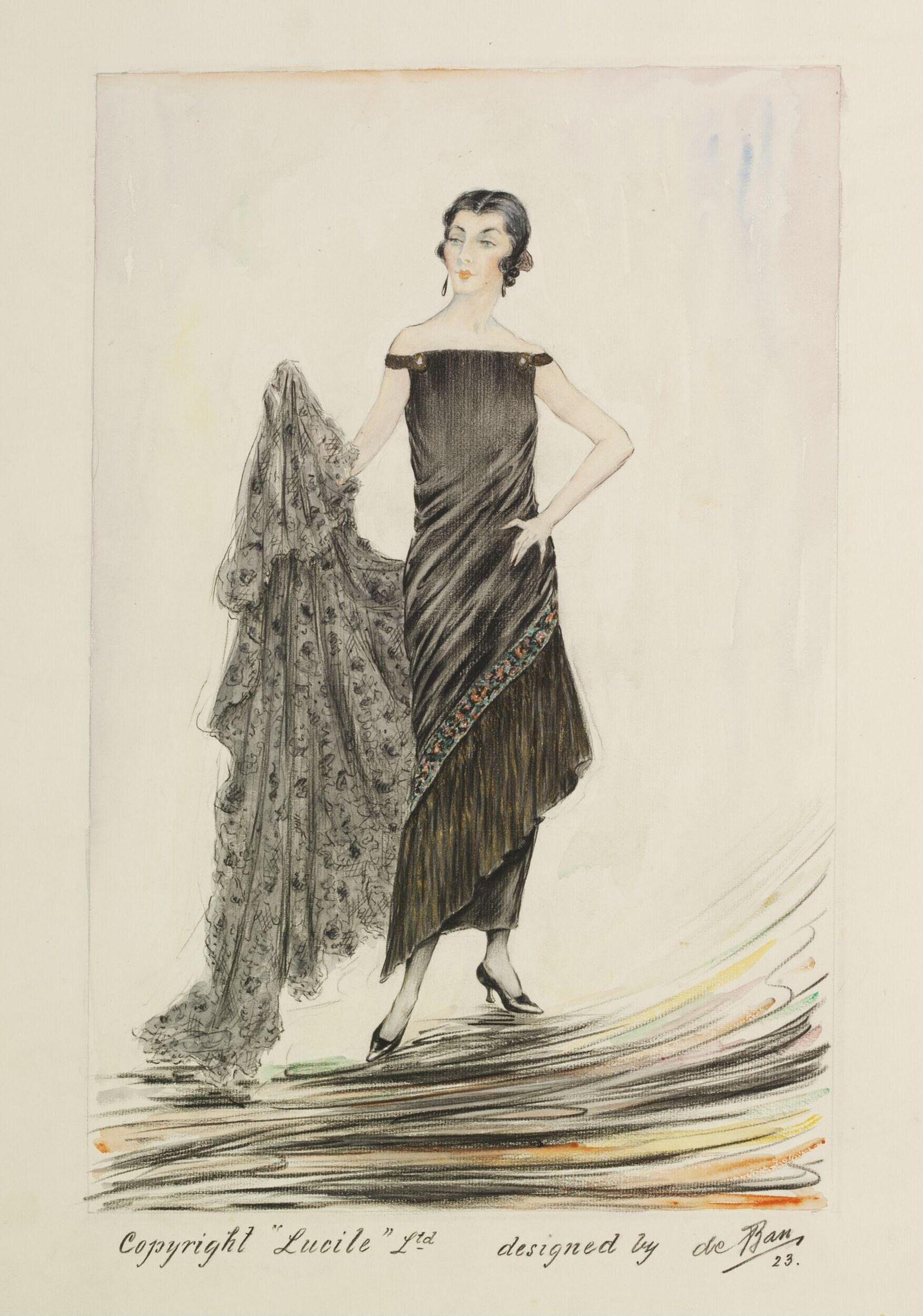
A single female figure stands in a three-quarter pose against a neutral background, modeling an elegant 1950s evening ensemble. She wears a strapless, off-shoulder cocktail dress in dark striped fabric—possibly silk or taffeta—that falls to mid-calf with a subtle diagonal drape. The dress features a decorative beaded or embroidered trim at the hip. Over her arm she carries an elaborate stole or shawl in a contrasting patterned fabric, rendered in lighter tones with an intricate floral or geometric design; the shawl trails dramatically across the composition, establishing movement and volume. She stands with her weight on one leg in a poised, elongated stance, one hand resting on her hip in a gesture of elegant repose. Her hair is styled in period waves, and she wears heels and drop earrings. The drawing is executed with refined line work and selective hand-coloring in gouache or watercolor, particularly evident in the face and the subtle shading of the dress fabric. Below the figure, swatches of fabric or embellishment samples are displayed—narrow strips in various colors (black, green, cream, orange) that appear to be material studies or trim options for the design.
The dancing
The figure is posed in a classic modeling stance from mid-twentieth-century fashion presentation: weight shifted to the back leg, the front knee slightly softened, the torso angled to suggest movement and dimensionality. The arm carrying the shawl is extended in a gesture that conveys both ease and control—the drape of the fabric suggests the fluidity of silk or lightweight crepe. The pose is neither rigid nor theatrical, but rather that practiced, professionally modeled presentation used to display evening wear to clients or in fashion illustration plates. The elongated line from hip through lifted heel is deliberate and shows understanding of how fabric moves across a standing body.
The dance depicted
This is not a depiction of dance but rather a fashion illustration and design presentation. The pose and gesture draw on conventions of ballroom posture and the idealized female body as it was presented in mid-century formal contexts—the stance recalls the frame used in social dances of the period (waltz, foxtrot, ballroom presentation)—but the purpose is the display of couture evening wear, not the documentation or celebration of dance movement itself. The work belongs to the history of fashion illustration and garment design rather than to dance imagery.
How it was made
This is a fashion illustration executed in mixed media: ink line drawing with hand-applied watercolor or gouache for the figure's face and selective tonal passages, and what appears to be gouache or colored pencil for the dress and particularly the shawl, which shows careful gradation and pattern rendering. The technique is characteristic of mid-twentieth-century couture house design presentation—the kind of rendering used by design ateliers to present proposed garments to clients, manufacturers, and in some cases to fashion magazines or buyers. The fabric swatches at the base suggest this was a working presentation piece, not a finished gallery work. The combination of precise draftsmanship with painterly rendering of luxurious materials was standard practice in haute couture studios of the 1920s–1950s, where such drawings served as specifications and sales tools.
About this work
This is a fashion design drawing by Jules de Ban from 1923, presenting an evening gown ensemble with coordinating shawl. The work sits at the intersection of fashion history, design practice, and the visual culture of early twentieth-century luxury dress. While it does not depict dance, it is part of the visual world that surrounded ballroom and evening wear in this period: the pose, the idealization of the female body, and the emphasis on graceful line and fluid fabric all reflect the aesthetic priorities of formal social dance and the fashions worn for it. The drawing is a design specification and sales presentation, made in the working hand of a couture designer to communicate both the visual effect and the material reality of a proposed garment.
How to look at it
Observe the artist's choices in posture and gesture: the slight S-curve of the standing body, the elongation of the neck and shoulder line, and the particular angle at which the shawl is held and allowed to trail. These choices communicate both the aesthetic ideal of the moment and a designer's awareness of how fabric must move and drape across a living, dancing body. Note the contrast between the precision of the dress construction (indicated by clean line and strategic shading) and the more painterly, luminous rendering of the shawl, which emphasizes the luxury and lightness of the material. The fabric swatches at the base ground the drawing in practical design work—this is not fantasy but specification.
The artist
Jules de Ban (signature visible as 'de Ban' in the inscription) was a fashion illustrator and designer working in the 1920s. Little is documented about de Ban's biographical details or career in major fashion history sources, but the signature and date confirm the work as a design presentation from 1923, a period when fashion illustration was a specialized and highly skilled profession. The refinement of the draftsmanship and the professional presentation suggest de Ban worked at or with a significant couture house or design atelier. The copyright mark ("Copyright 'Lucile' y^d" visible at the bottom) indicates association with or presentation to the design house or publisher Lucile, a major name in early twentieth-century fashion.
The period
In 1923, evening wear was undergoing rapid transformation. The constraints of Edwardian silhouettes had given way to the longer, leaner lines of the 1920s, though the fully dropped waistlines and radical simplifications of mid-decade had not yet fully taken hold. The strapless and off-shoulder neckline shown here was becoming fashionable in evening dress, reflecting the modernizing aesthetics of the 1920s avant-garde and a gradual relaxation of Edwardian formality. The emphasis on draped textiles and the coordination of dress with shawl or wrap was standard practice in couture presentation: evening dress was always presented as an ensemble with coordinating accessories. Ballroom dancing was at its height as a dominant form of social entertainment and courtship among the middle and upper classes, and the fashions for evening wear were inextricably linked to the silhouettes and movement requirements of foxtrot, waltz, and Charleston.
Where it lives
The work is held in a fashion design collection and is sourced from 'va,' likely indicating a fashion archive or museum collection. The copyright inscription to 'Lucile' y^d suggests the work was made for or in association with that design house, or was presented to them for consideration or licensing.
Questions about this work
Why is a fashion illustration in a dance archive?
Fashion and dance were inseparable in the early twentieth century. Evening wear was designed specifically for ballroom dancing, and the silhouettes, fabrics, and movement possibilities of a dress determined the dances that could be performed in it. By preserving fashion illustration from this period, we document the material reality of how dancers actually moved, what they wore, and how designers understood the relationship between garment and body in motion.
What does the copyright mark to 'Lucile' mean?
Lucile (Lady Duff-Gordon) was one of the most prestigious couture houses of the early twentieth century, based in London and later with branches in Paris and New York. The copyright mark suggests this drawing was either produced by de Ban for Lucile's atelier, or was a design proposed to them. Either way, it places the work within a major center of fashion innovation in the 1920s.
Could this gown be danced in?
Yes. The strapless bodice provided freedom of movement in the upper body and arms, while the length and relatively light construction allowed for the turning and traveling required of ballroom dances like the foxtrot and waltz. The slim silhouette and bias drape would create the fluid, elegant line prized in 1920s ballroom dancing. Formal evening wear of this period was always designed with social dancing in mind.
More dance artwork





