49 works in this view — arrow keys or swipe to move between them.
Dance in Art
Boston
Pierre Balmain
- Collection:
- Evening dress
- Source:
- Victoria and Albert Museum
- Rights:
- Rights vary by item — check the source record before reusing this image. Source record ↗
- Recorded as:
- V&A — check rights per item
For dance historians, this dress is a primary source document of the formal wear that shaped how mid-century dancers moved and presented themselves in social dance contexts. The construction, weight, and volume of the skirt dictated specific movement qualities—the way tulle layers caught air, how crinolines bounced, the coordination required to manage such volume—and understanding these garments is essential to understanding how 1950s ballroom and social dancing actually felt and looked.
What you are looking at
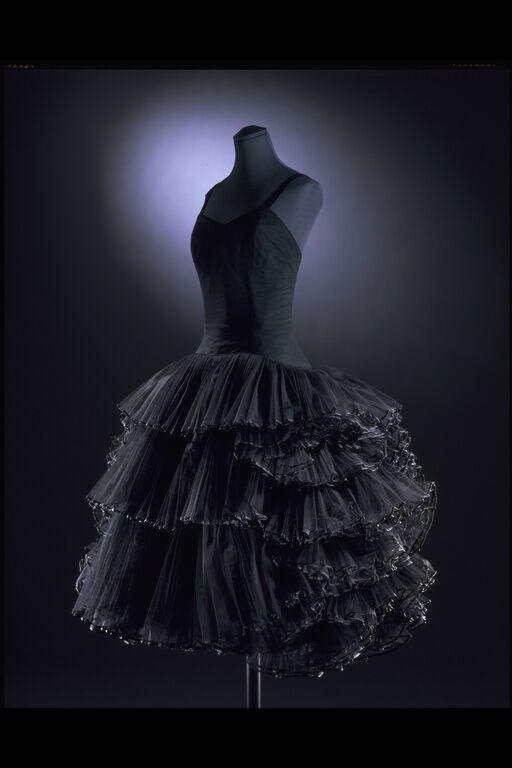
A mannequin wearing an evening dress stands against a dark, dramatically lit background that glows with soft blue-white illumination. The dress is a tour de force of mid-century formal wear: a fitted bodice with a sleeveless, boat-neck tank top in dark fabric sits atop a voluminous skirt of layered tulle. The skirt comprises at least three tiers of stiffened tulle ruffles, each edged with what appears to be beading or metallic trim that catches the light. The silhouette is architectural—the full skirt extends outward in a crinolined bell shape, creating the characteristic silhouette of 1950s haute couture. The photograph is taken from a three-quarter view, allowing the viewer to appreciate both the fitted bodice and the sculptural volume of the skirt. The styling and presentation suggest this is a couture garment intended for evening wear, likely for formal social occasions or gala events.
The dancing
This is a still life photograph of a dress on a mannequin, not a depiction of a moving dancer. The headless torso is posed upright with no arms, making gesture analysis impossible. The dress itself has an inherent posture: the stiffened tulle creates an ideal theatrical shape, the kind that would billow dramatically in motion but here is frozen in sculptural stillness.
The dance depicted
This work does not depict dance or dancers. It is a haute couture evening dress photographed as an object of fashion design. While the silhouette and construction would have been worn at formal balls and social dances of the 1950s, and the dress would certainly move beautifully in dance, the image itself shows only the garment's static form.
How it was made
This is a black-and-white or very pale colour photograph of high quality, likely a professional fashion or studio photograph. The dramatic backlighting—which creates the luminous glow around the dress—suggests skilled studio lighting setup. The technical execution reveals the photographer understood how to showcase the dress's architectural structure and the play of light on tulle and beading. This would have been a transparency or silver gelatin print, intended for publication or archival documentation of the couture house's collection.
About this work
Pierre Balmain's 'Boston' evening dress is a masterwork of 1950s haute couture construction. The dress embodies the post-war silhouette that dominated formal wear: a dramatically corseted bodice paired with yards of stiffened tulle arranged in sculptural tiers. This is a museum or archive photograph of the garment itself, presenting the dress as a design object. While it was created in the era when formal evening wear was inseparable from ballroom dance culture, the photograph records the dress as textile art rather than as clothing in use.
How to look at it
Attend to the mathematical precision of the skirt's construction: the three or more tiers of tulle, each edged with beading, create a cascading effect. Notice how the tulle is stiffened and directs the eye downward and outward—this is not a dress designed to hang vertically but to project. The backlighting reveals the translucency of the layered tulle and the glint of the beading. The contrast between the severe fitted bodice and the exuberant volume below is the essential visual tension of 1950s formal wear, and this photograph is composed to emphasize exactly that contrast.
The artist
Pierre Balmain (1914–1982) was a French haute couture designer who founded his fashion house in Paris in 1945. He was known for elegant, structured evening wear that epitomized post-war luxury and femininity. Balmain dressed society women, celebrities, and royalty throughout his career. His design philosophy emphasized impeccable tailoring, rich fabrics, and an architectural approach to silhouette—the dress shown here exemplifies his commitment to dramatic formal wear that combined precision craftsmanship with theatrical presence.
The period
In 1957, when this dress was created, the 1950s silhouette was at its apex. Christian Dior's 'New Look' (1947) had established the full-skirted, cinched-waist ideal that dominated the decade, and Balmain was among the most respected exponents of this aesthetic. This was the height of ballroom dancing's popularity in both Europe and America—debutante balls, gala evenings, and formal social dancing were central to upper-class life. The dress represents the material culture of this dance world: formal wear so constructed and voluminous that it became almost a costume, shaping not just how women looked but how they moved.
Where it lives
This work is catalogued as an evening dress in the collection of the Victoria and Albert Museum (VA). It is listed as a garment, not a fashion photograph per se, though what survives is a photographic documentation of the dress. Such archive photographs were created by couture houses and museums to preserve visual records of significant garments.
Questions about this work
Why is this in a database about dance?
Clothing is central to dance history. The silhouettes, construction, and materials of formal wear shaped how mid-century dancers moved, how they could balance, how their skirts caught air and created visual effects. This dress, like all couture evening wear of its era, was made for formal social dancing. Understanding what dancers wore is essential to understanding how they danced.
Who wore dresses like this?
Dresses of this type were worn by wealthy women and members of the social elite at formal events: debutante balls, gala dinners, embassy receptions, and formal dance competitions. A Balmain evening dress would have cost several months' wages for an ordinary person and was a marker of significant wealth and social standing.
How would this dress have moved in dance?
The stiffened tulle would have created dramatic movement: the layers would bounce and swirl with momentum, making every turn visible and amplifying the dancer's movement. The volume would have required coordination and awareness—the dancer had to account for the dress's spatial projection. In waltzes and foxtrots, the skirt would have created a visual arc, extending the line of the dancer's body.
Is this photograph the actual artwork, or is the dress?
The dress is the primary artwork; the photograph is a documentary record of it. Pierre Balmain designed and constructed the garment. The photograph, while technically skilled, was created to preserve and present the dress for archival purposes.
More dance artwork





