49 works in this view — arrow keys or swipe to move between them.
Dance in Art
Été 1901
Paquin, Jeanne
- Collection:
- Fashion design
- Source:
- Victoria and Albert Museum
- Rights:
- Rights vary by item — check the source record before reusing this image. Source record ↗
- Recorded as:
- V&A — check rights per item
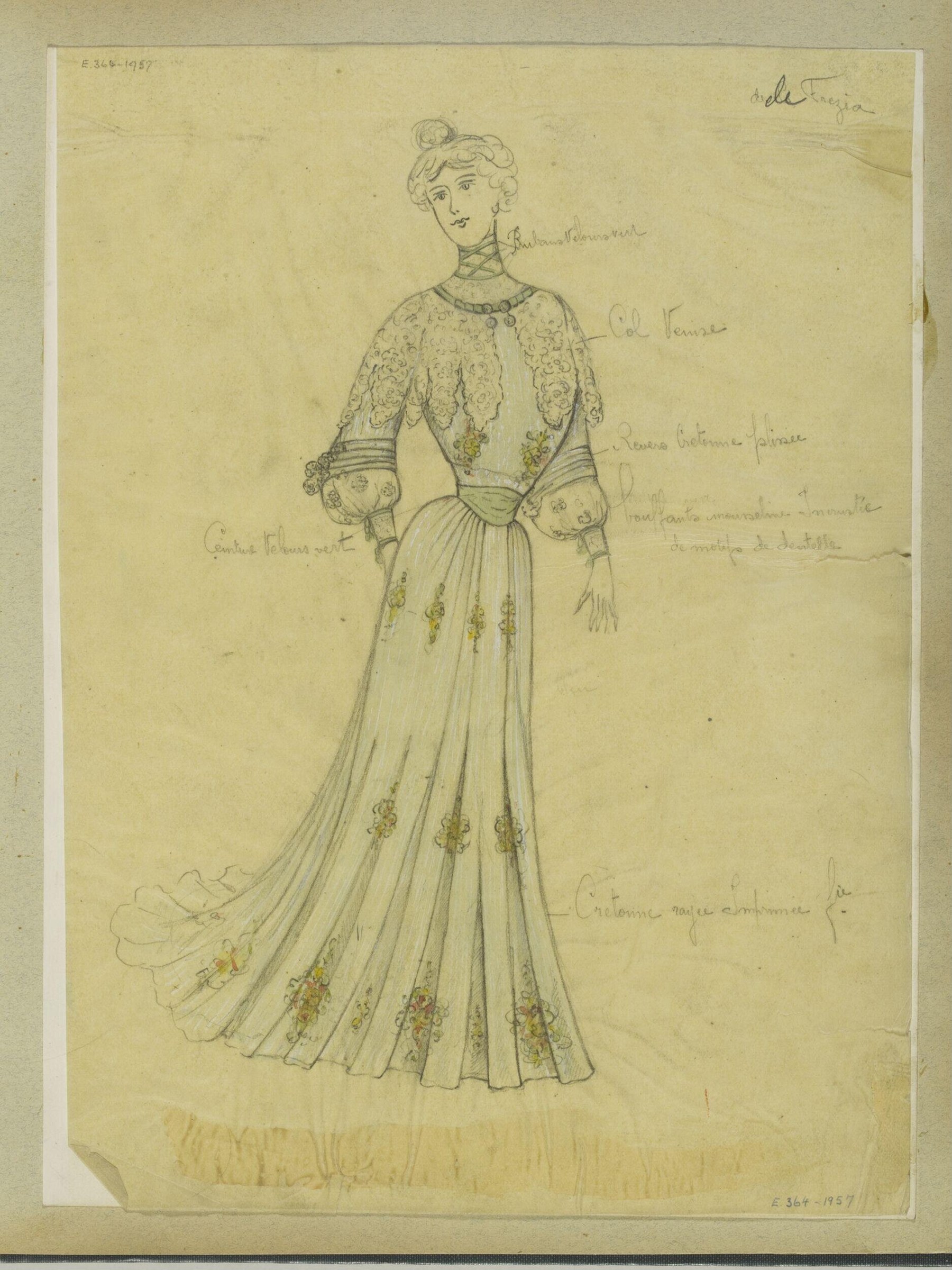
Jeanne Paquin was the preeminent couturier of the Belle Époque and Edwardian world; her designs dressed the wealthiest and most prominent women of her time, many of whom moved in ballroom society. This sketch shows how even a single garment was conceived as a total design, with structure, ornamentation, and silhouette calculated to produce a particular effect of elegance and authority. For anyone interested in how the bodies of early 20th-century society dancers were dressed and constrained by fashion, this is primary evidence.
What you are looking at
A fashion design sketch in graphite and watercolor depicting a single female figure in elegant Edwardian dress. The woman stands in a three-quarter pose against a plain cream background, her body weight subtly shifted. She wears a high-necked, intricately patterned jacket with puffed sleeves gathered at the forearm, elaborately decorated with floral or geometric embroidery rendered in gold and pale tones. A wide belt cinches her waist, and from it flows a floor-length skirt with knife pleats and matching decorative appliqués scattered down the length of the garment. The skirt extends into a graceful train at the hem. Her upswept hair is arranged in the pompadour style fashionable in 1901, with a small ornamental detail at the crown. The figure's pose—one arm at rest, the other gently at her side—suggests the poised, constrained stance of formal portrait dress rather than active movement.
The dancing
The single figure is rendered in a frontal or near-frontal stance with minimal dynamic weight shift. Her arms hang naturally at her sides with hands visible and delicately drawn. The posture is upright and dignified, the body symmetrical rather than in any asymmetrical dance frame. There is no partner, no hold, and no suggestion of movement in progress—this is presentation posture, the stance adopted for display or formal photography.
The dance depicted
This is not a depiction of dance. The work is a fashion design drawing—a costume sketch showing a proposed garment for wear. While the elegantly attired figure and the date (1901) place this at the height of the Edwardian era, when formal dress and ballroom dancing were intimately linked, the image itself documents fashion design rather than dancing bodies or choreography. The pose and framing are those of a dressmaker's pattern illustration or a design proposal for a couture house.
How it was made
This is a design drawing executed in graphite pencil with delicate watercolor or gouache overlay, primarily in gold, pale ochre, and pale blue-green tones. The technique is typical of haute couture fashion illustration of the period: precise line work for structure, light wash for fabric texture and decoration, and careful notation in the margins identifying garment elements. The drawing was made for professional use—to communicate design proposals to patrons, seamstresses, or manufacturers—and exists as a working document in a fashion archive rather than as fine art.
About this work
This is a couture design sketch by Jeanne Paquin, one of the leading dressmakers of the Edwardian era. The drawing documents her design practice through a single elegantly rendered proposal for a woman's ensemble. Though created in the same cultural moment when ballroom dancing flourished and formal dress was inseparable from social choreography, the sketch itself does not depict dance—it is a proposal for an object to be worn, not a record of movement. It belongs in a gallery about dance as evidence of the material culture surrounding formal dance and as a record of how the bodies of dancers and society figures were dressed and shaped in this period.
How to look at it
Examine the construction lines and the way the designer has indicated the gathering and draping of fabric—particularly the knife pleats of the skirt and the puffed sleeves. Note the careful placement of the decorative appliqués and embroidery, which are rendered as small repeated motifs scattered across the garment rather than concentrated. The marginal annotations in the designer's hand identify specific elements of construction and fabric. The figure's pose is deliberately static and symmetrical: this is not a moment of movement frozen in time, but rather the formal presentation stance in which the garment would be displayed to a client or photographed for the record.
The artist
Jeanne Paquin (1869–1936) was a French couturier and one of the first female fashion designers to establish an independent house under her own name. She founded her Paris salon in 1891 and became celebrated for her sophisticated draping, innovative use of embroidery and applied ornament, and her ability to flatter the silhouette demanded by Edwardian taste. She was a rival of the House of Worth and other major couture houses, and her designs were sought by aristocrats, actresses, and wealthy society women across Europe and America. Her sketches, of which this is an example, are held in fashion archives and museum collections as primary documents of her design process.
The period
In 1901, the Edwardian era was at its height. Women's fashion emphasized the S-bend corset silhouette, high necklines, and elaborate ornamentation through embroidery, lace, and applied decoration. Formal daytime wear and evening dress were sharply distinguished; the garment shown here, with its long train and lavish decoration, is evening or special occasion wear. Ballroom dancing—waltzes, quadrilles, and cotillions—was a central social practice for the upper classes, and the design and restriction of women's dress were intimately connected to the movement and spectacle of the ballroom. Fashion design as an independent artistic practice had recently begun to emerge as a recognized profession, especially through the work of pioneering female couturiers like Paquin.
Where it lives
The work is held in a fashion design collection and identified as a sketch by Jeanne Paquin from 1901, likely part of her atelier archives or a collection of her design drawings. The accession number suggests it is catalogued within a larger institutional holding of fashion materials.
Questions about this work
Is this a design for a dance costume?
It is a design for formal evening wear from the Edwardian era, a period when ballroom dancing was central to society life. While a woman wearing such a garment would likely have danced in it at balls and formal dinners, this is a fashion design sketch rather than a costume design for theatrical performance or a depiction of dance itself.
Why is this in a dance art gallery?
The sketch documents the material culture and bodily constraint of the Edwardian ballroom world. It shows how the bodies of society figures and dancers were shaped, dressed, and ornamented, and thus provides historical evidence for understanding how dance and formal dress were inseparably linked in early 20th-century Europe.
Who was Jeanne Paquin?
Paquin was one of the most celebrated couturiers of the Belle Époque and Edwardian era, founding her own fashion house in Paris and dressing aristocrats and wealthy society women across Europe and America. She was among the first female fashion designers to achieve international renown and independence in the profession.
More dance artwork





