49 works in this view — arrow keys or swipe to move between them.
Dance in Art
Été 1901
Paquin, Jeanne
- Collection:
- Fashion design
- Source:
- Victoria and Albert Museum
- Rights:
- Rights vary by item — check the source record before reusing this image. Source record ↗
- Recorded as:
- V&A — check rights per item
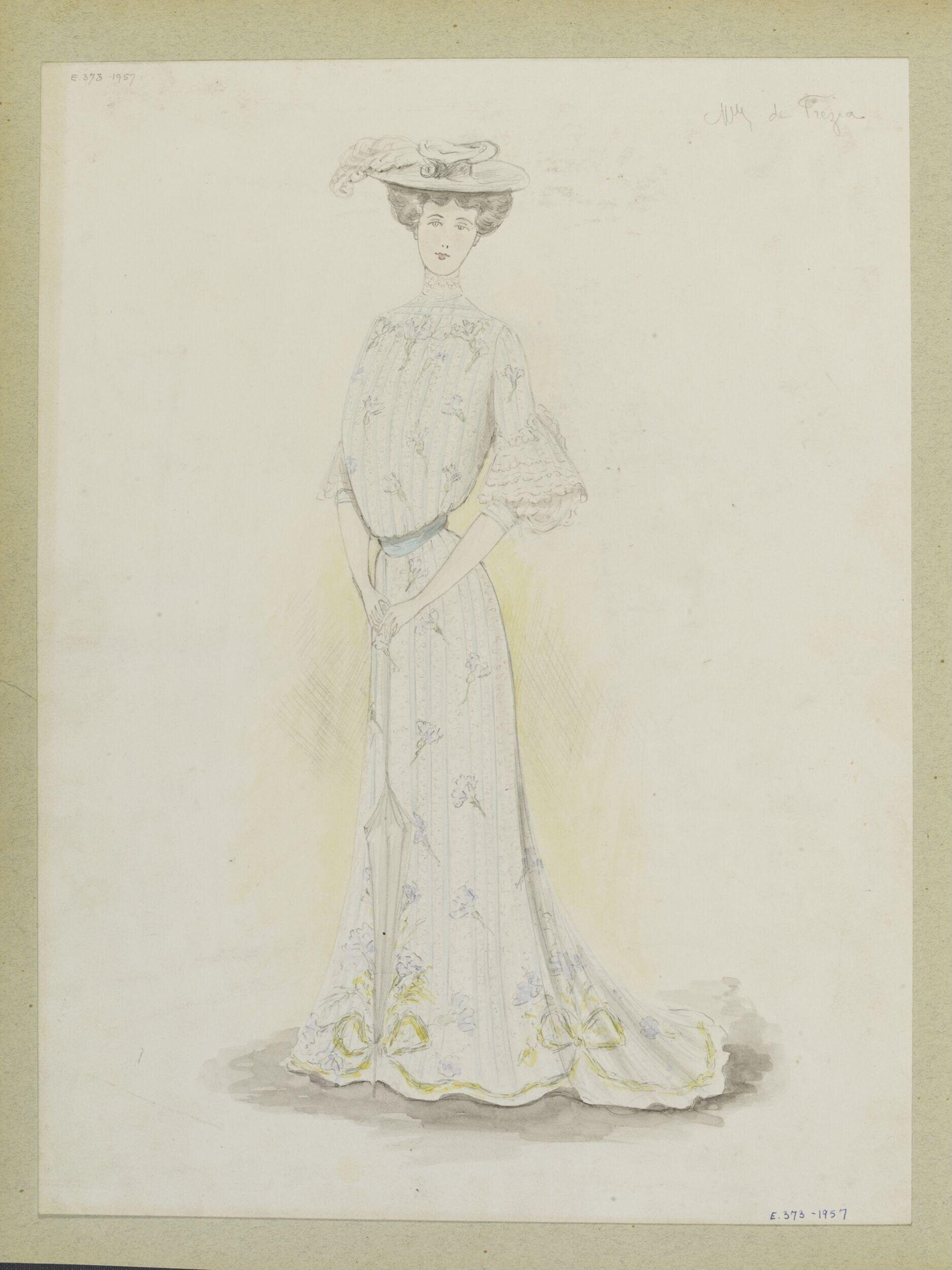
For scholars of dance history, this drawing is valuable as documentary evidence of the actual garments worn by dancers and ballroom participants in the Edwardian period. The silhouette—the S-curve corset shape, the fitted bodice, the weight and volume of the skirt—directly determined how women moved, what postures were possible, and how the dancing body appeared. Understanding this dress is essential to understanding how Edwardian waltz, two-step, and salon dance were executed and experienced.
What you are looking at
A full-length fashion illustration of a woman in Edwardian dress, shown in three-quarter view against a plain background. She wears an elegant white gown with a high waistline and subtle floral or decorative patterning throughout the bodice and skirt. The dress features the characteristic silhouette of 1901: a fitted bodice with a modest pigeon-breast projection, long sleeves gathered at the shoulders, and a skirt that falls in graceful folds to a train at the hem. The hem and train are highlighted in pale yellow wash, suggesting the fabric's movement and dimension. She wears a fashionable wide-brimmed hat trimmed with feathers or plumes, tilted slightly. Her posture is elegant and poised, with one hand resting on her hip or skirt, the other at her side—a gesture of refined leisure typical of the Gibson Girl aesthetic. The drawing is executed in pencil with selective watercolor wash, giving it the character of a high-fashion design sketch.
The dancing
The single figure stands in an upright, S-curve posture characteristic of Edwardian women's fashion silhouette—the body arched slightly backward from the corset, the shoulders thrown back, the hips forward. The arm placement is studied and graceful rather than dynamic: one arm hangs at the side, the other rests gently on the hip or upper thigh in a pose of composed elegance. The overall bearing conveys stillness and contemplative poise rather than movement or action.
The dance depicted
This is a fashion design, not a depiction of dance. The figure wears the social dress of the Edwardian era (circa 1901) and is posed as a standing model might be for a couturier's portfolio or salon presentation. While the dress would have been worn to formal social occasions—balls, dinners, theatre—where dancing occurred, the image itself documents fashion rather than the act or technique of dancing. The posture is that of a fashionable woman at rest, not in motion.
How it was made
The work is executed in pencil and watercolor on paper, characteristic of fashion illustration and design documentation of the period. The pencil provides fine linear definition of the garment's cut and construction, while selective watercolor wash—applied primarily to the train hem in pale yellow—suggests fabric weight and movement without fully coloring the design. This technique was standard practice for couture houses and fashion journals of the early 1900s, allowing rapid documentation of designs while the hand-colored detail (here minimal) emphasized key features. The refinement of the technique suggests this is a professional design record rather than a casual sketch.
About this work
This is a Parisian haute couture design drawing by Jeanne Paquin, one of the most celebrated fashion designers of the Edwardian era. Dated 1901 and titled *Été* (Summer), it documents a woman's day dress in the refined aesthetic of the period. The drawing is a primary historical record of how women dressed for social life in the early 1900s—a time when dancing in ballrooms and at garden parties was a central feature of upper-class society. While the image itself does not depict dancing, the garment shown is intimately tied to the dance culture of the era: women in such dresses waltzed, performed cotillions, and took part in the social rituals of Edwardian entertainment.
How to look at it
Attend to the silhouette: the extreme forward thrust of the bosom and the backward arch of the body created by the S-bend corset, visible in the line from shoulder to hip. Notice how the skirt hangs in heavy folds from the high waistline—this weight and volume would have constrained the stride and encouraged the swaying, gliding motion characteristic of the waltz. Observe the arm position: relaxed and graceful, with no suggestion of the vigorous arm work of earlier dances. This is the dress of a generation that danced for elegance and social ritual, not for exertion.
The artist
Jeanne Paquin (1869–1936) was a pioneering French couturière and one of the first women to establish a major fashion house in Paris. She founded her atelier in 1891 and became internationally renowned for elegant, understated designs that emphasized fine construction and subtle ornamentation. Paquin was known for her mastery of draping and for designs that flattered the fashionable silhouette of the day while allowing a degree of comfort and movement unusual for the period. Her sketches and design drawings are held in museum collections worldwide as exemplary documents of haute couture practice.
The period
In 1901, the Edwardian era was at its height, and fashion was dominated by the S-bend corset and the Gibson Girl ideal. This was the age of the formal ball, the garden party, and the social dance as essential ritual for the upper classes. Women in such gowns danced the waltz, the two-step, the cotillion, and emerging novelty dances in ballrooms and at private entertainments. The dress itself was an instrument of both beauty and social constraint: the corsetry that created the fashionable silhouette limited movement while the ample skirts allowed certain kinds of swaying, turning motion. Fashion illustration of this period served both artistic and commercial purposes—documenting designs for wealthy clients and for reproduction in fashion journals that circulated internationally.
Where it lives
The work is held in a fashion design collection (marked 'va' in the source record), indicating it is part of a systematic archive of design documentation. Such collections typically preserve original design drawings by couturiers as records of their output and as reference material for historical scholarship and contemporary design practice.
Questions about this work
Is this dress designed for dancing?
It is designed for social occasions where dancing occurred—balls, garden parties, dinners—but it was not designed solely or primarily for dance. The dress embodies the aesthetic ideals of the Edwardian era: elegance, refinement, and a fashionable silhouette. Women in such dresses did dance, and the garment's construction (the tight corset, the heavy skirt, the raised waistline) directly shaped how they moved when they did.
What does the 'S-curve' silhouette tell us about how women danced?
The extreme forward arch of the corset—visible in Paquin's design—limited the natural curvature of the spine and forced the body into an exaggerated posture. This corsetry made certain kinds of movement difficult: a long stride, vigorous arm work, or rapid footwork were all constrained. The waltz and two-step of the period accommodated these constraints, favoring a graceful, gliding motion with minimal arm movement and a narrow base of support.
Why is the hem of the skirt colored differently?
The pale yellow watercolor wash applied to the train hem suggests the color or sheen of the fabric at that point, or emphasizes the visual weight and movement of the skirt's lower edge. In fashion design practice, such selective coloring helps the eye understand the garment's construction and how it would drape and move in three dimensions.
More dance artwork





