49 works in this view — arrow keys or swipe to move between them.
Dance in Art
A dancer
Unknown
- Collection:
- Source:
- Victoria and Albert Museum
- Rights:
- Rights vary by item — check the source record before reusing this image. Source record ↗
- Recorded as:
- V&A — check rights per item
This work reveals the symbiotic relationship between dance culture and visual representation in the early 19th century. The figure's pose, deportment, and costume reflect the ballroom conventions and body ideals that were shaped by Regency and early Victorian dance practices, even when the artist is not depicting an active dance step.
What you are looking at
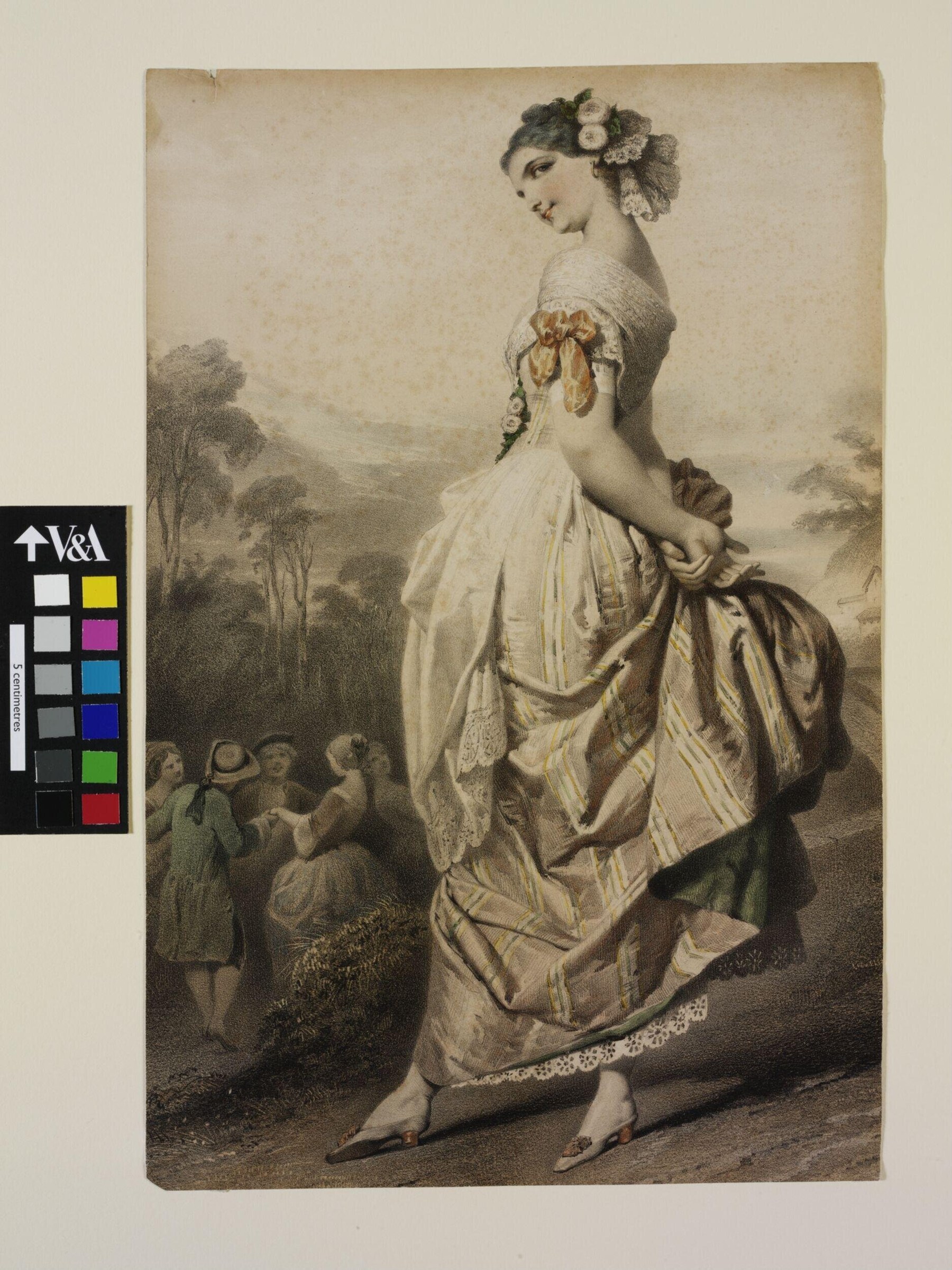
A woman in early 19th-century dress stands in profile, gazing downward with a contemplative expression. She wears a pale, high-waisted gown with a dramatically swept train that pools on the ground behind her, and a shawl or light drapery draped across her shoulders and back. Her dark hair is pinned up with ornamental flowers or feathering. In her hands she holds what appears to be a fan or decorative object. The setting is a wooded landscape with trees and foliage suggested in soft tones in the background; in the middle distance to the left, two small figures—possibly children—can be seen. The composition emphasizes the solitary elegance of the principal figure and the volume and movement of her garments. The overall effect is one of refined leisure and contemplation rather than active movement.
The dancing
The dancer stands nearly motionless, weight evenly distributed, with a gentle forward tilt of the torso that draws the eye downward. Her arms are relaxed and hang naturally, one hand holding an accessory. There is no visible partnering and no suggestion of active footwork or momentum. The pose is static and presentational rather than caught mid-step. The body language suggests a moment of pause or formal presentation rather than the execution of a dance step.
The dance depicted
This does not appear to depict a dance in the technical sense. The figure is posed in the manner of a Regency-era promenade or formal presentation rather than executing a dance step or pattern. It is more likely a portrait of fashionable leisure dress arranged in a picturesque setting. The title 'A dancer' may be aspirational or reflect a social identity (someone who dances at court or assembly) rather than a record of active dancing. No hold, formation, or dynamic gesture typical of any recognizable dance style is evident.
How it was made
This is a hand-colored engraving or aquatint, identifiable by the fine linear detailing in the background landscape and the delicate stippled or hatched shading in the drapery and figures. The medium allowed for wide distribution through prints and made fashionable costume imagery accessible to the middle class. The soft coloring suggests hand-application of watercolor or light pigment over the printed line, a labor-intensive technique that positioned such prints as affordable luxury items. The precision of the line work and the sophistication of the composition indicate a work of commercial theatrical or fashion circulation, likely sold as a single sheet or within a series.
About this work
This is a portrait engraving from circa 1840 depicting a woman in fashionable Regency or early Victorian dress set in a pastoral landscape. Although titled 'A dancer,' the work is not a record of active dancing but rather a display of elegant costume and deportment. The print is characteristic of commercial fashion and theatrical imagery of its era, circulated as affordable luxury for middle-class consumption. It belongs in a dance gallery not because it depicts the execution of a dance form, but because it documents the dress, posture, and social performance expected of women in ballroom and courtly settings, and the way dance culture shaped fashion and aesthetic ideals.
How to look at it
Observe the posture and carriage: the slight forward inclination of the torso, the relaxed arms, the downward gaze. This is the comportment expected of a refined woman in a ballroom setting—graceful but composed, aware of being observed. Note the strategic arrangement of the drapery, which creates diagonal lines and visual drama without suggesting active movement. The painter has chosen stillness rather than motion, presentation rather than execution.
The period
The 1840s saw a surge in printed fashion and theatrical imagery aimed at middle-class consumers. This coincided with the height of Romantic ballet, though the costume and setting here suggest fashionable secular dress rather than theatrical dance costume. The high waist and flowing skirts are characteristic of Regency silhouette, which had fallen from fashion by 1840, suggesting the print may be reproducing or referencing an earlier fashion ideal. Engraving and aquatint were the dominant reproductive technologies for such imagery before lithography became widespread.
Where it lives
The work is held as a print in the collection of the Victoria and Albert Museum, London. The source notation 'va' confirms this attribution. It is likely a single-sheet print from a commercial series of fashion or theatrical imagery.
Questions about this work
Is this person actually dancing?
No. The figure is standing in a static pose that reflects the posture and deportment valued in Regency and early Victorian ballroom culture, but no dance step or movement is depicted. The title 'A dancer' likely refers to her social identity or the cultural context, not to active dancing.
What is the date and who made it?
The catalogue record dates it to 1840 and notes the artist as unknown. It is an engraving or aquatint, likely printed in London and hand-colored after printing. Without a signature or further documentation, the maker cannot be identified with confidence.
Why would this be in a dance gallery?
Dance culture shaped fashion, posture, and aesthetic ideals in this period. This print documents how ballroom conventions influenced women's deportment and dress, and how dance literacy was visible in a woman's carriage and presentation. It is part of the visual history of dance even though no active dancing is shown.
More dance artwork





