49 works in this view — arrow keys or swipe to move between them.
Dance in Art
Painting
Unknown
- Collection:
- Painting
- Source:
- Victoria and Albert Museum
- Rights:
- Rights vary by item — check the source record before reusing this image. Source record ↗
- Recorded as:
- V&A — check rights per item
This image is valuable for understanding the relationship between music and dance in South Asian court culture, and for documenting the jewelled, elaborate aesthetic conventions of court performance across centuries. The precise costume details offer evidence about the dress worn by high-status performers in royal courts at a time when many classical dance vocabularies were being codified.
What you are looking at
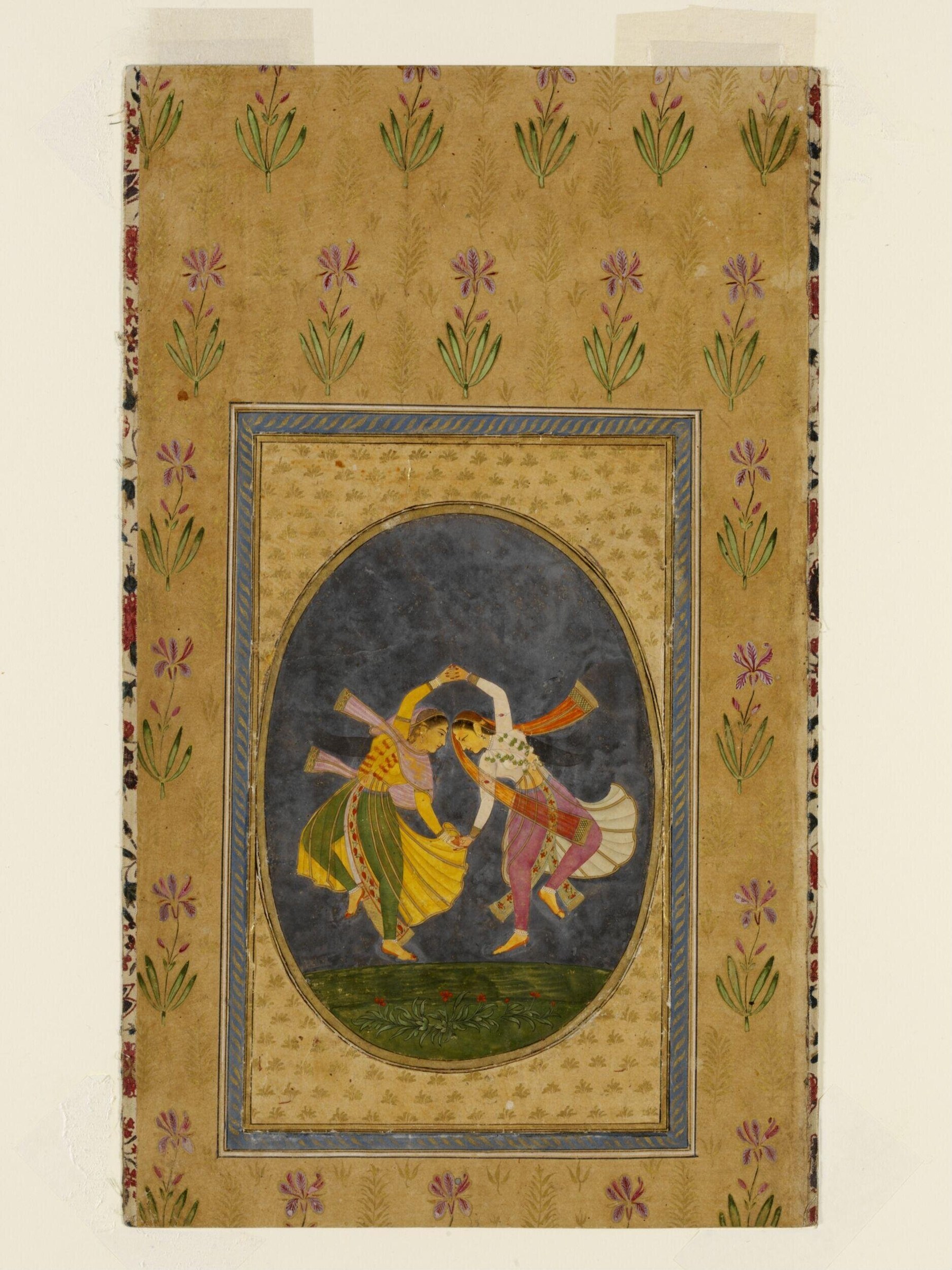
Two figures in elaborate dress perform against a dark background within an oval frame, surrounded by a decorative border of gold leaf and patterned margins featuring repeating floral motifs in green and purple. The figures wear jewelled costumes in rich yellows, oranges, and pinks; both have ornate headdresses. The figure on the left wears a yellow dhoti and jewelled vest; the figure on the right wears pink and white garments. Both hold long curved horns or wind instruments to their mouths. A thin band of green foliage marks the ground beneath them. The entire composition is rendered in the miniature painting tradition on paper, with the precision and jewel-like colours characteristic of South Asian court art.
The dancing
Both figures stand in profile or three-quarter view, playing long curved horns or wind instruments (likely shenai or similar court instruments) held vertically or at angles. Their bodies are upright and formal rather than in a dynamic dance position. The figure on the left has the weight distributed evenly; the figure on the right leans slightly. Neither figure shows the flexed knees, curved spine, or weight shift typical of South Asian classical dance forms. The framing and composition suggests performers rather than dancers, or dancers in a moment of musical accompaniment rather than active choreographed movement.
The dance depicted
This image most likely depicts court musicians performing together, possibly in a Mughal or Rajasthani court context, though a ceremonial dance involving instrumental music cannot be ruled out. The elaborate costume, jewelled ornamentation, and formal setting indicate this is a court or palace performance. However, the posture and gesture are those of instrumentalists rather than dancers. The work may document a moment of musical performance that accompanied dance, or may represent the dancers themselves in a moment of musical interlude. Without clear evidence of footwork or the bodily articulation of South Asian classical dance, identification as a specific dance style is not reliable.
How it was made
This is a miniature painting in the Indo-Persian or Mughal tradition, executed on paper with opaque watercolour (likely gouache) and gold leaf. The technique involves precise line work, jewel-like pigments applied in flat and graduated washes, and the use of gold for decorative borders and highlights. Such works were typically bound into albums (muraqqa) for court patrons and required months of labour. The small scale and intricate detail indicate an object for intimate viewing, handling, and study by literate elites rather than public display. The gold border and floral margins are consistent with Mughal album conventions of the 16th–18th centuries.
About this work
This is a miniature painting depicting two elaborately dressed court musicians or performers with wind instruments, rendered in the Indo-Persian tradition associated with Mughal or post-Mughal South Asian courts. The work belongs in a dance gallery because it documents court performance culture and may represent dancers in a musical context, but its primary subject appears to be instrumental music-making rather than dance proper. The precise rendering of costume and ornament provides rich evidence about the visual culture of South Asian court performance in the period when classical dance forms were developing under royal patronage.
How to look at it
Observe the precision of the costume detail—the jewelled vest, the headdress, the weight and texture of the fabric—which reveals the visual splendour court patrons expected from high-status performers. Notice the formal posture and the careful rendering of the instruments, which suggests these are musicians as much as dancers. The dark background throws the figures into sharp relief, allowing the eye to rest on every ornamental detail. The oval frame and decorative margin are conventions of Mughal album art, designed to present the image as a precious object worthy of close study.
The period
This work was created within the Indo-Persian miniature painting tradition, likely during the Mughal period (16th–18th centuries) or in the court traditions that continued after Mughal decline. During this period, South Asian classical dance forms including Kathak, Kathakali, and others were developing under royal and temple patronage, often in close association with court music and the patronage systems that supported both. Court musicians and dancers held high status and performed for elite audiences; their images in miniature albums document both the aesthetics and the institutional context of classical performance.
Where it lives
Held in a collection designated 'Painting' with source noted as 'va' (likely a museum or archive abbreviation). The work is a leaf from what may have been a larger album or collection of court performance imagery.
Dance in this work
Questions about this work
Are these dancers or musicians?
The image shows performers holding wind instruments and in a posture suited to playing rather than dancing. They may be musicians accompanying dancers, or court performers whose role combined both arts. The formal, upright stance and the prominence of the instruments suggest music-making is the primary subject, though in court culture these roles were often intertwined.
What is the setting and who would have seen this?
This is a miniature painting, likely a page from a Mughal court album (muraqqa). It was made for wealthy patrons—rulers, nobles, or collectors—to own, handle, and study in private. Such albums circulated among elites and served as displays of artistic achievement, courtly taste, and knowledge of court life.
What period is this from?
The style is consistent with Mughal or post-Mughal South Asian court painting of the 16th–18th centuries, though a more precise date requires specialist analysis of the pigments, paper, and artistic hand.
More dance artwork





